. 2017 Jul 11;114(28):7385-7390.
doi: 10.1073/pnas.1705765114. Epub 2017 Jun 22.

Evolution of nonspectral rhodopsin function at high altitudes

Affiliations

Evolution of nonspectral rhodopsin function at high altitudes

Gianni M Castiglione et al. Proc Natl Acad Sci U S A. .

Abstract

High-altitude environments present a range of biochemical and physiological challenges for organisms through decreases in oxygen, pressure, and temperature relative to lowland habitats. Protein-level adaptations to hypoxic high-altitude conditions have been identified in multiple terrestrial endotherms; however, comparable adaptations in aquatic ectotherms, such as fishes, have not been as extensively characterized. In enzyme proteins, cold adaptation is attained through functional trade-offs between stability and activity, often mediated by substitutions outside the active site. Little is known whether signaling proteins [e.g., G protein-coupled receptors (GPCRs)] exhibit natural variation in response to cold temperatures. Rhodopsin (RH1), the temperature-sensitive visual pigment mediating dim-light vision, offers an opportunity to enhance our understanding of thermal adaptation in a model GPCR. Here, we investigate the evolution of rhodopsin function in an Andean mountain catfish system spanning a range of elevations. Using molecular evolutionary analyses and site-directed mutagenesis experiments, we provide evidence for cold adaptation in RH1. We find that unique amino acid substitutions occur at sites under positive selection in high-altitude catfishes, located at opposite ends of the RH1 intramolecular hydrogen-bonding network. Natural high-altitude variants introduced into these sites via mutagenesis have limited effects on spectral tuning, yet decrease the stability of dark-state and light-activated rhodopsin, accelerating the decay of ligand-bound forms. As found in cold-adapted enzymes, this phenotype likely compensates for a cold-induced decrease in kinetic rates-properties of rhodopsin that mediate rod sensitivity and visual performance. Our results support a role for natural variation in enhancing the performance of GPCRs in response to cold temperatures.

Keywords: Andean catfishes; G protein-coupled receptor; in vitro expression; protein evolution; visual pigment.


Conflict of interest statement

The authors declare no conflict of interest.

Figures
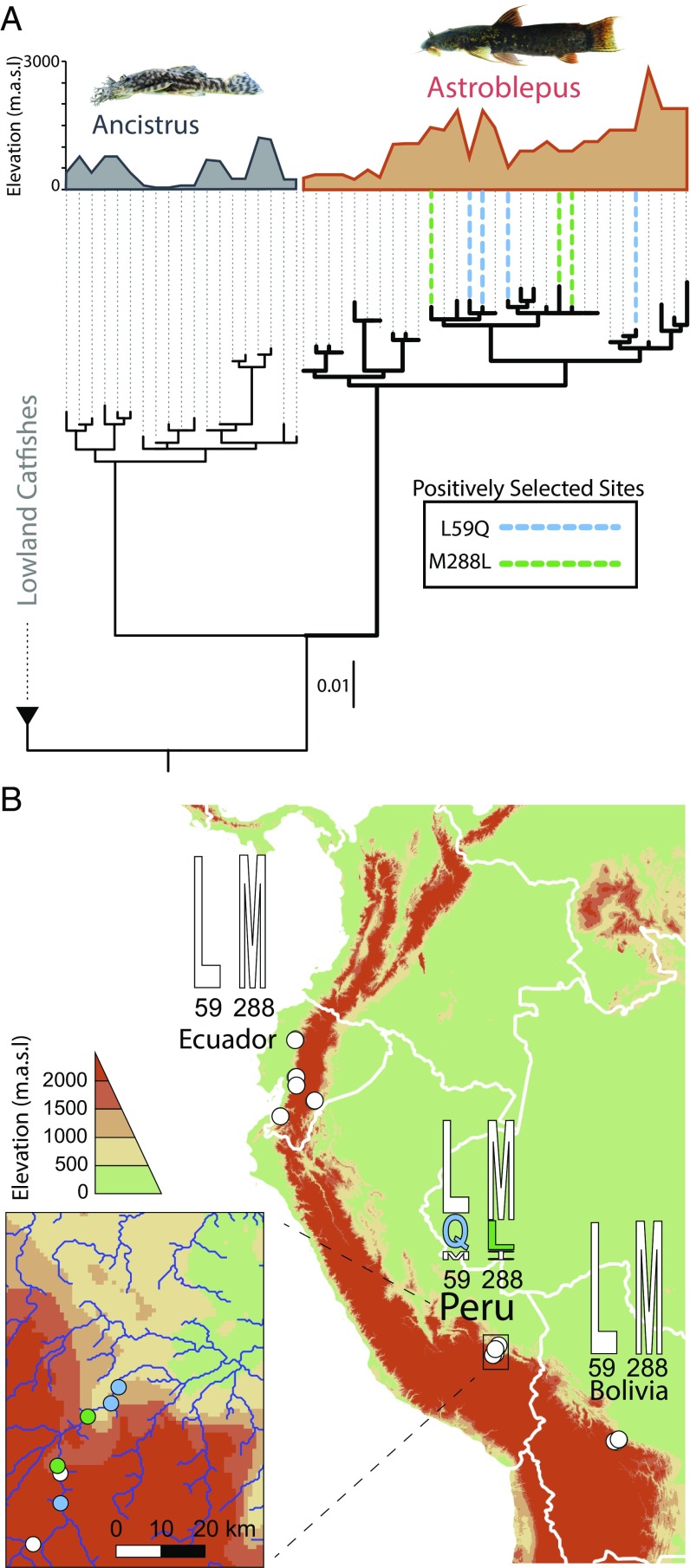
Fig. 1.
Fig. 1.
Positive and divergent selection in rh1 in high-altitude specialist catfish. (A) Rh1 coding sequences were obtained from high-altitude catfish collected from a range of elevations throughout the Andes Mountains in Bolivia, Ecuador, and Peru, with near sea level Ancistrus individuals collected from Guyana and Trinidad. The rh1 ML gene tree is shown. Collection site elevation is shown in meters above sea level. Bold lines indicate distinct evolutionary pressures, whereas dashed lines indicate lineages with amino acid substitutions to positively selected sites. (B) Overview of collection sites (white dots) in Ecuador, Peru, and Bolivia. Shown are rhodopsin sequence logos for the Astroblepus taxa collected and sequenced from each region. (Inset) Zoom-in of Peruvian collection sites where natural variant Astroblepus Q59 rhodopsin (blue dots) or L288 rhodopsin (green dots) originate. Elevations are shown as meters above sea level.
Fig. 2.
Fig. 2.
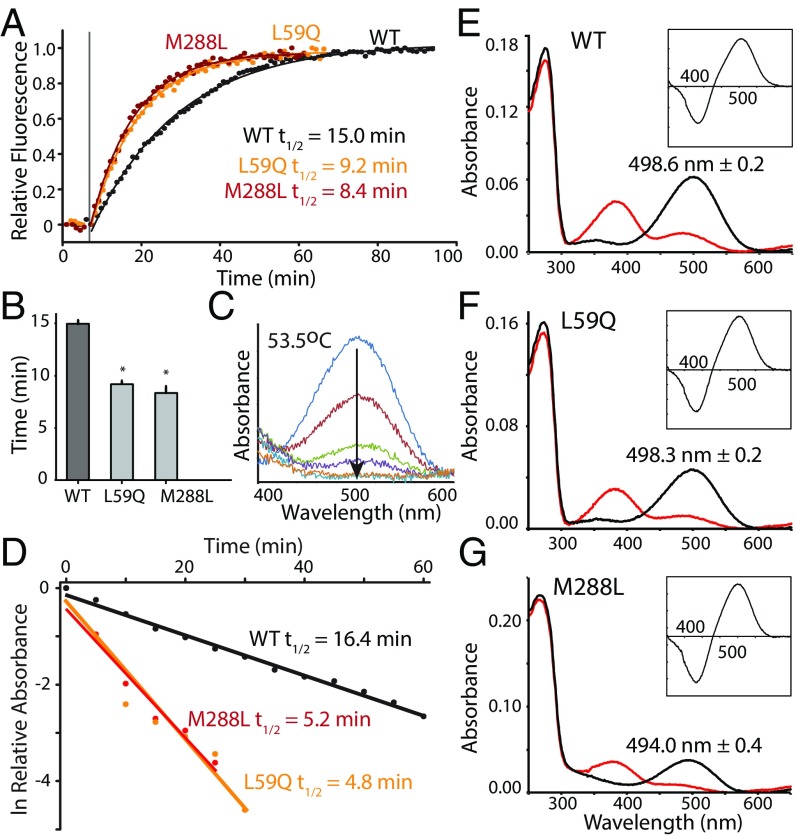
Rhodopsin sites under positive selection in high-altitude catfish modulate kinetic rates of dark- and light-activated rhodopsin. (A) Decay of active-state (MII) WT and mutant rhodopsins, assayed by monitoring increasing fluorescence intensity upon release of all–trans-retinal after exposure to light (vertical line). Lines are data fits to first-order exponential equations, with half-life values calculated from the rate constant. (B) Differences in WT vs. mutant rhodopsin retinal release half-life values were statistically assessed. (C) Decay of dark-state WT and mutant rhodopsin at 53.5 °C, assayed by monitoring decreasing absorbance at λMAX in the dark over time (arrow). (D) Absorbance data converted to its natural logarithm and plotted against time with half-life values calculated from the rate constant. (EG) UV-Vis absorbance spectra of dark-state and light-activated (E) WT, (F) L59Q, and (G) M288L rhodopsin, with dark-state λMAX values shown. All Insets show difference spectra between dark-state and MII, which indicates photoactivation as assessed by the well-established changes in spectral sensitivity between these rhodopsin species (SI Appendix).
Fig. 3.
Fig. 3.
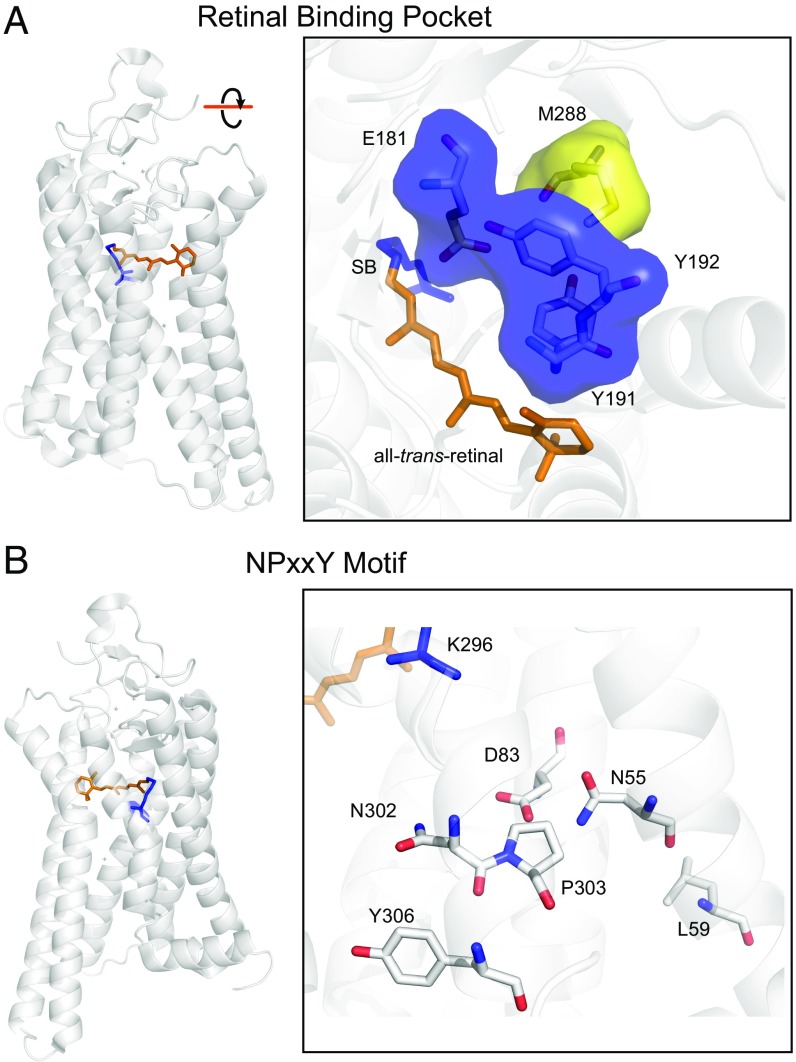
Sites accelerating kinetic rates of dark- and active-state rhodopsin are proximal to functionally key HBNs. Crystal structure of Meta II [PDB ID code 3PXO (62)] with the Schiff-base (SB; blue) and all–trans-retinal (orange). (A) Zoomed in view of the retinal binding pocket of MII, with residues proximal to M288 (yellow) and those involved in the local HBN shown as a Connolly surface (blue) (23, 66). (B) Stabilizing structural features proximal to L59: the NPxxY motif (N302-P303-Y306), N55, and D83.

References

    1. Storz JF, et al. The molecular basis of high-altitude adaptation in deer mice. PLoS Genet. 2007;3:e45. - PMC - PubMed
    1. Beall CM. Two routes to functional adaptation: Tibetan and Andean high-altitude natives. Proc Natl Acad Sci USA. 2007;104:8655–8660. - PMC - PubMed
    1. Hayes JP, Connor CSO, Hayes JP, Connor CSO. Natural selection on thermogenic capacity of high-altitude deer mice. Evolution. 1999;53:1280–1287. - PubMed
    1. Körner C. The use of ‘altitude’ in ecological research. Trends Ecol Evol. 2007;22:569–574. - PubMed
    1. Song D, et al. Defective Tibetan PHD2 binding to p23 links high altitude adaption to altered oxygen sensing. J Biol Chem. 2014;289:14656–14665. - PMC - PubMed

Publication types

Associated data

LinkOut - more resources