Comparative Study
. 2017 Aug 11;292(32):13374-13380.
doi: 10.1074/jbc.M117.784934. Epub 2017 Jun 22.

The influence of disulfide bonds on the mechanical stability of proteins is context dependent

Affiliations
Comparative Study

The influence of disulfide bonds on the mechanical stability of proteins is context dependent

Aitor Manteca et al. J Biol Chem. .

Abstract

Disulfide bonds play a crucial role in proteins, modulating their stability and constraining their conformational dynamics. A particularly important case is that of proteins that need to withstand forces arising from their normal biological function and that are often disulfide bonded. However, the influence of disulfides on the overall mechanical stability of proteins is poorly understood. Here, we used single-molecule force spectroscopy (smFS) to study the role of disulfide bonds in different mechanical proteins in terms of their unfolding forces. For this purpose, we chose the pilus protein FimG from Gram-negative bacteria and a disulfide-bonded variant of the I91 human cardiac titin polyprotein. Our results show that disulfide bonds can alter the mechanical stability of proteins in different ways depending on the properties of the system. Specifically, disulfide-bonded FimG undergoes a 30% increase in its mechanical stability compared with its reduced counterpart, whereas the unfolding force of I91 domains experiences a decrease of 15% relative to the WT form. Using a coarse-grained simulation model, we rationalized that the increase in mechanical stability of FimG is due to a shift in the mechanical unfolding pathway. The simple topology-based explanation suggests a neutral effect in the case of titin. In summary, our results indicate that disulfide bonds in proteins act in a context-dependent manner rather than simply as mechanical lockers, underscoring the importance of considering disulfide bonds both computationally and experimentally when studying the mechanical properties of proteins.

Keywords: atomic force microscopy (AFM); disulfide; molecular dynamics; protein folding; single-molecule biophysics.


Conflict of interest statement

The authors declare that they have no conflicts of interest with the contents of this article

Figures
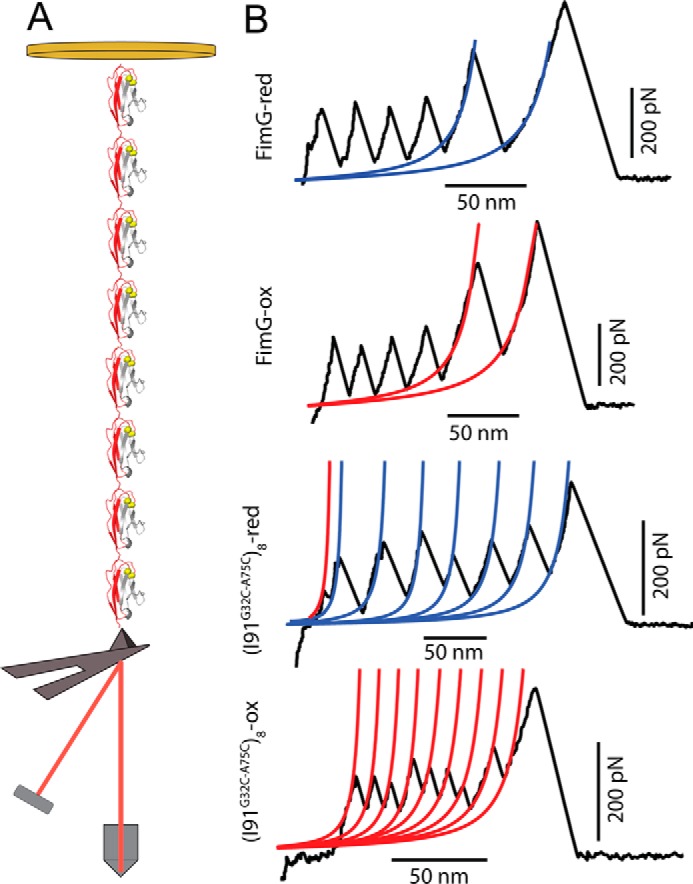
Figure 1.
Figure 1.
Single molecule pulling experiments on polyprotein constructs. A, schematic illustration of a smFS experiment with the(I91G32C/A75C)8 polyprotein. The Ig domains unfold due to the mechanical force applied between the gold substrate and the cantilever (not to scale). B, typical FimG and (I91G32C/A75C)8 construct experimental force-extension traces for their oxidized and reduced states. The contour lengths of oxidized and reduced domains are shown in red and blue, respectively. In all the traces the last peak corresponds to the detachment of the protein from the cantilever or surface.
Figure 2.
Figure 2.
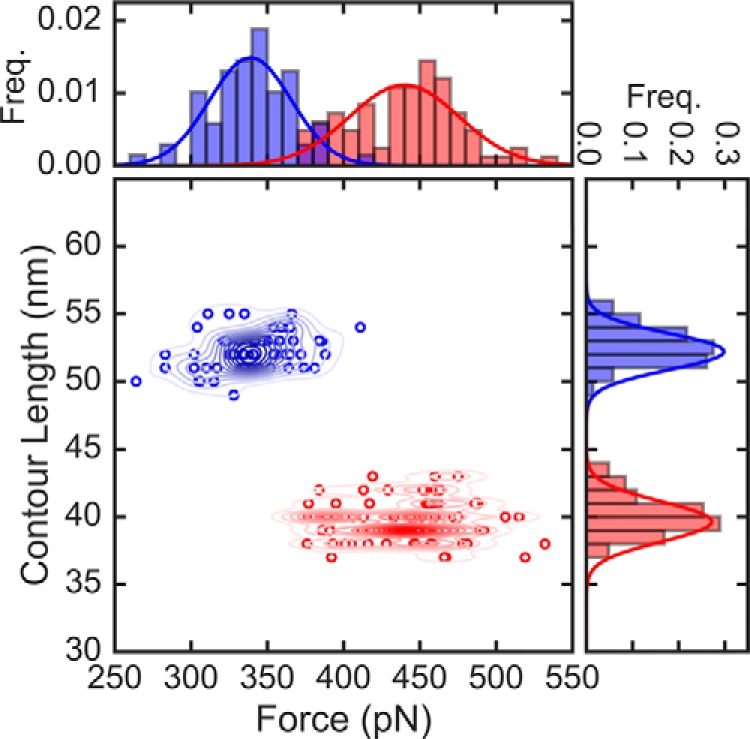
Unfolding forces and contour lengths of FimG from constant force pulling. Scatter plot of force versus contour length with corresponding histograms (top and right, respectively) of the self-complemented FimG. The total number of data points are n = 83 and 69 for oxidized domains and reduced domains, respectively. Lines in the histograms are Gaussian fits to the data. The red and blue colors denote the oxidized and reduced states, respectively. Contour lines in the scatter plot were generated using kernel density estimates.
Figure 3.
Figure 3.
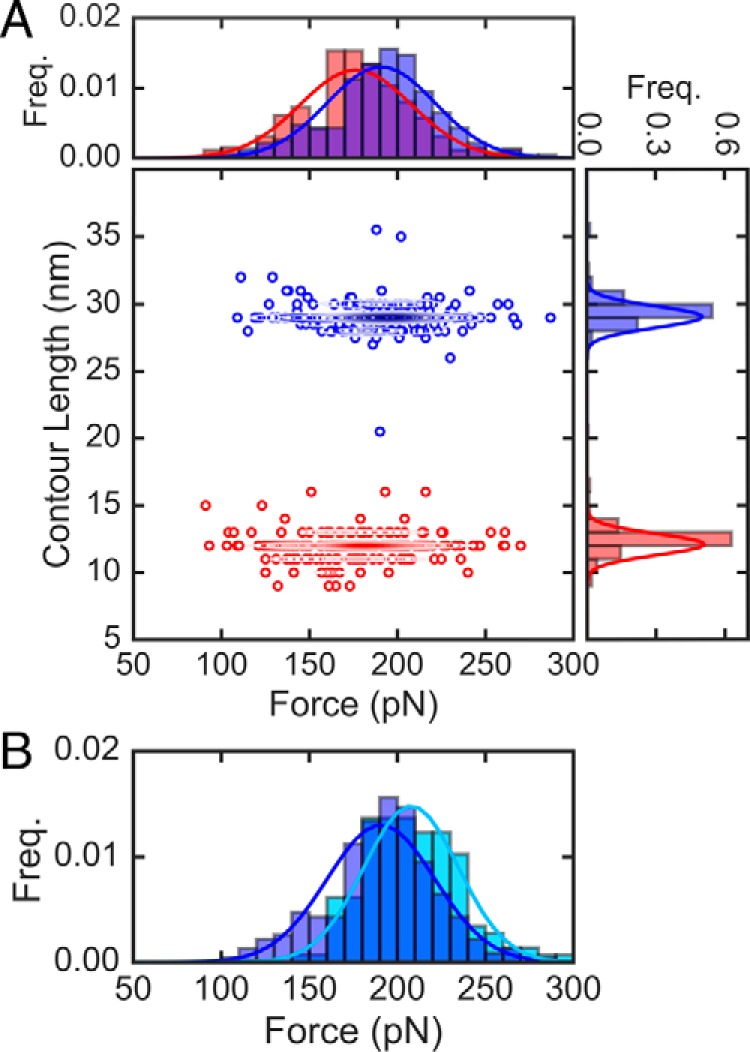
Unfolding forces and contour lengths of titin I91 from constant force pulling. A, scatter plot of force versus contour length with corresponding histograms (top and right, respectively) of the (I91G32C/A75C)8 polyprotein. Lines in the histograms are Gaussian fits to the data. The red and blue colors denote the oxidized and reduced states, respectively. The total number of data points are n = 262 and 232 for oxidized domains and reduced domains, respectively. Contour lines in the scatter plot were generated using kernel density estimates. B, comparison of unfolding forces for I91G32C/A75C (blue) and I91 WT (light blue), with n = 146.
Figure 4.
Figure 4.
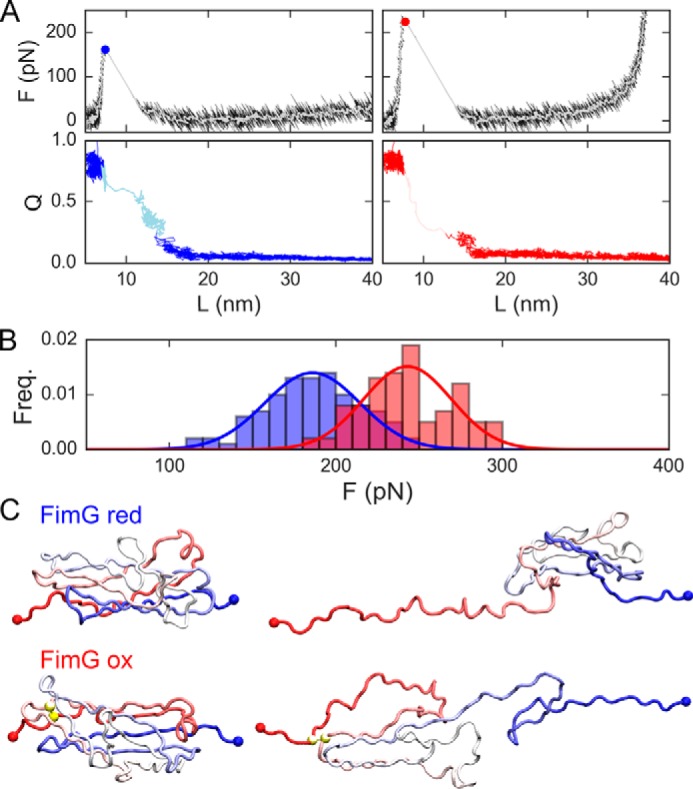
Coarse-grained simulation results for oxidized and reduced FimG. A, force (top) and fraction of native contacts (Q, bottom) versus the protein extension (L) for representative trajectories of the model for the oxidized and reduced protein (blue and red, respectively). White lines are running averages of the forces. Filled circles represent the estimated unfolding force. In the QvsL plots, the lighter shade of color indicates the unfolding transition path. B, cumulative frequencies of the unfolding forces. C, representative snapshots from the simulations for the folded state (left) and the unfolded state reached right after the unfolding force peak (right) for reduced (top) and oxidized (bottom) FimG models. In the latter, yellow spheres indicate the position of disulfide bonded cysteines.
Figure 5.
Figure 5.
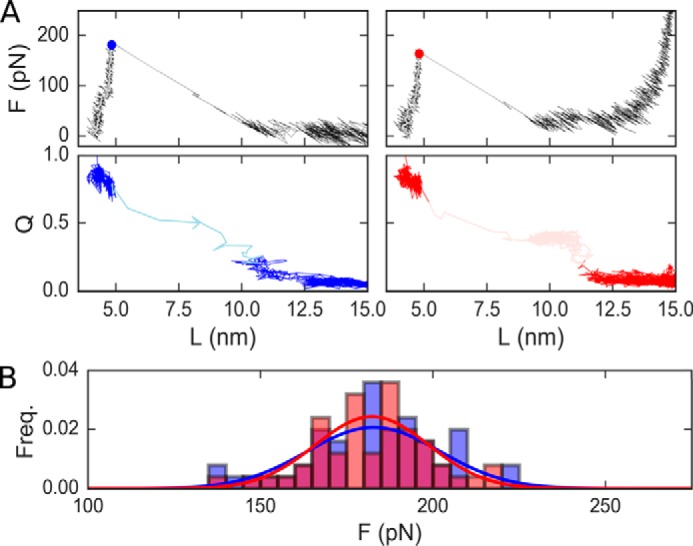
Coarse-grained simulation results for oxidized and reduced titin I91G32C/A75C. A, force/Q versus extension plots for the reduced (blue) and oxidized (red) forms of the protein. Circles mark the unfolding force. Transition paths are shown in a lighter shade of each color. B, cumulative histograms of the simulated unfolding forces for the oxidized (red) and reduced forms (blue).

References

    1. Fass D. (2012) Disulfide bonding in protein biophysics. Annu. Rev. Biophys. 41, 63–79 - PubMed
    1. Betz S. F. (1993) Disulfide bonds and the stability of globular proteins. Protein Sci. 2, 1551–1558 - PMC - PubMed
    1. Flory P. J. (1956) Theory of elastic mechanisms in fibrous proteins. J. Am. Chem. Soc. 78, 5222–5235
    1. Doig A. J., and Williams D. H. (1991) Is the hydrophobic effect stabilizing or destabilizing in proteins? J. Mol. Biol. 217, 389–398 - PubMed
    1. Santiveri C. M., León E., Rico M., and Jiménez M. A. (2008) Context-dependence of the contribution of disulfide bonds to β-hairpin stability. Chemistry 14, 488–499 - PubMed

Publication types

MeSH terms

LinkOut - more resources