


Particulate Air Pollution from Wildfires in the Western US under Climate Change
- PMID: 28642628
- PMCID: PMC5476308
- DOI: 10.1007/s10584-016-1762-6
Particulate Air Pollution from Wildfires in the Western US under Climate Change
Abstract
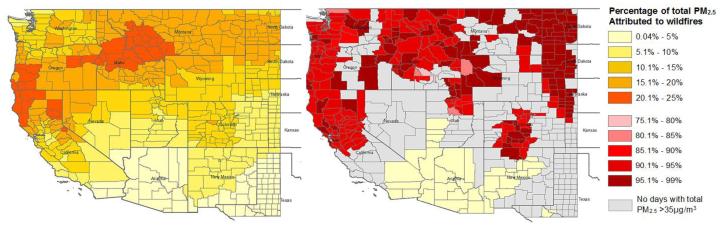
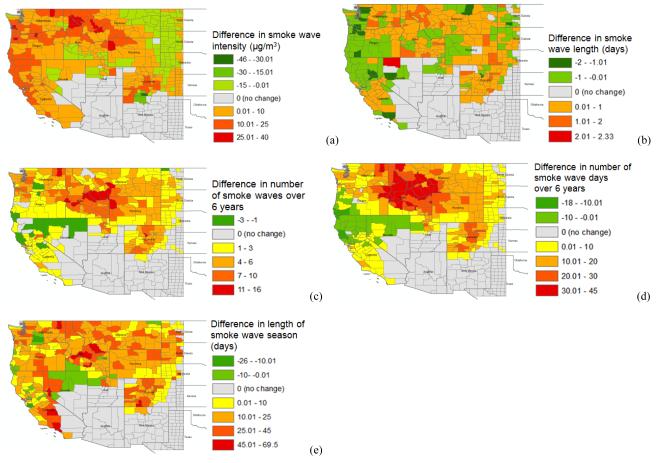
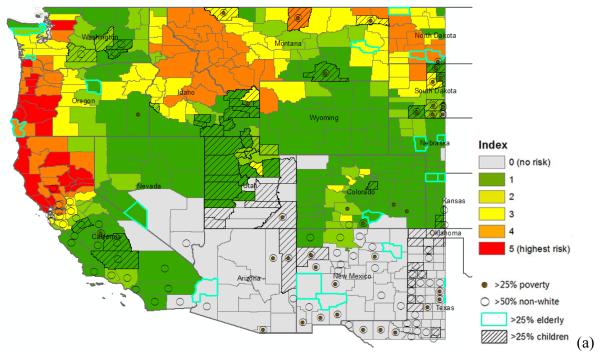
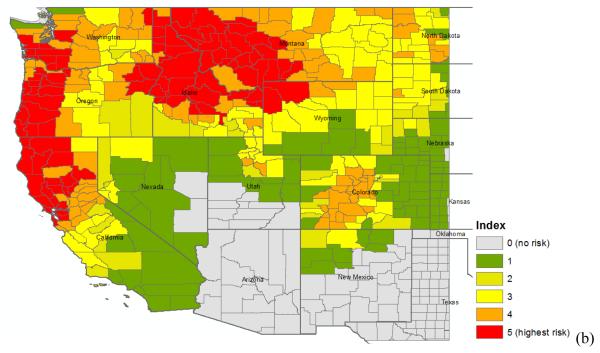
Wildfire can impose a direct impact on human health under climate change. While the potential impacts of climate change on wildfires and resulting air pollution have been studied, it is not known who will be most affected by the growing threat of wildfires. Identifying communities that will be most affected will inform development of fire management strategies and disaster preparedness programs. We estimate levels of fine particulate matter (PM2.5) directly attributable to wildfires in 561 western US counties during fire seasons for the present-day (2004-2009) and future (2046-2051), using a fire prediction model and GEOS-Chem, a 3-D global chemical transport model. Future estimates are obtained under a scenario of moderately increasing greenhouse gases by mid-century. We create a new term "Smoke Wave," defined as ≥2 consecutive days with high wildfire-specific PM2.5, to describe episodes of high air pollution from wildfires. We develop an interactive map to demonstrate the counties likely to suffer from future high wildfire pollution events. For 2004-2009, on days exceeding regulatory PM2.5 standards, wildfires contributed an average of 71.3% of total PM2.5. Under future climate change, we estimate that more than 82 million individuals will experience a 57% and 31% increase in the frequency and intensity, respectively, of Smoke Waves. Northern California, Western Oregon and the Great Plains are likely to suffer the highest exposure to widlfire smoke in the future. Results point to the potential health impacts of increasing wildfire activity on large numbers of people in a warming climate and the need to establish or modify US wildfire management and evacuation programs in high-risk regions. The study also adds to the growing literature arguing that extreme events in a changing climate could have significant consequences for human health.
Keywords: PM2.5; air pollution; climate change; wildfire.
Figures
References
-
- Ammann H, Blaisdell R, Lipsett M, Stone SL, Therriault S. Wildfire Smoke: A Guide for Public Health Officials. 2001.
-
- Andreae MO, Merlet P. Emission of trace gases and aerosols from biomass burning. Global Biogeochem Cy. 2001;15:955–966.
-
- Balshi MS, McGuirez AD, Duffy P, Flannigan M, Walsh J, Melillo J. Assessing the response of area burned to changing climate in western boreal North America using a Multivariate Adaptive Regression Splines (MARS) approach. Global Change Biol. 2009;15:578–600.
-
- Brown TJ, Hall BL, Westerling AL. The impact of twenty-first century climate change on wildland fire danger in the western United States: An applications perspective. Climatic Change. 2004;62:365–388.
Publication types
Grants and funding
LinkOut - more resources
Full Text Sources
Other Literature Sources