Review
. 2017:2017:6436130.
doi: 10.1155/2017/6436130. Epub 2017 May 31.

The Complexity of Zoonotic Filariasis Episystem and Its Consequences: A Multidisciplinary View

Affiliations
Review

The Complexity of Zoonotic Filariasis Episystem and Its Consequences: A Multidisciplinary View

Fernando Simón et al. Biomed Res Int. 2017.

Abstract

Vector-borne transmitted helminthic zoonosis affects the health and economy of both developing and developed countries. The concept of episystem includes the set of biological, environmental, and epidemiological elements of these diseases in defined geographic and temporal scales. Dirofilariasis caused by different species of the genus Dirofilaria is a disease affecting domestic and wild canines and felines and man, transmitted by different species of culicid mosquitoes. This complexity is increased because Dirofilaria species harbor intracellular symbiont Wolbachia bacteriae, which play a key role in the embryogenesis and development of dirofilariae and in the inflammatory pathology of the disease. In addition, the vector transmission makes the dirofilariasis susceptible to the influence of the climate and its variations. The present review addresses the analysis of dirofilariasis from the point of view of the episystem, analyzing the complex network of interactions established between biological components, climate, and factors related to human activity, as well as the different problems they pose. The progress of knowledge on human and animal dirofilariasis is largely due to the multidisciplinary approach. Nevertheless, different aspects of the disease need to continue being investigated and cooperation between countries and specialists involved should be intensified.


Figures
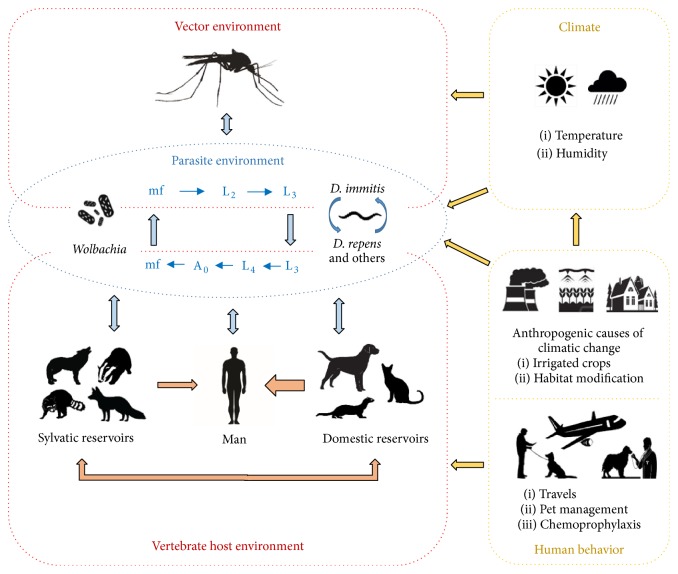
Figure 1
Figure 1
The episystem of dirofilariasis. Main interactions among organisms involved, climate, and human-derived behavior factors.
Figure 2
Figure 2
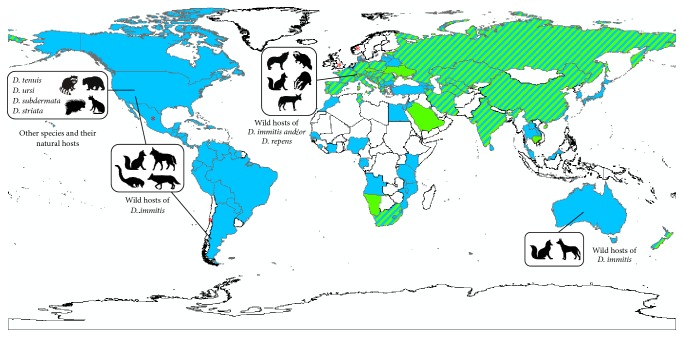
Geographic distribution of the different species of Dirofilaria in the animal hosts in the world. D. immitis in pets (blue); D. repens in pets (green); D. immitis and D. repens in pets (striped); without information (white); () sporadic subcutaneous infections.
Figure 3
Figure 3
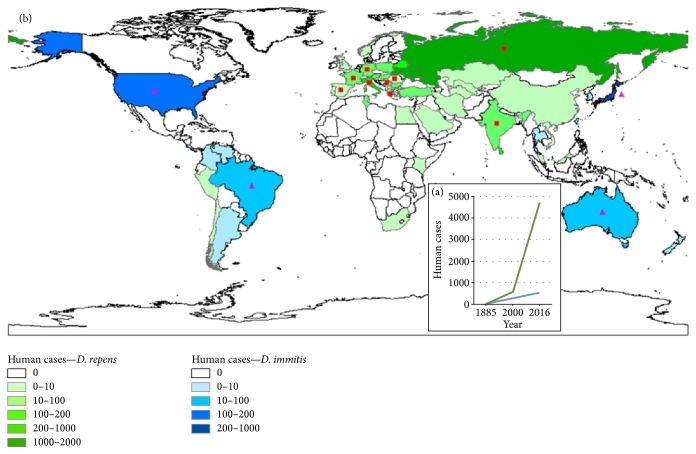
Changes in the incidence of human dirofilariasis reported cases (a). Geographic distribution of human dirofilariasis (reported cases) (b). Pulmonary dirofilariasis (blue); subcutaneous/ocular dirofilariasis (green); sporadic cases of subcutaneous/ocular dirofilariasis in areas where pulmonary dirofilariasis predominates (fuchsia triangles); sporadic cases of pulmonary dirofilariasis in areas where subcutaneous/ocular dirofilariasis predominates (red squares).

References

    1. Faburay B. The case for a "one health" approach to combating vector-borne diseases. Infection Ecology and Epidemiology. 2015;5(1) doi: 10.3402/iee.v5.28132.28132 - DOI - PMC - PubMed
    1. Day M. J. One health: the importance of companion animal vector-borne diseases. Parasites and Vectors. 2011;4(1, article 49) doi: 10.1186/1756-3305-4-49. - DOI - PMC - PubMed
    1. McCall J. W., Genchi C., Kramer L. H., Guerrero J., Venco L. Heartworm disease in animals and humans. Advances in Parasitology. 2008;66:193–285. doi: 10.1016/S0065-308X(08)00204-2. - DOI - PubMed
    1. Bowman D. D., Liu Y., McMahan C. S. Forecasting United States heartworm Dirofilaria immitis prevalence in dogs. Parasites and Vectors. 2016;9:p. 540. - PMC - PubMed
    1. Simón F., Morchón R., González-Miguel J., Marcos-Atxutegi C., Siles-Lucas M. What is new about animal and human dirofilariosis? Trends in Parasitology. 2009;25(9):404–409. doi: 10.1016/j.pt.2009.06.003. - DOI - PubMed

MeSH terms

LinkOut - more resources