Review
. 2017 Aug 2;34(8):981-1009.
doi: 10.1039/c7np00029d.

Nonribosomal peptide synthetase biosynthetic clusters of ESKAPE pathogens

Affiliations
Review

Nonribosomal peptide synthetase biosynthetic clusters of ESKAPE pathogens

Andrew M Gulick. Nat Prod Rep. .

Abstract

Covering: up to 2017.Natural products are important secondary metabolites produced by bacterial and fungal species that play important roles in cellular growth and signaling, nutrient acquisition, intra- and interspecies communication, and virulence. A subset of natural products is produced by nonribosomal peptide synthetases (NRPSs), a family of large, modular enzymes that function in an assembly line fashion. Because of the pharmaceutical activity of many NRPS products, much effort has gone into the exploration of their biosynthetic pathways and the diverse products they make. Many interesting NRPS pathways have been identified and characterized from both terrestrial and marine bacterial sources. Recently, several NRPS pathways in human commensal bacterial species have been identified that produce molecules with antibiotic activity, suggesting another source of interesting NRPS pathways may be the commensal and pathogenic bacteria that live on the human body. The ESKAPE pathogens (Enterococcus faecium, Staphylococcus aureus, Klebsiella pneumoniae, Acinetobacter baumannii, Pseudomonas aeruginosa, and Enterobacter spp.) have been identified as a significant cause of human bacterial infections that are frequently multidrug resistant. The emerging resistance profile of these organisms has prompted calls from multiple international agencies to identify novel antibacterial targets and develop new approaches to treat infections from ESKAPE pathogens. Each of these species contains several NRPS biosynthetic gene clusters. While some have been well characterized and produce known natural products with important biological roles in microbial physiology, others have yet to be investigated. This review catalogs the NRPS pathways of ESKAPE pathogens. The exploration of novel NRPS products may lead to a better understanding of the chemical communication used by human pathogens and potentially to the discovery of novel therapeutic approaches.


Figures
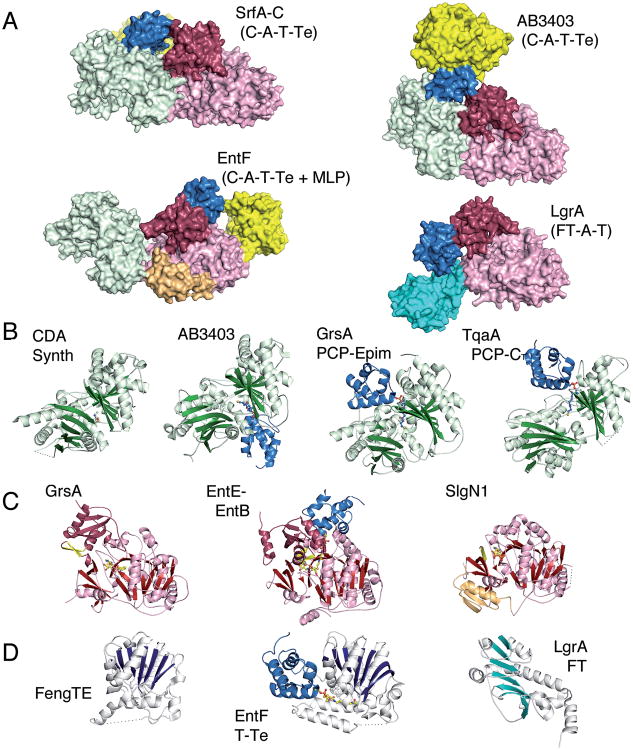
Fig. 1
Fig. 1
Structures of NRPS enzymes. A. Surface representation of multidomain NRPS enzymes indicating domain architecture. Complete modules of SrfA-C (PDB 2VSQ), AB3403 (4ZXI), EntF (5JA1), and LgrA (5ES9). Surfaces are colored to highlight condensation (green), adenylation N-terminal (pink) and C-terminal (red) subdomains, PCP (blue), thioesterase (yellow) and formyltransferase (cyan) domains. The EntF structure also illustrates a bound MLP, YbdZ (orange) B. Ribbon diagrams of condensation domains from CDA Synthetase (5DU9) and AB3403, as well as the homologous epimerization (5ISX) and cyclization (5EJD) domains. C. Ribbon diagrams of adenylation domains showing GrsA in the adenylate-forming conformation (1AMU), the functional interaction of the EntE adenylation domain with the EntB carrier protein domain in the thioester-forming conformation (4IZ6), and the interaction between the MLP and N-terminal subdomain of the adenylation domain of SlgN1 (4GR5). D. Ribbon diagrams of the thioesterase domain from fengycin NRPS FenB (2CB9) and the functional interaction between the PCP and thioesterase of EntF (3TEJ). Additionally shown is the ribbon diagram from the formyltransferase domain of LgrA.
Fig. 2
Fig. 2
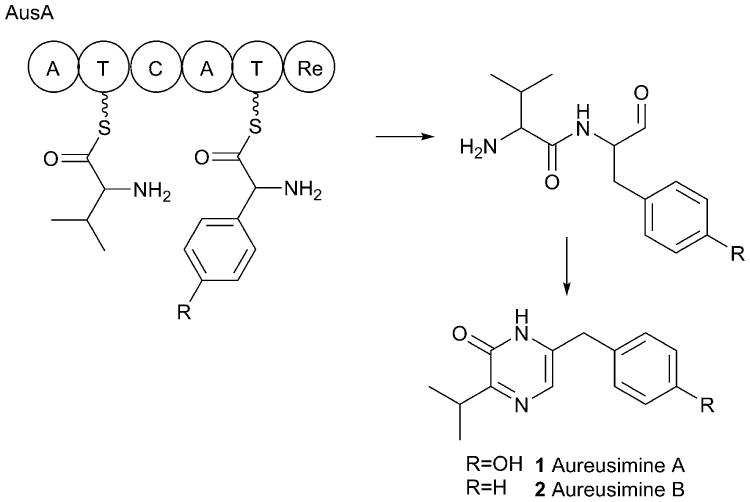
Aureusimine biosynthesis. The production of aureusimine has been demonstrated in biochemical experiments with holo-AusA. Cyclization of the dipeptide aldehyde is believed to occur spontaneously. Multidomain NRPS proteins are represented here and in subsequent figures as circles and labeled as described in Table I.
Fig. 3
Fig. 3
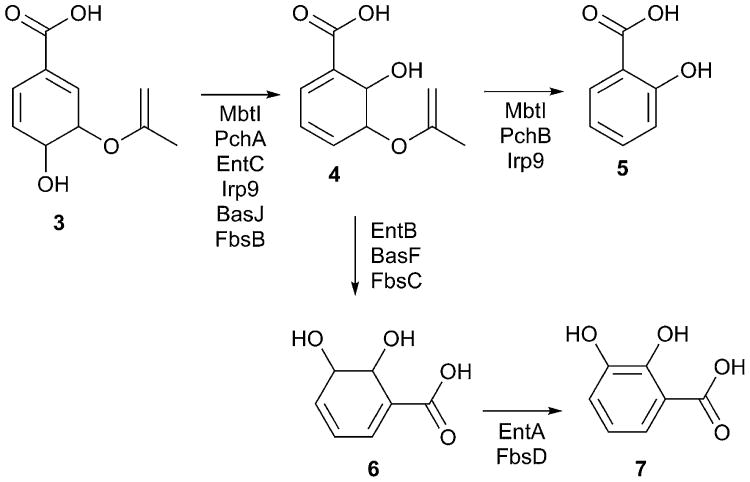
Chorismate utilizing enzymes in NRPS siderophore pathways. Members of the MST family of chorismate-utilizing enzymes convert chorismate to isochorismate. MbtI and Irp9 are able to perform a second reaction to convert isochorismate 4 to salicylate 5, while PchB is a monofunctional salicylate synthase. EntB, BasF, and FbsC are isochorismatase enzymes. EntA and FbsD are dehydrogenases that produce 2,3-dihydroxybenzoate 7.
Fig. 4
Fig. 4
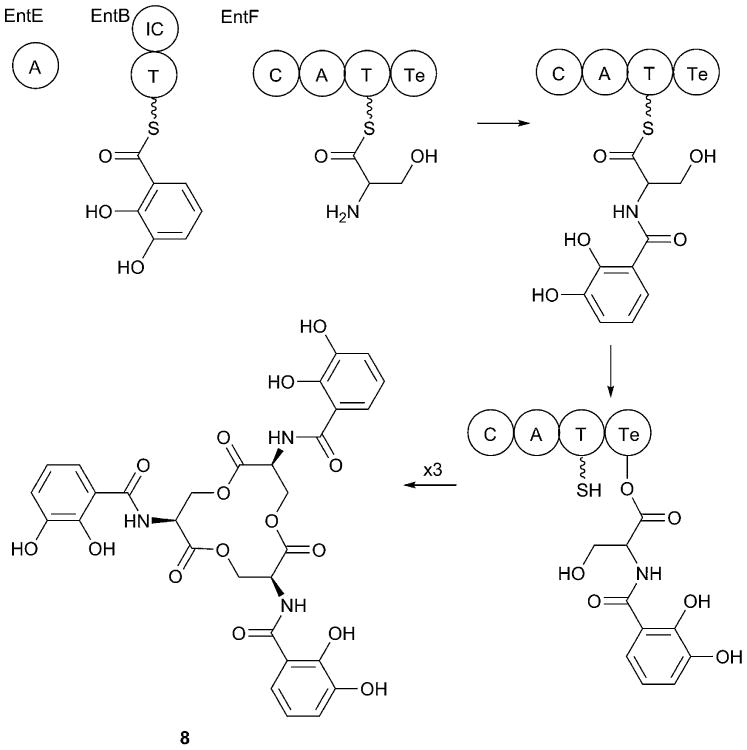
Enterobactin biosynthesis. Enterobactin biosynthesis has been demonstrated biochemically for the homologous enzymes from E. coli. EntE and EntB form a single module for incorporation of DHB, while EntF forms a single module for serine. EntB contains the thiolation domain as well as the isochorismatase domain (IC) used in DHB biosynthesis. The N-(2,3-dihydroxybenoyl)serine is bound to a catalytic serine within the thioesterase domain of EntF for two subsequent cycles of synthesis that iteratively complete the trilactone.
Fig. 5
Fig. 5
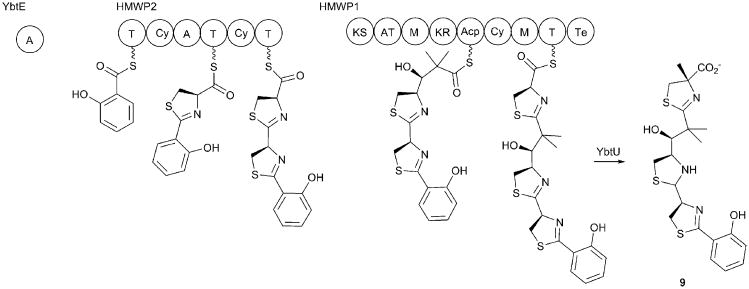
Yersiniabactin biosynthesis. Yersiniabactin biosynthesis has been reconstituted for the homologous enzymes from Y. pestis. HMWP2 contains condensation/cyclization domains (Cy) that catalyze peptide bond formation and thiazoline formation. HMWP1 contains a PKS module containing ketosynthase (KS), acyltransferase (AT), methyltransferase (M), ketoreductase (KR) and acyl carrier protein (ACP) domains in addition to other domains described earlier.
Fig 6
Fig 6
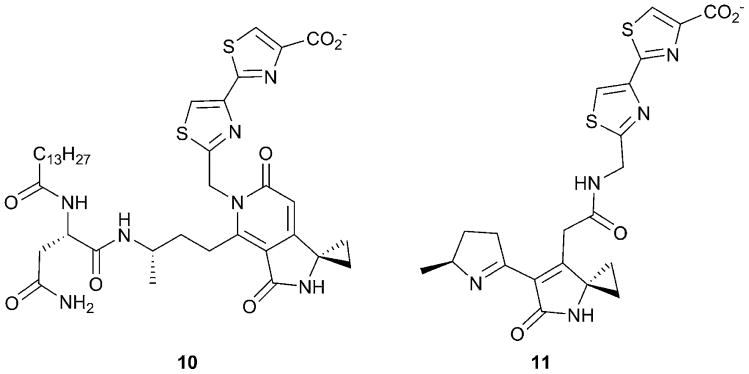
Precolibactin molecules. The bioactive product of the colibactin pathway has not yet been identified. Several precolibactin metabolites, including 10 containing the acyl-Asn peptide leader and 11 derived after cleavage of the leader, have been identified.
Fig. 7
Fig. 7
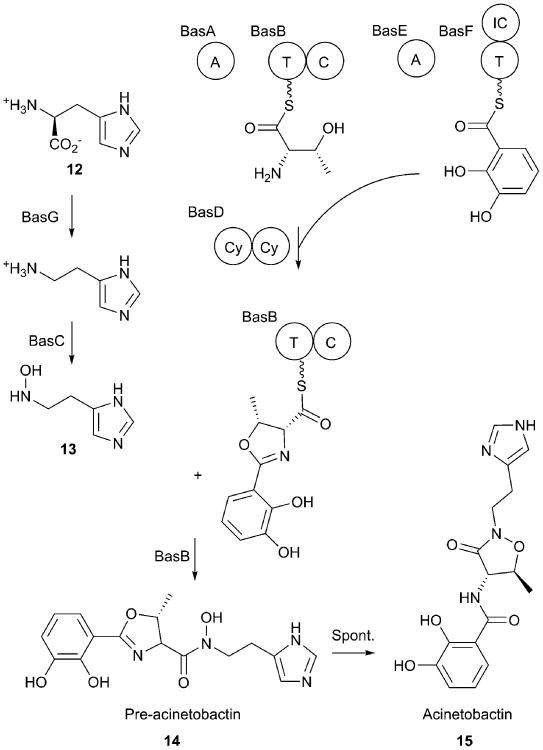
Acinetobactin biosynthesis. N-hydroxyhistamine is produced through the activites of BasG and BasC. The intermolecular loading of DHB on the carrier domain of BasF has been demonstrated biochemically while the subsequent reactions are assumed based on the homologous reactions of pseudomonine biosynthesis. The tandem cyclization domains of BasD perform the peptide bond formation and cyclization to form the oxazoline ring. The condensation domain of BasB then transfers the DHB-oxazoline to 13 to result in the formation of pre-acinetobactin 14.
Fig. 8
Fig. 8
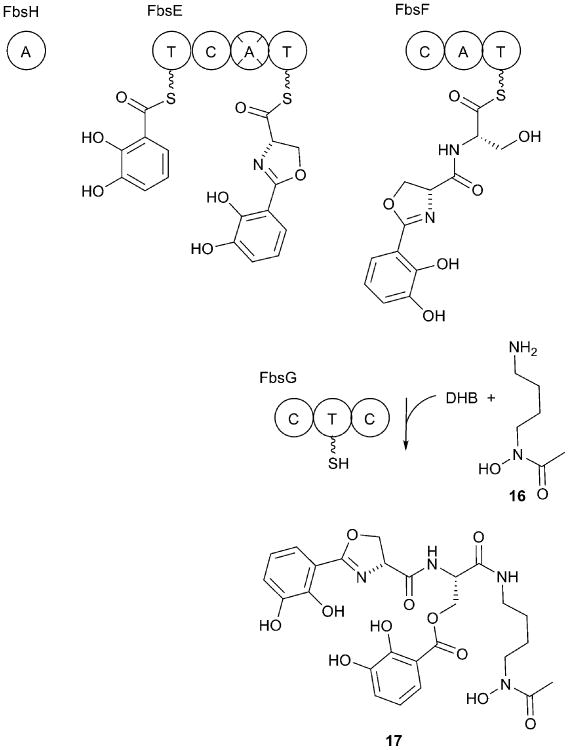
Fimsbactin biosynthesis. The formation of the initial DHB-oxazoline-serine tripeptide on FbsF is catalyzed using standard NRPS biochemistry. The final steps catalyzed by FbsG are not yet characterized. The truncated adenylation domain of FbsE is depicted with the cross-hairs through the domain. The biosynthesis of fimsbactin has not been demonstrated biochemically but the early steps can be confidently assigned on the basis of homologous enzymes.
Fig. 9
Fig. 9
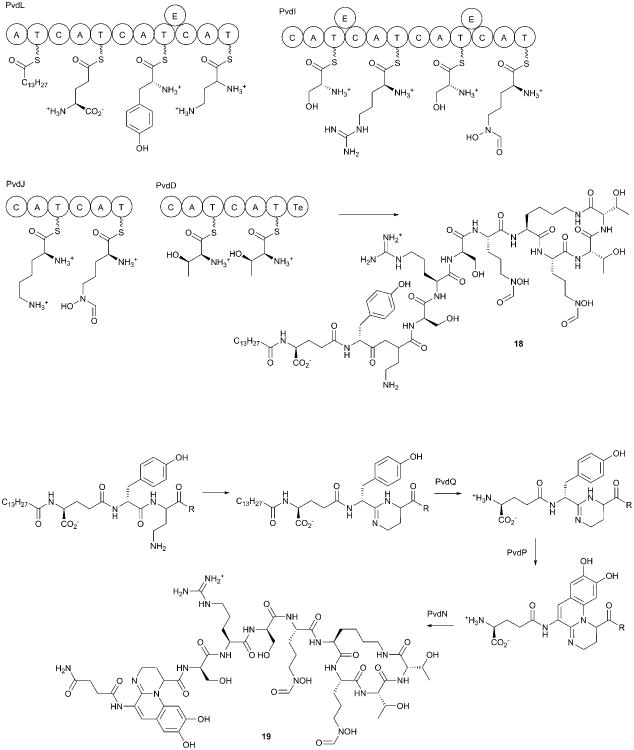
Pyoverdine biosynthesis. Four NRPS proteins are involved in the production of the initial pyoverdine precursor (18). Final steps in the biosynthesis convert precursor (18) to mature pyoverdine (19). The complete biosynthesis of pyoverdine has not been reconstituted in vitro with the NRPS proteins. Several of the steps in chromophore maturation have been demonstrated with precursor or analog substrates.
Fig. 10
Fig. 10
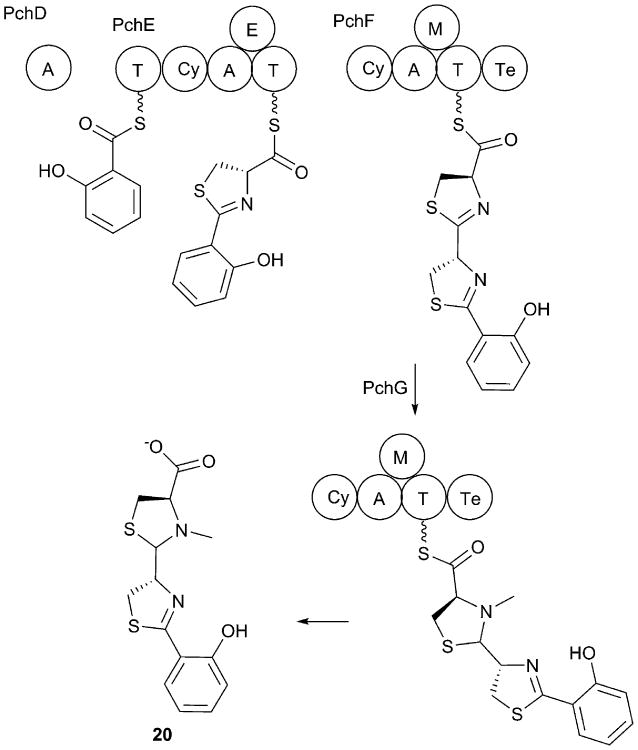
Pyochelin biosynthesis. Pyochelin biosynthesis has been demonstrated biochemically using the three NRPS enzymes PchD, PchE, PchF, as well as the redutase PchG, along with building blocks DHB and cysteine, along with necessary substrates ATP, NADPH, and SAM. PchE contains an additional epimerization domain (E), while PchF contains an N-methyltransferase.
Fig. 11
Fig. 11
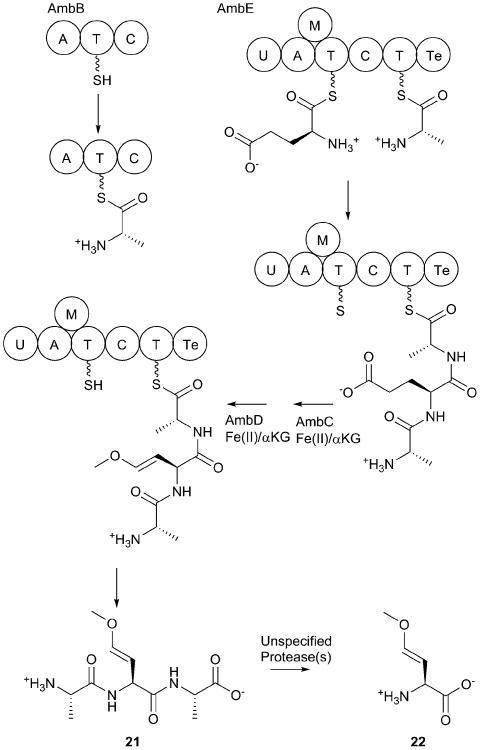
AMB biosynthesis. The AMB residue is produced in two steps from glutamate through the activities of AmbC and AmbD. The formation of the Ala-Glu-Ala tripeptide on AmbE has been shown biochemically to precede conversion to the AMB containing tripeptide, which occurs while the tripeptide is loaded on AmbE if AmbC and AmbD are present.
Fig. 12
Fig. 12
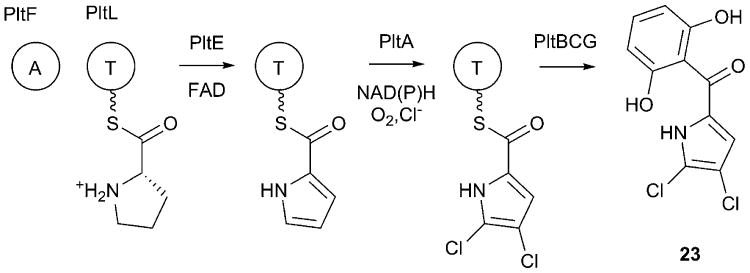
Pyoluteorin biosynthesis. The early steps in pyoluteorin biosynthesis have been demonstrated with enzymes from related pseuodomonads. The 4,5-dichloropyrrole has been shown to be produced while tethered to the carrier protein PltL. Subsequent PKS enzymes produce the resorcinol moiety.

References

    1. Gevers W, Kleinkauf H, Lipmann F. Proc Natl Acad Sci U S A. 1968;60:269–276. - PMC - PubMed
    1. Gevers W, Kleinkauf H, Lipmann F. Proc Natl Acad Sci U S A. 1969;63:1335–1342. - PMC - PubMed
    1. Gilhuus-Moe CC, Kristensen T, Bredesen JE, Zimmer T, Laland SG. FEBS Lett. 1970;7:287–290. - PubMed
    1. Kleinkauf H, Roskoski R, Jr, Lipmann F. Proc Natl Acad Sci U S A. 1971;68:2069–2072. - PMC - PubMed
    1. Mittenhuber G, Weckermann R, Marahiel MA. J Bacteriol. 1989;171:4881–4887. - PMC - PubMed

Publication types

MeSH terms

LinkOut - more resources