Molecular phylogeny of 42 species of Culicoides (Diptera, Ceratopogonidae) from three continents
- PMID: 28643630
- PMCID: PMC5482051
- DOI: 10.1051/parasite/2017020
Molecular phylogeny of 42 species of Culicoides (Diptera, Ceratopogonidae) from three continents
Abstract
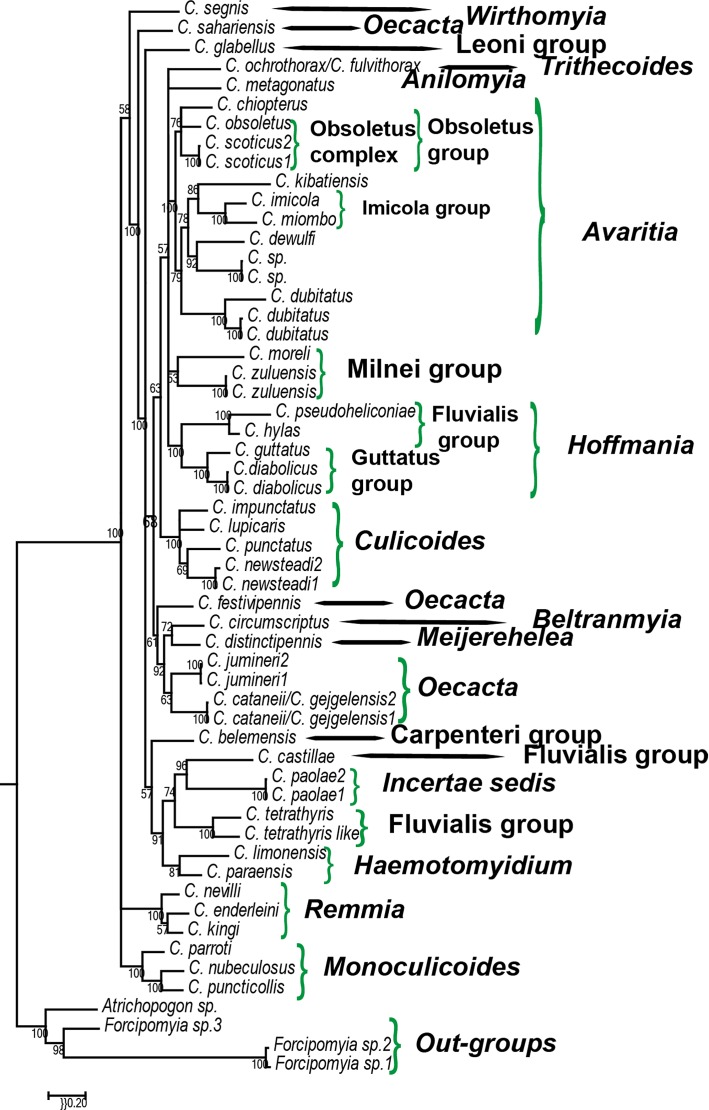
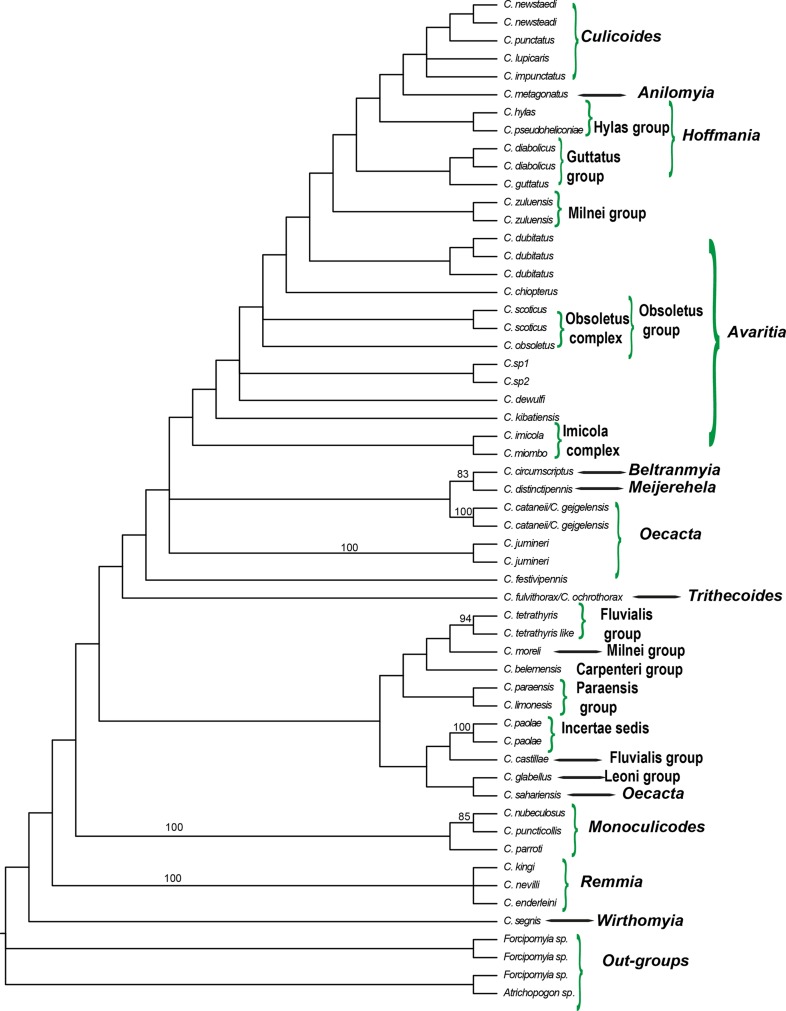
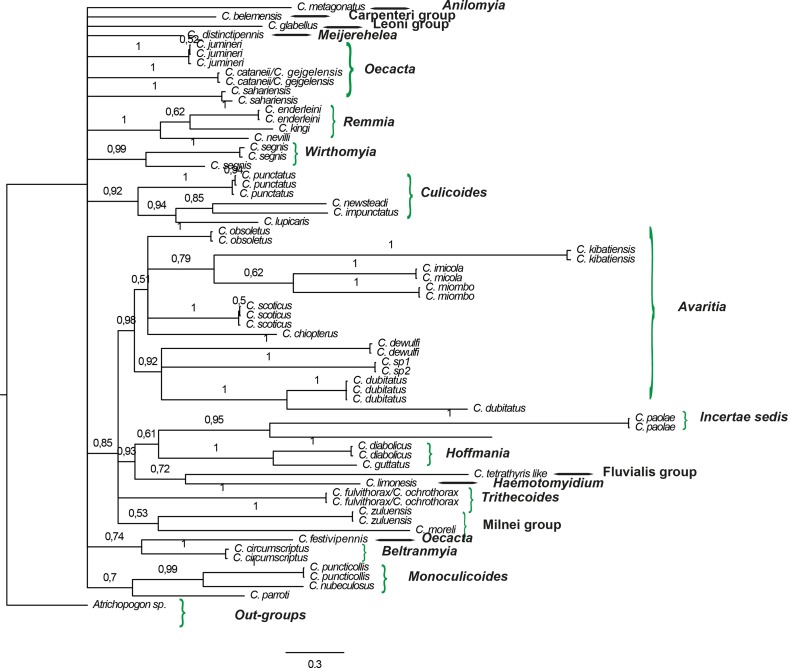
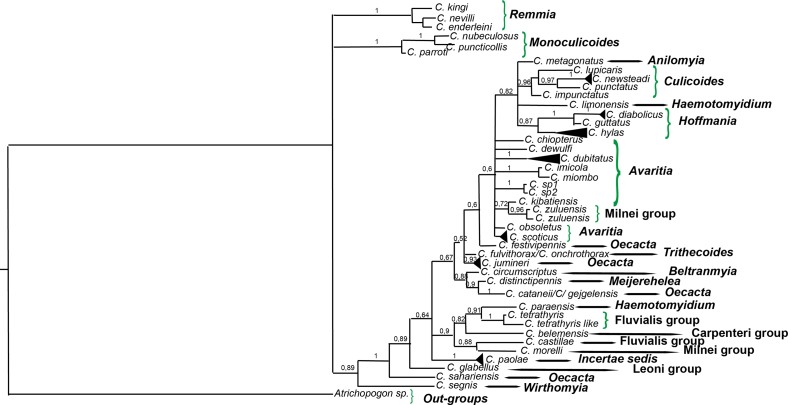
The genus Culicoides includes vectors of important animal diseases such as bluetongue and Schmallenberg virus (BTV and SBV). This genus includes 1300 species classified in 32 subgenera and 38 unclassified species. However, the phylogenetic relationships between different subgenera of Culicoides have never been studied. Phylogenetic analyses of 42 species belonging to 12 subgenera and 8 ungrouped species of genus Culicoides from Ecuador, France, Gabon, Madagascar and Tunisia were carried out using two molecular markers (28S rDNA D1 and D2 domains and COI mtDNA). Sequences were subjected to non-probabilistic (maximum parsimony) and probabilistic (Bayesian inference (BI)) approaches. The subgenera Monoculicoides, Culicoides, Haematomyidium, Hoffmania, Remmia and Avaritia (including the main vectors of bluetongue disease) were monophyletic, whereas the subgenus Oecacta was paraphyletic. Our study validates the subgenus Remmia (= Schultzei group) as a valid subgenus, outside of the subgenus Oecacta. In Europe, Culicoides obsoletus, Culicoides scoticus and Culicoides chiopterus should be part of the Obsoletus complex whereas Culicoides dewulfi should be excluded from this complex. Our study suggests that the current Culicoides classification needs to be revisited with modern tools.
Le genre Culicoides comprend des vecteurs de maladies animales importantes telles que la fièvre catarrhale et le virus Schmallenberg. Ce genre comprend 1300 espèces classées dans 32 sous-genres et 38 espèces non classées. Cependant, les relations phylogénétiques entre les différents sous-genres de Culicoides n’ont jamais été étudiées. Des analyses phylogénétiques de 42 espèces appartenant à 12 sous-genres et 8 espèces non groupées du genre Culicoides d’Équateur, de France, du Gabon, de Madagascar et de Tunisie ont été réalisées en utilisant deux marqueurs moléculaires (ADNr 28S domaines D1 et D2 et ADNmt COI). Les séquences ont été soumises à des approches non probabilistes (maximum de parcimonie) et probabilistes (inférence bayésienne). Les sous-genres Monoculicoides, Culicoides, Haematomyidium, Hoffmania, Remmia et Avaritia (y compris les principaux vecteurs de la fièvre catarrhale du mouton) étaient monophylétiques alors que le sous-genre Oecacta était paraphylétique. Notre étude valide le sous-genre Remmia (= groupe Schultzei) sous la forme d’un sous-genre valide, en dehors du sous-genre Oecacta. En Europe, Culicoides obsoletus, Culicoides scoticus et Culicoides chiopterus devraient faire partie du complexe Obsoletus alors que Culicoides dewulfi devrait être exclu de ce complexe. Notre étude suggère que la classification actuelle de Culicoides doit être revisitée avec des outils modernes.
© D. Augot et al., published by EDP Sciences, 2017.
Figures
References
-
- Ander M, Troell K, Chirico J. 2013. Barcoding of biting midges in the genus Culicoides: a tool for species determination. Medical and Veterinary Entomology, 27(3), 323–331. - PubMed
-
- Augot D, Sauvage F, Jouet D, Simphal E, Veuille M, Couloux A, Kaltenbach ML, Depaquit J. 2010. Discrimination of Culicoides obsoletus and Culicoides scoticus, potential bluetongue vectors, by morphometrical and mitochondrial cytochrome oxidase subunit I analysis. Infection Genetics & Evolution, 10, 629–637. - PubMed
-
- Augot D, Randrianambinintsoa FJ, Gasser A, Depaquit J. 2013. Record of two species of Culicoides (Diptera: Ceratopogonidae) new for Madagascar and molecular study showing the paraphylies of the subgenus Oecacta and the Schultzei group. Bulletin de la Société de Pathologie Exotique, 106, 201–205. - PubMed
-
- Bakhoum MT, Fall M, Fall AG, Bellis GA, Gottlieb Y, Labuschagne K, Venter GJ, Diop M, Mall I, Seck MT, Allène X, Diarra M, Gardès L, Bouyer J, Delécolle JC, Balenghien T, Garros C. 2013. First record of Culicoides oxystoma Kieffer and diversity of species within the Schultzei group of Culicoides Latreille (Diptera: Ceratopogonidae) biting midges in Senegal. PLoS One, 8(12), e84316. - PMC - PubMed
-
- Balenghien T, Pagès N, Goffredo M, Carpenter S, Augot D, Jacquier E, Talavera S, Monaco F, Depaquit J, Grillet C, Pujols J, Satta G, Kasbari M, Setier-Rio ML, Izzo F, Alkan C, Delécolle JC, Quaglia M, Charrel R, Polci A, Bréard E, Federici V, Cêtre-Sossah C, Garros C. 2014. The emergence of Schmallenberg virus across Culicoides communities and ecosystems in Europe. Preventive Veterinary Medicine, 116(4), 360–369. - PubMed
MeSH terms
Substances
LinkOut - more resources
Full Text Sources
Other Literature Sources