


Low Hepatic Tissue Copper in Pediatric Nonalcoholic Fatty Liver Disease
- PMID: 28644356
- PMCID: PMC5492896
- DOI: 10.1097/MPG.0000000000001571
Low Hepatic Tissue Copper in Pediatric Nonalcoholic Fatty Liver Disease
Abstract
Objective: Animal models and studies in adults have demonstrated that copper restriction increases severity of liver injury in nonalcoholic fatty liver disease (NAFLD). This has not been studied in children. We aimed to determine if lower tissue copper is associated with increased NAFLD severity in children.
Methods: This was a retrospective study of pediatric patients who had a liver biopsy including a hepatic copper quantitation. The primary outcome compared hepatic copper concentration in NAFLD versus non-NAFLD. Secondary outcomes compared hepatic copper levels against steatosis, fibrosis, lobular inflammation, balloon degeneration, and NAFLD activity score (NAS).
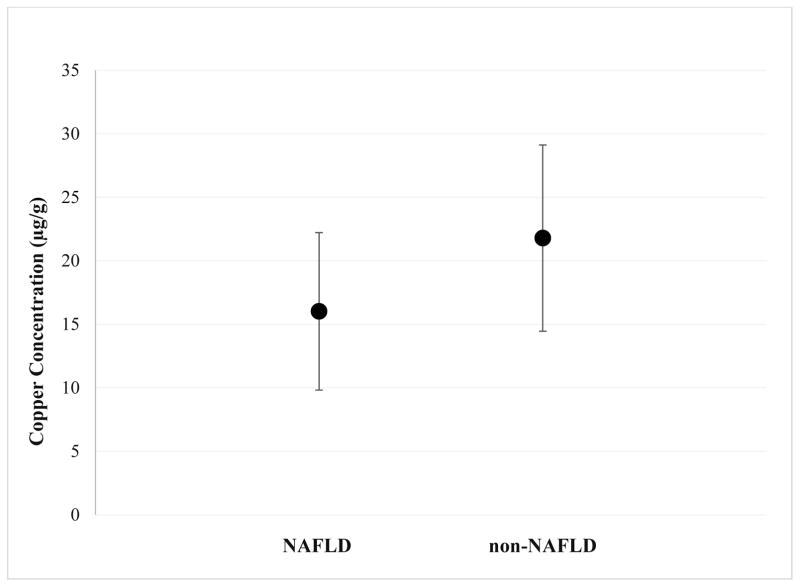
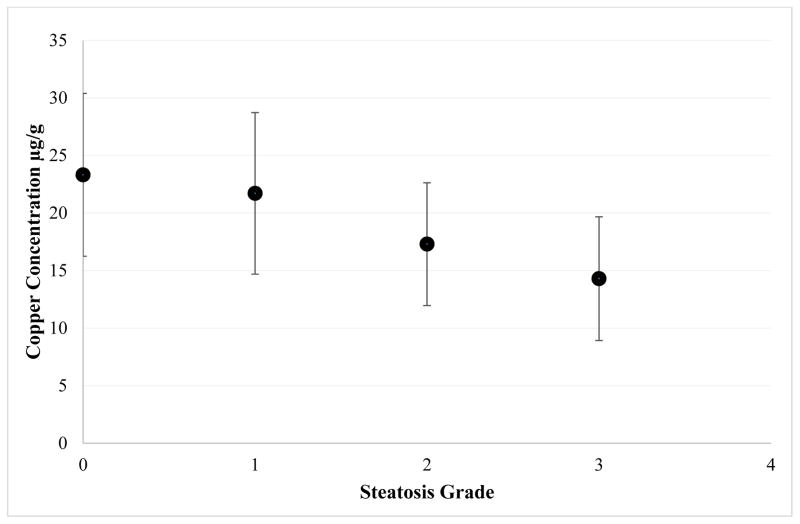
Results: The study analysis included 150 pediatric subjects (102 with NAFLD and 48 non-NAFLD). After adjusting for age, body mass index z score, gamma glutamyl transferase, alanine aminotransferase, and total bilirubin, NAFLD subjects had lower levels of hepatic copper than non-NAFLD (P = 0.005). In addition, tissue copper concentration decreased as steatosis severity increased (P < 0.001). Copper levels were not associated with degree of fibrosis, lobular inflammation, portal inflammation, or balloon degeneration.
Conclusions: In this cohort of pediatric subjects with NAFLD, we observed decreased tissue copper levels in subjects with NAFLD when compared with non-NAFLD subjects. In addition, tissue copper levels were lower in subjects with nonalcoholic steatohepatitis, a more severe form of the disease, when compared with steatosis alone. Further studies are needed to explore the relationship between copper levels and NAFLD progression.
Conflict of interest statement
Figures
References
-
- Rubino JT, Franz KJ. Coordination chemistry of copper proteins: how nature handles a toxic cargo for essential function. J Inorg Biochem. 2012;107:129–43. - PubMed
MeSH terms
Substances
Grants and funding
LinkOut - more resources
Full Text Sources
Other Literature Sources
Medical
