


Sleep Disturbance after Hospitalization and Critical Illness: A Systematic Review
- PMID: 28644698
- PMCID: PMC5711402
- DOI: 10.1513/AnnalsATS.201702-148SR
Sleep Disturbance after Hospitalization and Critical Illness: A Systematic Review
Abstract
Rationale: Sleep disturbance during intensive care unit (ICU) admission is common and severe. Sleep disturbance has been observed in survivors of critical illness even after transfer out of the ICU. Not only is sleep important to overall health and well being, but patients after critical illness are also in a physiologically vulnerable state. Understanding how sleep disturbance impacts recovery from critical illness after hospital discharge is therefore clinically meaningful.
Objectives: This Systematic Review aimed to summarize studies that identify the prevalence of and risk factors for sleep disturbance after hospital discharge for critical illness survivors.
Data sources: PubMed (January 4, 2017), MEDLINE (January 4, 2017), and EMBASE (February 1, 2017).
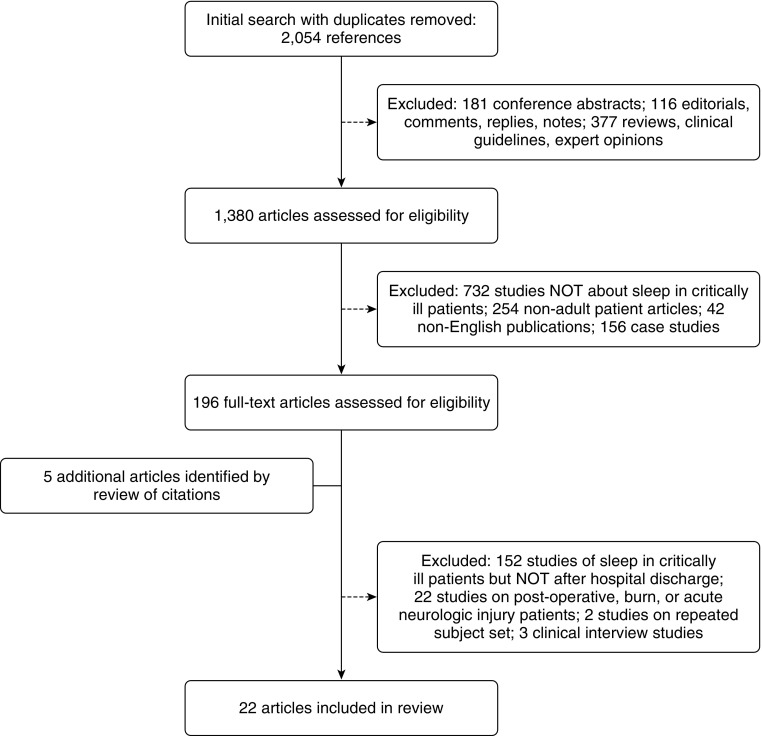
Data extraction: Databases were searched for studies of critically ill adult patients after hospital discharge, with sleep disturbance measured as a primary outcome by standardized questionnaire or objective measurement tools. From each relevant study, we extracted prevalence and severity of sleep disturbance at each time point, objective sleep parameters (such as total sleep time, sleep efficiency, and arousal index), and risk factors for sleep disturbance.
Synthesis: A total of 22 studies were identified, with assessment tools including subjective questionnaires, polysomnography, and actigraphy. Subjective questionnaire studies reveal a 50-66.7% (within 1 mo), 34-64.3% (>1-3 mo), 22-57% (>3-6 mo), and 10-61% (>6 mo) prevalence of abnormal sleep after hospital discharge after critical illness. Of the studies assessing multiple time points, four of five questionnaire studies and five of five polysomnography studies show improved aspects of sleep over time. Risk factors for poor sleep varied, but prehospital factors (chronic comorbidity, pre-existing sleep abnormality) and in-hospital factors (severity of acute illness, in-hospital sleep disturbance, pain medication use, and ICU acute stress symptoms) may play a role. Sleep disturbance was frequently associated with postdischarge psychological comorbidities and impaired quality of life.
Conclusions: Sleep disturbance is common in critically ill patients up to 12 months after hospital discharge. Both subjective and objective studies, however, suggest that sleep disturbance improves over time. More research is needed to understand and optimize sleep in recovery from critical illness.
Keywords: critical illness; insomnia; patient discharge; sleep quality; sleep wake disorders.
Figures
References
Publication types
MeSH terms
Grants and funding
LinkOut - more resources
Full Text Sources
Other Literature Sources
Medical
