


Sarcopenia is a predictive factor for intestinal resection in admitted patients with Crohn's disease
- PMID: 28644887
- PMCID: PMC5482469
- DOI: 10.1371/journal.pone.0180036
Sarcopenia is a predictive factor for intestinal resection in admitted patients with Crohn's disease
Abstract
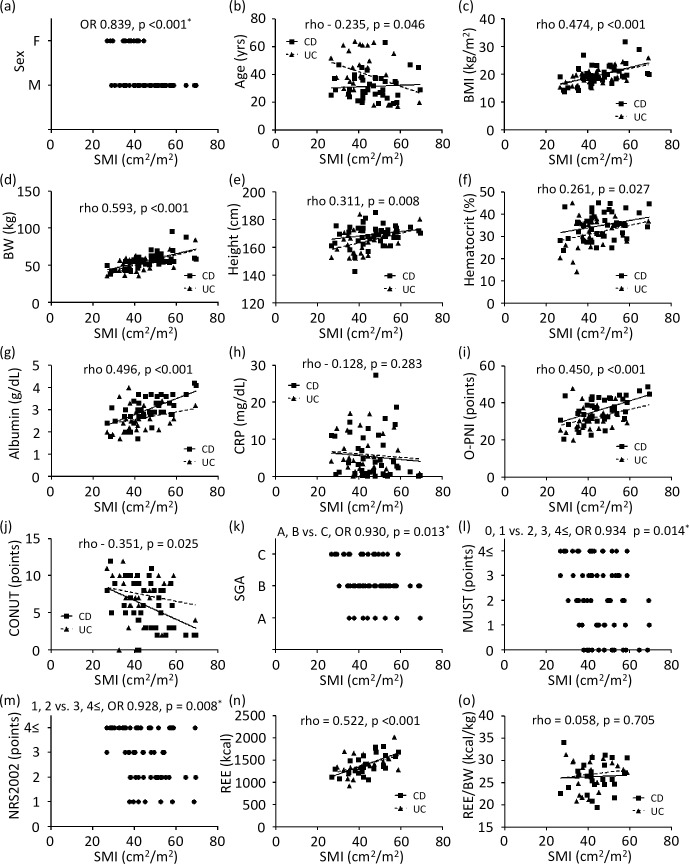
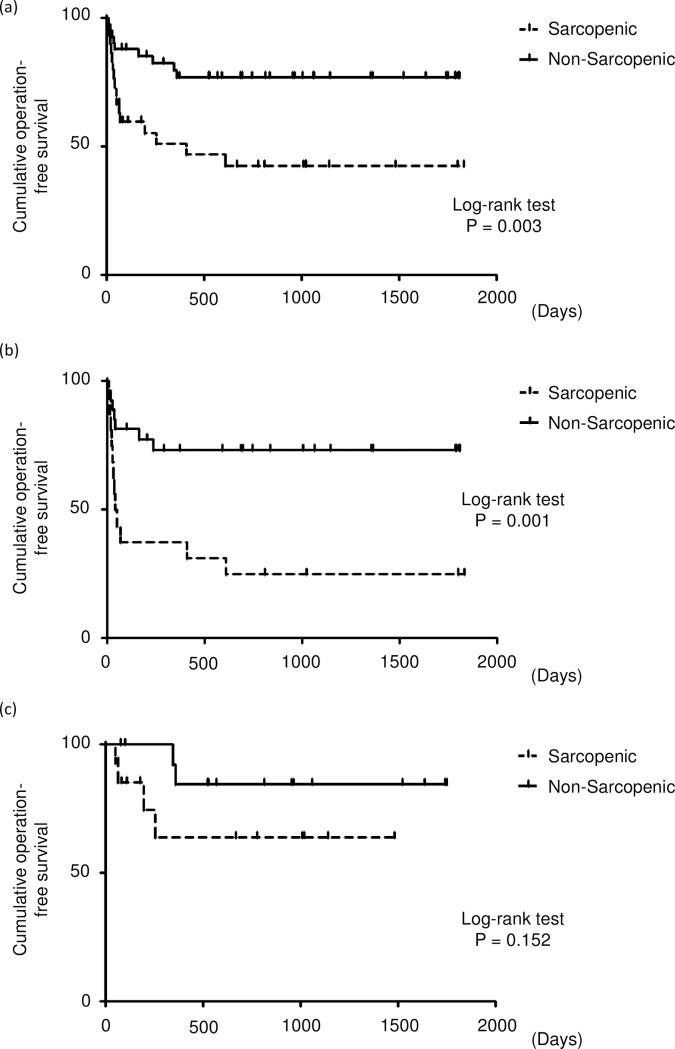
The relationship between skeletal muscle volume and the prognosis of patients with inflammatory bowel disease (IBD) remains undetermined. We conducted a retrospective study of 72 IBD patients who were admitted to the hospital due to disease exacerbation. We enrolled IBD patients who had undergone abdominal computed tomography and assessed the nutritional indices, such as the Onodera's prognostic nutritional index (O-PNI) and the controlling nutritional status (CONUT) index. The L3 skeletal muscle index (SMI), which is the ratio of the cross-sectional area of skeletal muscles at the level of the third lumbar (L3) vertebra to the height squared, was used to identify sarcopenia. Sarcopenia, defined as a low SMI, was observed in 42% of all IBD patients (37% with Crohn's disease (CD) and 48% with ulcerative colitis (UC)). In UC patients, the O-PNI and CONUT values, height, and albumin levels were significantly lower than in CD patients. The SMI strongly correlated with sex, body weight, albumin level, and O-PNI in IBD patients. Multivariate analysis using the Cox regression model demonstrated that the presence of sarcopenia (P = 0.015) and disease type (CD or UC) (P = 0.007) were significant factors predicting intestinal resection. The cumulative operation-free survival rate was significantly lower for sarcopenic patients than in all IBD patients (P = 0.003) and a stratified analysis of CD patients (P = 0.001) using the Kaplan-Meier method and log-rank test. The L3 skeletal muscle area is a prognostic factor for intestinal resection in patients with CD.
Conflict of interest statement
Figures
References
-
- Krok KL, Lichtenstein GR. Nutrition in Crohn disease. Curr Opin Gastroenterol. 2003;19(2):148–153. - PubMed
-
- Rigaud D, Angel LA, Cerf M, Carduner MJ, Melchior JC, Sautier C, et al. Mechanisms of decreased food intake during weight loss in adult Crohn's disease patients without obvious malabsorption. Am J Clin Nutr. 1994;60(5):775–781. - PubMed
-
- Al-Jaouni R, Schneider SM, Piche T, Rampal P, Hebuterne X. Effect of steroids on energy expenditure and substrate oxidation in women with Crohn's disease. Am J Gastroenterol. 2002;97(11):2843–2849. doi: 10.1111/j.1572-0241.2002.07032.x - DOI - PubMed
-
- Sasaki M, Johtatsu T, Kurihara M, Iwakawa H, Tanaka T, Bamba S, et al. Energy expenditure in Japanese patients with severe or moderate ulcerative colitis. J Clin Biochem Nutr. 2010;47(1):32–36. doi: 10.3164/jcbn.10-07 - DOI - PMC - PubMed
MeSH terms
Substances
LinkOut - more resources
Full Text Sources
Other Literature Sources
Medical
Molecular Biology Databases
