


Per- and polyfluoroalkyl substances in human serum and urine samples from a residentially exposed community
- PMID: 28645013
- PMCID: PMC5673082
- DOI: 10.1016/j.envint.2017.06.007
Per- and polyfluoroalkyl substances in human serum and urine samples from a residentially exposed community
Abstract
Background: Per- and polyfluoroalkyl substances (PFAS) are considered chemicals of emerging concern, in part due to their environmental and biological persistence and the potential for widespread human exposure. In 2007, a PFAS manufacturer near Decatur, Alabama notified the United States Environmental Protection Agency (EPA) it had discharged PFAS into a wastewater treatment plant, resulting in environmental contamination and potential exposures to the local community.
Objectives: To characterize PFAS exposure over time, the Agency for Toxic Substances and Disease Registry (ATSDR) collected blood and urine samples from local residents.
Methods: Eight PFAS were measured in serum in 2010 (n=153). Eleven PFAS were measured in serum, and five PFAS were measured in urine (n=45) from some of the same residents in 2016. Serum concentrations were compared to nationally representative data and change in serum concentration over time was evaluated. Biological half-lives were estimated for perfluorooctanoic acid (PFOA), perfluorooctane sulfonic acid (PFOS), and perfluorohexane sulfonic acid (PFHxS) using a one-compartment pharmacokinetic model.
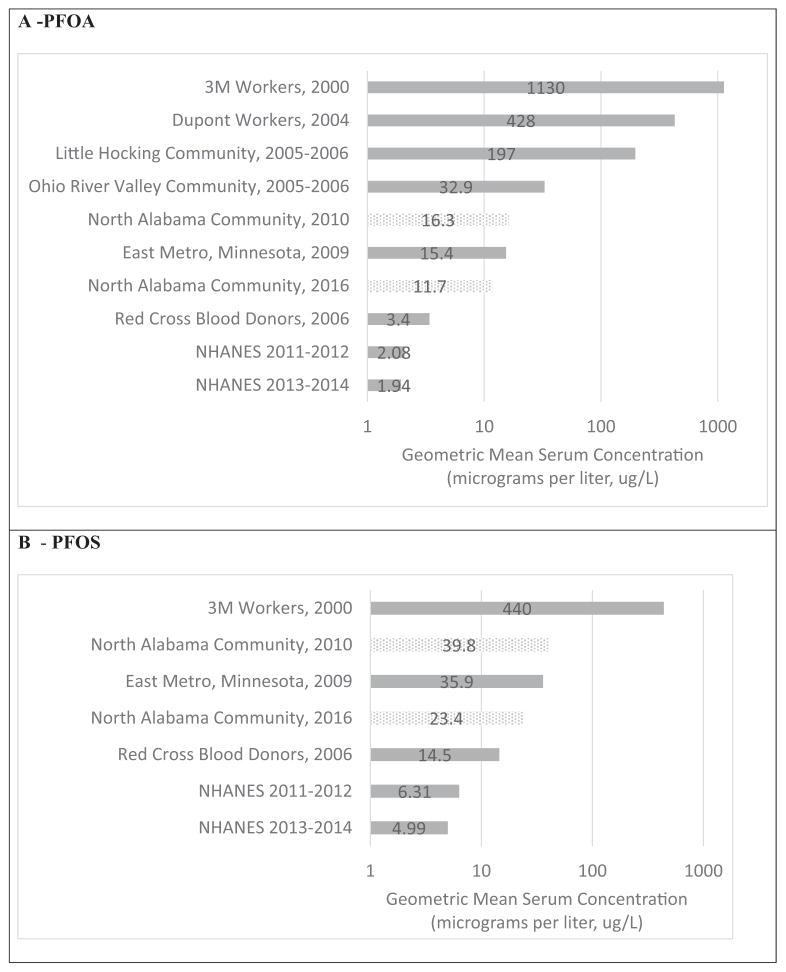
Results: In 2010 and 2016, geometric mean PFOA and PFOS serum concentrations were elevated in participants compared to the general U.S.
Population: In 2016, the geometric mean PFHxS serum concentration was elevated compared to the general U.S.
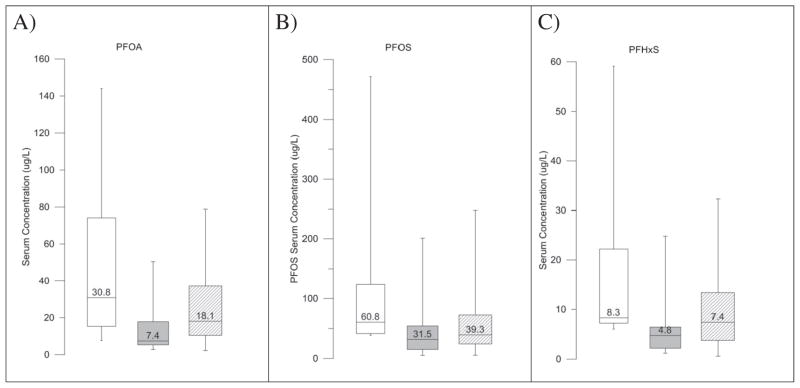
Population: Geometric mean serum concentrations of PFOA, PFOS, and perfluorononanoic acid (PFNA) were significantly (p≤0.0001) lower (49%, 53%, and 58%, respectively) in 2016 compared to 2010. Half-lives for PFOA, PFOS, and PFHxS were estimated to be 3.9, 3.3, and 15.5years, respectively. Concentrations of PFOA in serum and urine were highly correlated (r=0.75) in males.
Conclusions: Serum concentrations of some PFAS are decreasing in this residentially exposed community, but remain elevated compared to the U.S. general population.
Keywords: Biomonitoring; Half-life; PFAS; PFOA; PFOS.
Published by Elsevier Ltd.
Conflict of interest statement
None.
Figures
References
-
- Alexander BH, Olsen GW. Bladder cancer in perfluorooctanesulfonyl fluoride manufacturing workers. Ann Epidemiol. 2007;17:471–478. - PubMed
-
- Andersen ME, Clewell HJ, 3rd, Tan YM, Butenhoff JL, Olsen GW. Pharmacokinetic modeling of saturable, renal resorption of perfluoroalkylacids in monkeys–probing the determinants of long plasma half-lives. Toxicology. 2006;227:156–164. - PubMed
-
- ATSDR. Exposure Investigation Report - Perfluorochemical Serum Sampling in the Vicinity of Decatur, AL, Morgan, Lawrence, and Limestone Counties. Division of Community Health Investigation; 2013. https://www.atsdr.cdc.gov/hac/pha/Decatur/Perfluorochemical_Serum%20Samp....
MeSH terms
Substances
Grants and funding
LinkOut - more resources
Full Text Sources
Other Literature Sources
Research Materials
