Review
. 2017:591:33-53.
doi: 10.1016/bs.mie.2017.03.002. Epub 2017 Apr 6.

Proteomic Analyses of the Eukaryotic Replication Machinery

Affiliations
Review

Proteomic Analyses of the Eukaryotic Replication Machinery

David Cortez. Methods Enzymol. 2017.

Abstract

DNA replication in a human cell involves hundreds of proteins that copy the DNA accurately and completely each cell division cycle. In addition to the core DNA copying machine (the replisome), accessory proteins work to respond to replication stress, correct errors, and repackage the DNA into appropriate chromatin structures. New proteomic tools have been invented in the past few years to facilitate the purification, identification, and quantification of the replication, chromatin maturation, and replication stress response machineries. These tools, including iPOND (isolation of proteins on nascent DNA) and NCC (nascent chromatin capture), have yielded discoveries of new proteins involved in these processes and insights into the dynamic regulatory processes ensuring genome and chromatin integrity. In this review, I will introduce these experimental approaches and examine how they have been utilized to define the replication fork proteome.

Keywords: Chromatin; DNA replication; Mass spectrometry; Nascent chromatin capture; Proteomics; Replication stress; Replisome; SILAC; iPOND.


Figures

Figure 1
Figure 1
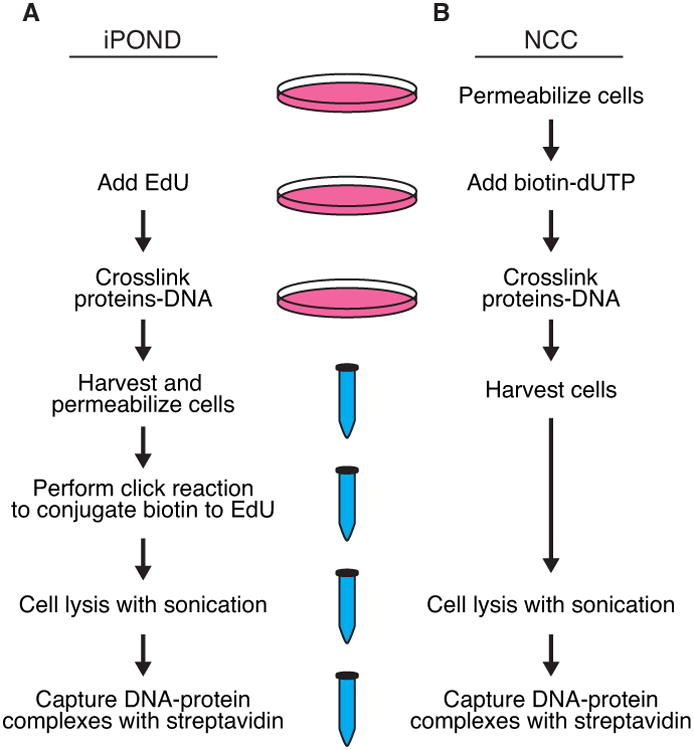
Schematic of the (A) iPOND and (B) NCC approaches to purifying proteins associated with nascent DNA.
Figure 2
Figure 2
A pulse-chase protocol is essential to identify proteins that are specifically enriched near the replication fork versus proteins that are associated more generally with chromatin. This methodology also facilitates analysis of chromatin maturation.
Figure 3
Figure 3
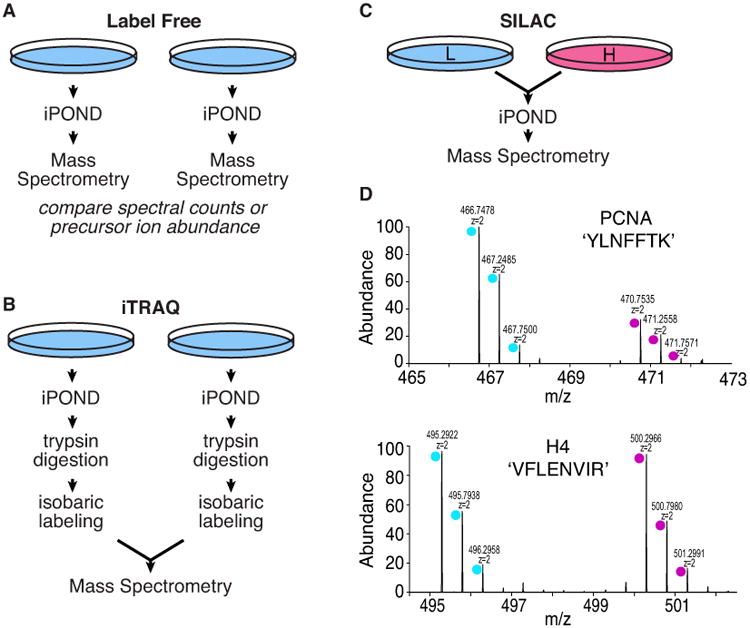
Comparison of mass spectrometry approaches that have been combined with iPOND. (A) Label free methods depend on comparing datasets that are generated independently. (B) iTRAQ improves the quantitation precision but does not eliminate variability associated with purification. (C) SILAC improves precision and reduces variation since heavy and light samples are combined prior to purification. (D) Example of data obtained from a SILAC experiment in which the light sample was labeled with EdU and the heavy sample was the chase.
Figure 4
Figure 4
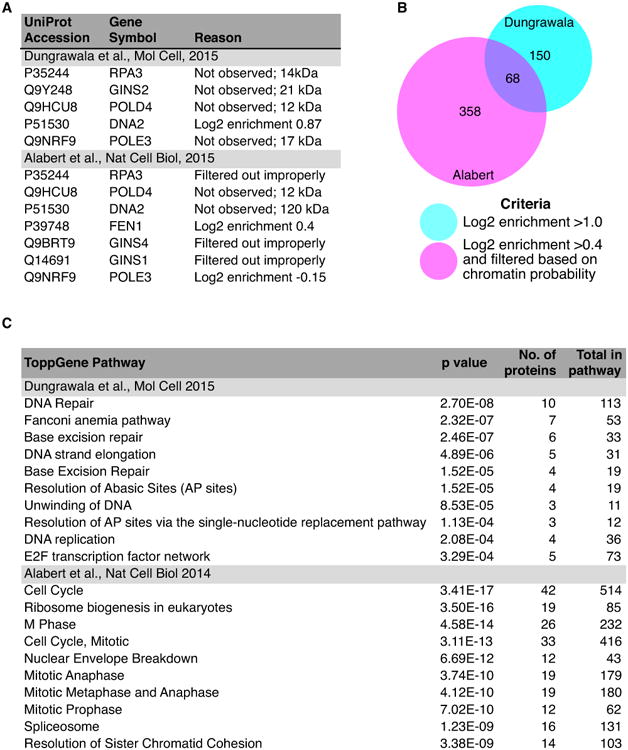
Comparison of the iPOND-SILAC and NCC-SILAC datasets. (A) Known replication fork proteins that were not identified or filtered out by the bioinformatics approach used in the NCC study. (B) Comparison of the total numbers of proteins identified in each dataset and the criteria utilized. (C) Gene ontology analysis of the 150 and 358 proteins uniquely identified in the Dungrawala et al., or Alabert et al., datasets.
Figure 5
Figure 5
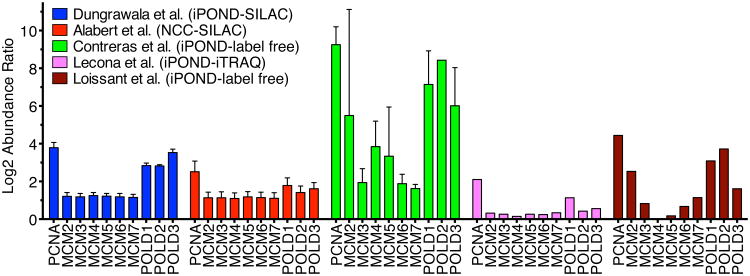
Comparison of the enrichment of selected replisome proteins at replication forks calculated in five proteomic datasets. A log2 transformation of the mean enrichment comparing fork/chromatin (pulse/chase) is depicted. Larger positive values indicate increased enrichment at forks compared to bulk chromatin. Error bars were calculated as SEM where possible. The data illustrates the reproducibility and precision of SILAC quantitation compared to other methods.

References

    1. Alabert C, Barth TK, Reveron-Gomez N, Sidoli S, Schmidt A, Jensen ON, Imhof A, Groth A. Two distinct modes for propagation of histone PTMs across the cell cycle. Genes Dev. 2015;29:585–590. - PMC - PubMed
    1. Alabert C, Bukowski-Wills JC, Lee SB, Kustatscher G, Nakamura K, de Lima Alves F, Menard P, Mejlvang J, Rappsilber J, Groth A. Nascent chromatin capture proteomics determines chromatin dynamics during DNA replication and identifies unknown fork components. Nat Cell Biol. 2014;16:281–293. - PMC - PubMed
    1. Aranda S, Rutishauser D, Ernfors P. Identification of a large protein network involved in epigenetic transmission in replicating DNA of embryonic stem cells. Nucleic acids research. 2014;42:6972–6986. - PMC - PubMed
    1. Bakkenist CJ, Kastan MB. DNA damage activates ATM through intermolecular autophosphorylation and dimer dissociation. Nature. 2003;421:499–506. - PubMed
    1. Bass TE, Luzwick JW, Kavanaugh G, Carroll C, Dungrawala H, Glick GG, Feldkamp MD, Putney R, Chazin WJ, Cortez D. ETAA1 acts at stalled replication forks to maintain genome integrity. Nat Cell Biol. 2016;18:1185–1195. - PMC - PubMed

Publication types

LinkOut - more resources