. 2017 Aug;174(4):2023-2037.
doi: 10.1104/pp.17.00489. Epub 2017 Jun 23.

Generation of a Collection of Mutant Tomato Lines Using Pooled CRISPR Libraries

Affiliations

Generation of a Collection of Mutant Tomato Lines Using Pooled CRISPR Libraries

Thomas B Jacobs et al. Plant Physiol. 2017 Aug.

Abstract

The high efficiency of clustered regularly interspaced short palindromic repeats (CRISPR)-mediated mutagenesis in plants enables the development of high-throughput mutagenesis strategies. By transforming pooled CRISPR libraries into tomato (Solanum lycopersicum), collections of mutant lines were generated with minimal transformation attempts and in a relatively short period of time. Identification of the targeted gene(s) was easily determined by sequencing the incorporated guide RNA(s) in the primary transgenic events. From a single transformation with a CRISPR library targeting the immunity-associated leucine-rich repeat subfamily XII genes, heritable mutations were recovered in 15 of the 54 genes targeted. To increase throughput, a second CRISPR library was made containing three guide RNAs per construct to target 18 putative transporter genes. This resulted in stable mutations in 15 of the 18 targeted genes, with some primary transgenic plants having as many as five mutated genes. Furthermore, the redundancy in this collection of plants allowed for the association of aberrant T0 phenotypes with the underlying targeted genes. Plants with mutations in a homolog of an Arabidopsis (Arabidopsis thaliana) boron efflux transporter displayed boron deficiency phenotypes. The strategy described here provides a technically simple yet high-throughput approach for generating a collection of lines with targeted mutations and should be applicable to any plant transformation system.


Figures

Figure 1.
Figure 1.
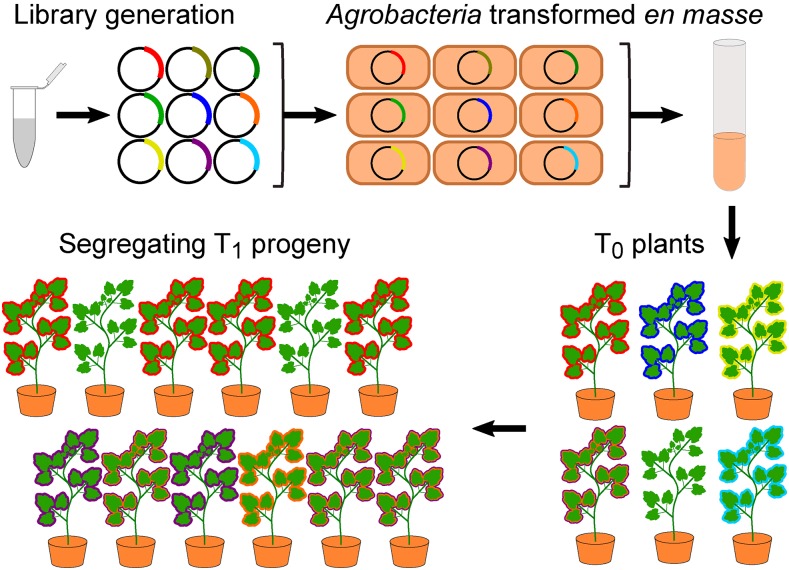
The concept of using a pooled CRISPR library screen in plants. A pool of CRISPR vectors is cloned, maintained as a library in A. tumefaciens, and transformed en masse into a plant system. The resulting T0 plants will generally contain a single T-DNA insertion and a mutation in a single gene (colored outline). Identification of the target genes can be accomplished by sequencing the incorporated gRNA(s). Some plants will not be mutated (wild type; no outline), and ∼20% of plants will contain multiple mutations due to multiple T-DNA insertions (multicolor outline). The T0 plants will give rise to T1 lines segregating for mutant and wild-type alleles and can be used in functional screens or to establish true-breeding mutant lines for future characterization.
Figure 2.
Figure 2.
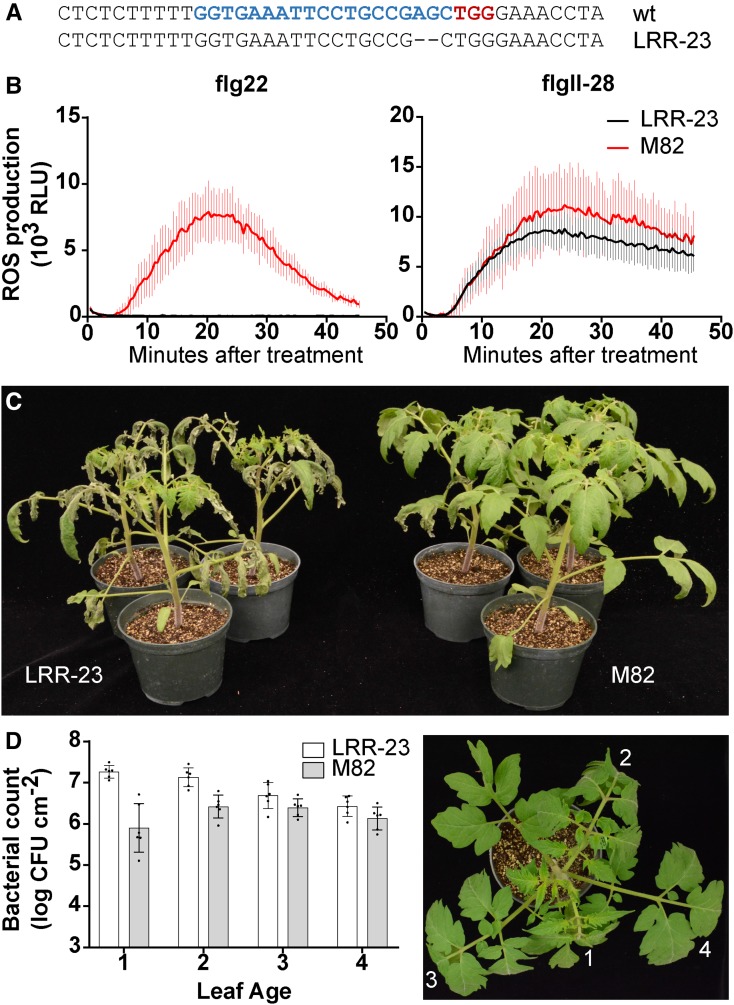
Fls2.1 is required for flg22 perception and disease resistance. A, Alignment of the wild-type (wt) Fls2.1 target sequence and a 2-bp deletion in LRR-23. The protospacer is in blue, and the PAM is in red. B, Leaf discs were treated with the peptide flg22 or flgII-28, and the production of ROS was measured over time. Values are averages ± sd of 14 LRR-23 T1 plants and four M82sp+ plants. Four leaf discs per plant were used for flg22, and two leaf discs per plant were used for flgII-28. Graphs were generated by GraphPad Prism 7. RLU, Relative light units. C, Disease symptoms on LRR-23 T1 plants 3 d after vacuum infiltration with 3.5 × 10⁵ colony-forming units (CFU) mL−1 P. syringae DC3000∆avrPto∆avrPtoB. D, Bacterial growth measured on leaves at different developmental stages. Leaf discs were taken 2 d after vacuum infiltration with 3.5 × 10⁴ CFU mL−1 DC3000∆avrPto∆avrPtoB. Bars are averages ± sd for six plants per genotype. Individual values are represented as dots. Graphs were generated by GraphPad Prism 7.
Figure 3.
Figure 3.
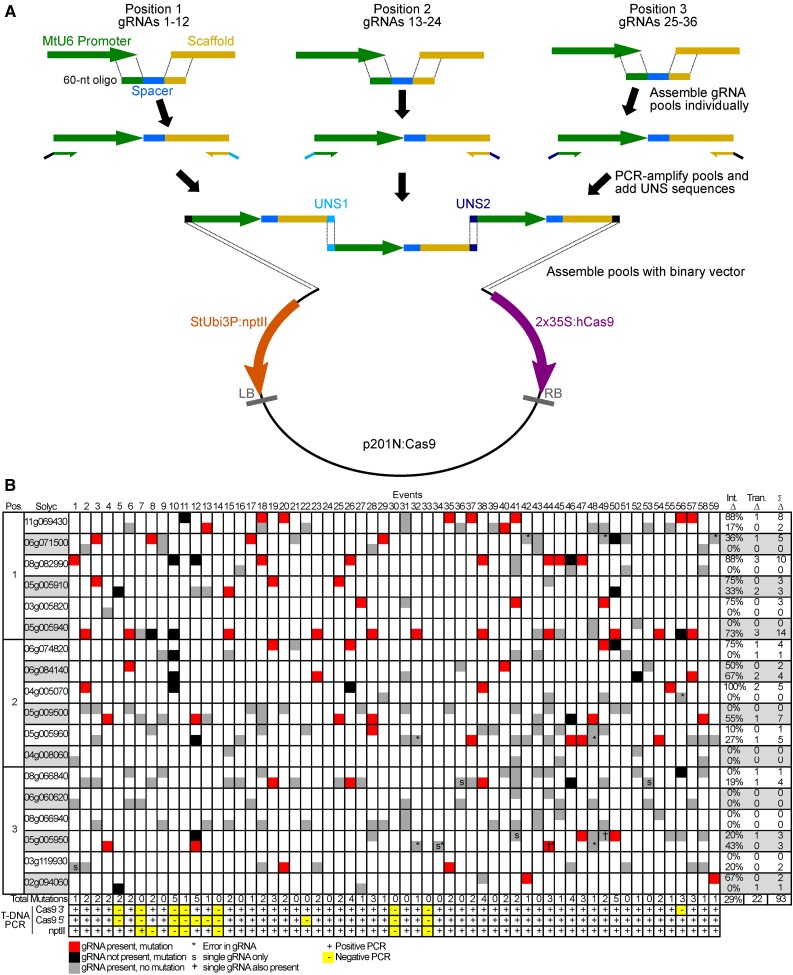
Higher order transporter library scheme. A, Twelve gRNAs, targeting six genes, were pooled and assembled per gRNA position. Amplification with primers containing unique nucleotide sequences (Torella et al., 2014) allowed for specific positioning of the gRNAs in the final DNA assembly step. B, All 59 transporter events were checked for mutations at all 36 targeted loci and incorporation of the T-DNA. Average mutant values are reported for integrated gRNAs (Int. ∆), total transient mutations (Tran. ∆), and total mutations (∑∆).
Figure 4.
Figure 4.
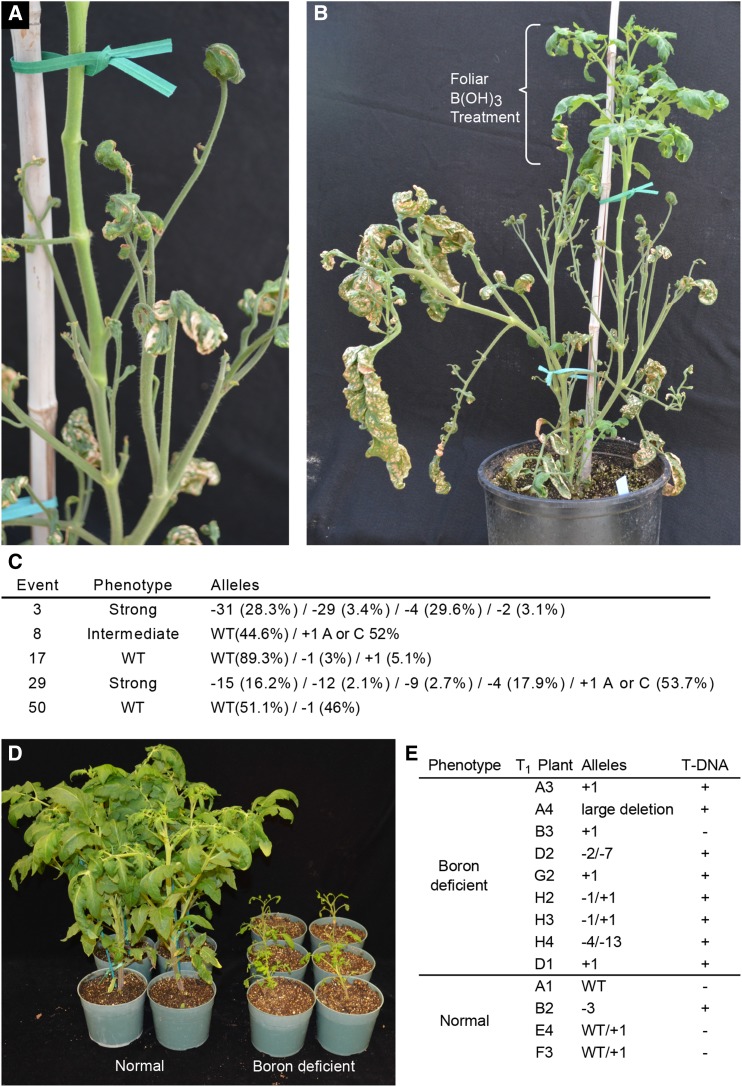
Mutations in Solyc06g071500 are associated with a boron-deficient phenotype. A, The T0 transporter-3 showed a strong aberrant phenotype similar to boron deficiency. B, Daily foliar treatments with 100 µm boric acid allowed the plant to recover and set fruit. C, Events with boron-deficient phenotypes are associated with mutations in Solyc06g071500. Estimated allele frequencies are from TIDE analysis. D, Transporter-8 T1 plants segregate for the boron-deficient phenotype. E, Normal T1 plants contain a functional wild-type (WT) copy or an in-frame deletion, and all boron-deficient plants contain only frame-shift alleles.
Figure 5.
Figure 5.
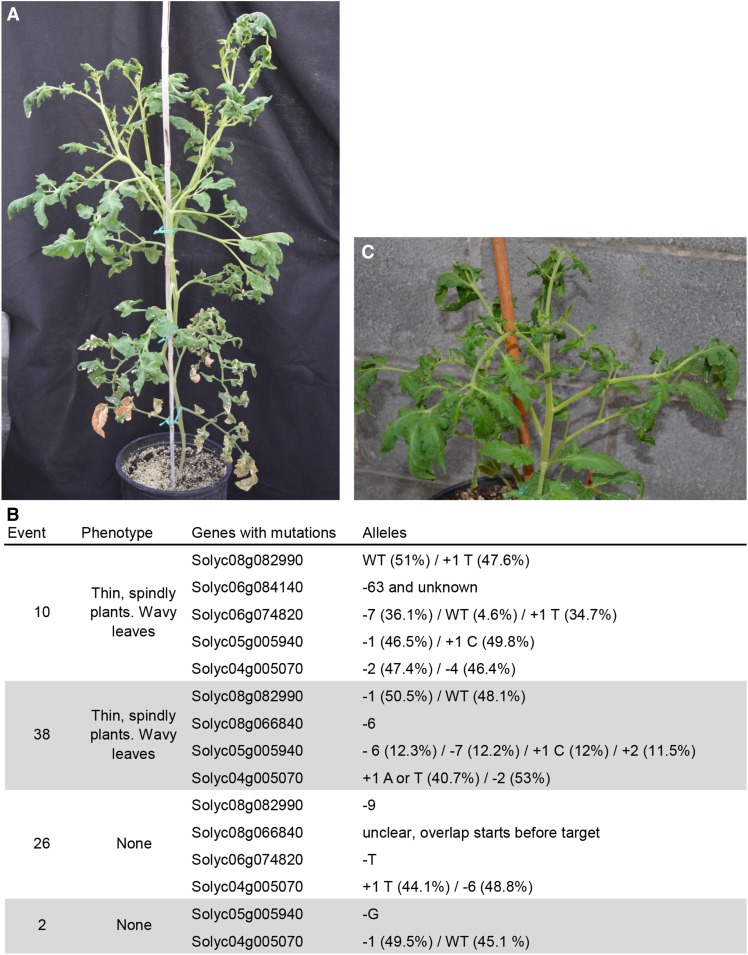
Mutations in Solyc04g005070 are associated with an aberrant phenotype. A, T0 transporter-38 showing the open architecture, elongated internodes, and rippled or wavy leaves. B, Transporter-10 and -38 have the same phenotype and are the only events with biallelic mutations in Solyc04g005070. WT, Wild type. C, A transporter-2 T1 progeny with a homozygous 2-bp deletion shows the same aberrant phenotype.

References

    1. Andolfo G, Jupe F, Witek K, Etherington GJ, Ercolano MR, Jones JD (2014) Defining the full tomato NB-LRR resistance gene repertoire using genomic and cDNA RenSeq. BMC Plant Biol 14: 120. - PMC - PubMed
    1. Belhaj K, Chaparro-Garcia A, Kamoun S, Nekrasov V (2013) Plant genome editing made easy: targeted mutagenesis in model and crop plants using the CRISPR/Cas system. Plant Methods 9: 39. - PMC - PubMed
    1. Berardini TZ, Reiser L, Li D, Mezheritsky Y, Muller R, Strait E, Huala E (2015) The Arabidopsis Information Resource: making and mining the “gold standard” annotated reference plant genome. Genesis 53: 474–485 - PMC - PubMed
    1. Bortesi L, Fischer R (2015) The CRISPR/Cas9 system for plant genome editing and beyond. Biotechnol Adv 33: 41–52 - PubMed
    1. Brinkman EK, Chen T, Amendola M, van Steensel B (2014) Easy quantitative assessment of genome editing by sequence trace decomposition. Nucleic Acids Res 42: e168. - PMC - PubMed