. 2017 Jun 23;7(1):4214.
doi: 10.1038/s41598-017-04086-w.

Upregulation of circulating microRNA-134 in adult-onset Still's disease and its use as potential biomarker

Affiliations

Upregulation of circulating microRNA-134 in adult-onset Still's disease and its use as potential biomarker

Tsai-Ling Liao et al. Sci Rep. .

Abstract

Adult-onset Still's disease (AOSD) is a multi-systemic inflammatory disorder of unknown etiology. To date, no single diagnostic test is available for AOSD. Herein, we investigated the pathogenic role of microRNAs in AOSD. MicroRNA profiles in plasma from AOSD patients and healthy controls were analyzed by microarray analysis, followed by quantitative reverse transcription PCR validation. The biological functions of microRNAs were evaluated using in vitro cell-based assay. Among the differentially expressed microRNAs, microRNA-134 (miR-134) expression was positively correlated with AOSD activity scores and significantly decreased after effective treatment. An increased miR-134 level is significantly associated with the activation of Toll-like receptor 3 (TLR3). The reporter assay identified IL-18 binding protein (IL-18BP) as the target of miR-134. A negative correlation between miR-134 expression and IL-18BP mRNA levels were detected in peripheral blood cells following TLR3 ligand treatment. Lower plasma IL-18BP levels and higher IL-18 levels were also observed in active AOSD patients who had higher miR-134 expression than inactive patients. Upregulation of circulating miR-134 was associated with elevated IL-18 levels by targeting IL-18BP in AOSD patients and was positively correlated with disease activity, suggesting its involvement in AOSD pathogenesis. MiR-134 may be a novel activity indicator or potential prognostic biomarker in AOSD.


Conflict of interest statement

The authors declare that they have no competing interests.

Figures
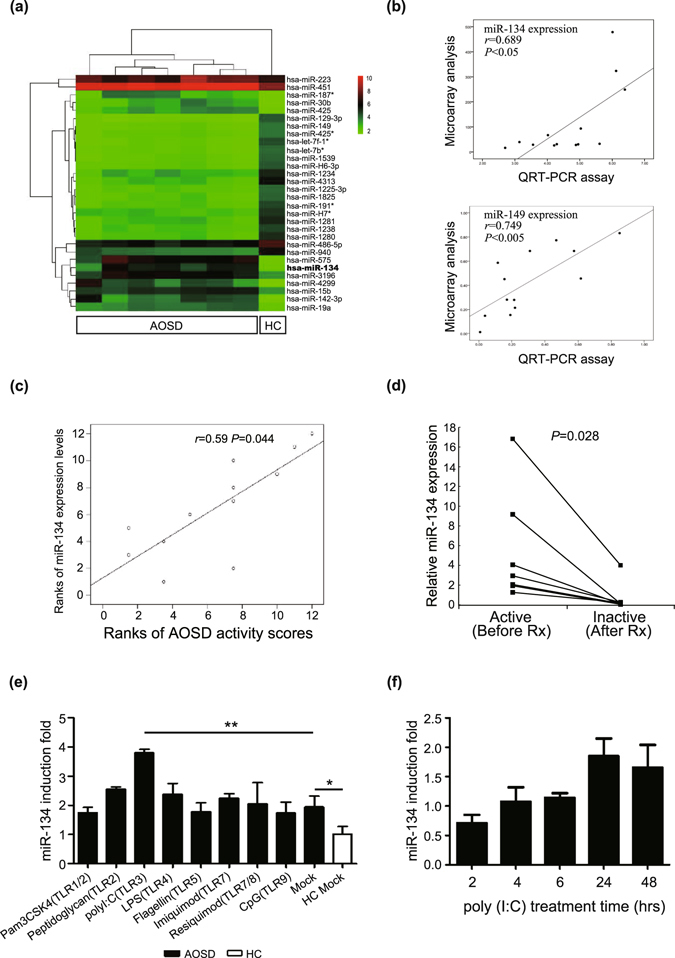
Figure 1
Figure 1
Increased microRNA-134 (miR-134) levels in patients with active adult-onset Still’s disease (AOSD) is associated with disease activity and induced by Toll-like receptor 3 (TLR3) ligand stimulation. (a) The differentially expressed microRNAs (miRNAs) in plasma from patients with AOSD and healthy controls (HC) identified using microarray analysis. Hierarchical clustering of miRNA profiles in AOSD patients group and HC group. Relative expression levels of miRNAs are depicted according to a color scale (red represents relative expression greater than the median expression level across all samples and green represents an expression level lower than the median). (b) Validation of miRNA microarray with quantitative reverse transcription PCR (QRT-PCR) for the two randomly selected differentially expressed miRNAs in AOSD patients. (c) A significant correlation between disease activity and miR-134 expression determined by QRT-PCR assay in AOSD patients. (d) Significant decreases in miR-134 expression levels paralleled the clinical remission in AOSD patients after 6 months of therapy. (e) Analysis of miR-134 expression in response to a panel of innate immunity Toll-like receptors (TLRs) ligands stimulation. The peripheral blood mononuclear cells (PBMCs) from patients with AOSD were treated with the indicated stimuli for 24 h. MiR-134 expression was analyzed by QRT-PCR and normalized using Rnu6 levels. (f) Kinetics of TLR3 ligand induction of miR-134.
Figure 2
Figure 2
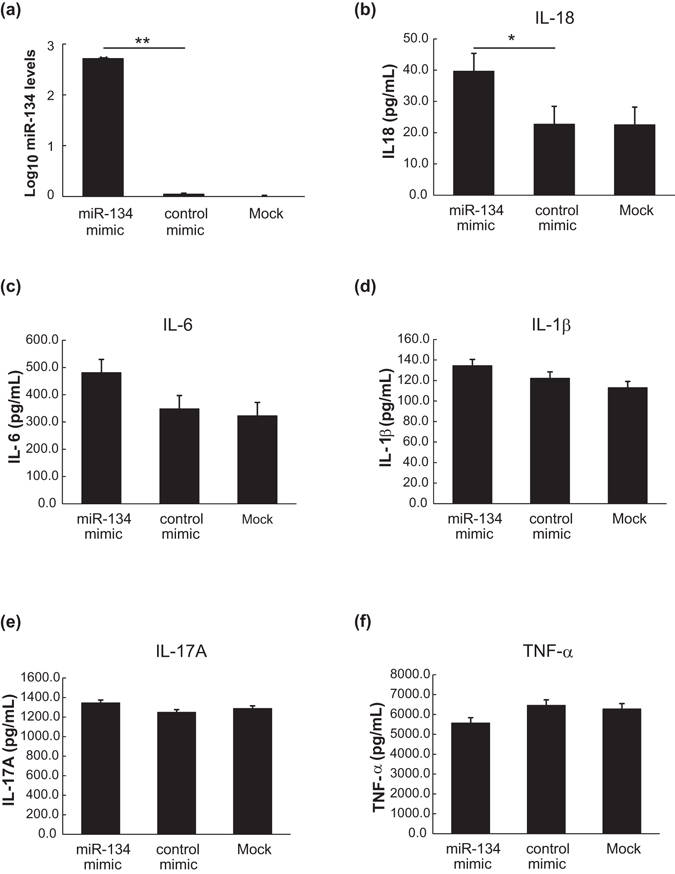
A close link of microRNA-134 (miR-134) expression with levels of IL-18. (a) Comparison of miR-134 expression levels in miR-134 mimic-transfected cells, in control-transfected cells, or in non-transfection cells (mock). Comparison of supernatant levels of proinflammatory cytokines including (b) IL-18, (c) IL-6, (d) IL-1β, (e) IL-17A, and (f) TNF-α released in miR-134 mimic-expressing cells, in mimic control-expressing, and in non-transfection cells (mock) after 24 hours of transfection. Data are presented as mean ± SEM. *P < 0.05, versus mimic control-expressing or in non-transfection cells, determined by the ANOVA test with Scheffe correction.
Figure 3
Figure 3
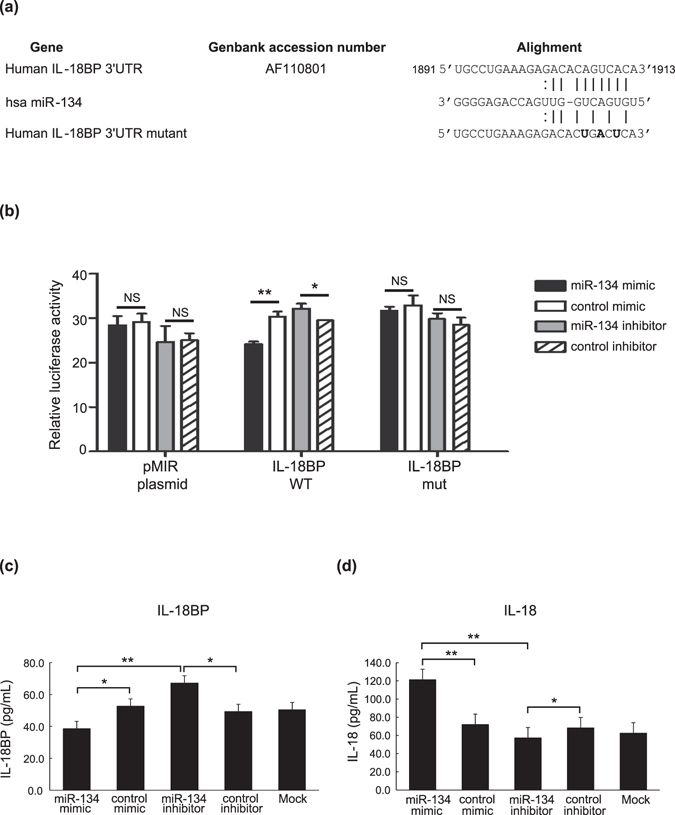
MicroRNA-134 (miR-134) targets IL-18 binding protein (IL-18BP). (a) The potential target for miR-134 was IL-18BP. Sequence alignment of miR-134 with reverse complementary IL-18BP (http://www.microrna.org). (b) 293 T cells were co-transfected with IL-18BP 3′UTR wild type (WT), IL-18BP 3′UTR mutant or empty pMIR-REPORT vector and pTK-RL plasmid, together with miR-134 mimic/mimic control or miR-134 inhibitor/inhibitor control. After 36 h, luciferase activities were measured and normalized by Renilla luciferase activity. Data are presented as mean ± SEM. *P < 0.05, **P < 0.01. NS, non-statistical significant. Comparison of supernatant levels of IL-18BP (c) or IL-18 (d) released in THP-1 cells transfected with miR-134 mimic, miR-134 inhibitor, mimic/inhibitor control, or non-transfection cells (mock). Data are presented as mean ± SEM. *P < 0.05, **P < 0.01, versus miR-134 inhibitor, mimic/inhibitor control, or non-transfection cells (mock), determined by the Student’s t-test.
Figure 4
Figure 4
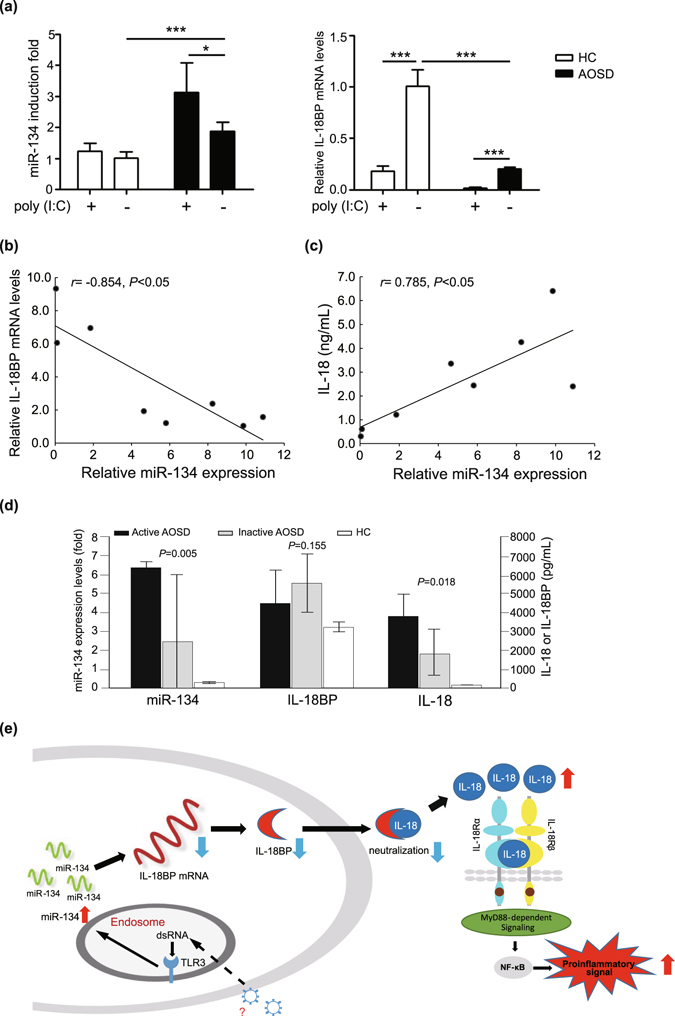
Toll-like receptor 3 (TLR3) ligand-induced miR-134 contributes elevated free interleukin-18 (IL-18) levels by targeting interleukin-18 binding protein (IL-18BP). (a) TLR3 ligand poly (I:C) stimulation induced miR-134 up-regulation (left panel), caused significantly reduced IL-18BP mRNA levels (right panel) in PBMCs from AOSD patients or healthy controls (HC). Data are presented as mean ± SEM. *P < 0.05, ***P < 0.005. Correlation between miR-134 expressions and IL-18BP mRNA levels (b) or IL-18 levels (c) in AOSD patients is determined by Spearman’s correlation test. (d) Comparison of expression levels of miR-134, IL-18, and IL-18BP in active AOSD patients, inactive AOSD patients, and HC. Data are presented as mean ± SEM. (e) Proposed model for the biologic role of miR-134 in increased level of free IL-18 by targeting IL-18BP in an inflammatory response of AOSD based on the results of this study and previous reports. MyD88, myeloid differentiation primary-response protein 88; NF-ĸB, nuclear factor ĸB.

References

    1. Bartel DP. MicroRNAs: genomics, biogenesis, mechanism, and function. Cell. 2004;116:281–297. doi: 10.1016/S0092-8674(04)00045-5. - DOI - PubMed
    1. Krol J, Loedige I, Filipowicz W. The widespread regulation of microRNA biogenesis, function, and decay. Nat Rev Genet. 2010;11:597–610. - PubMed
    1. Wei B, Pei G. MicroRNAs: critical regulators in Th17 cells and players in diseases. Cell Mol Immunol. 2010;7:175–181. doi: 10.1038/cmi.2010.19. - DOI - PMC - PubMed
    1. Kozomara A, Griffiths-Jones S. miRBase: annotating high confidence microRNAs using deep sequencing data. Nucleic Acids Res. 2013;42:D68–73. doi: 10.1093/nar/gkt1181. - DOI - PMC - PubMed
    1. Sonkoly E, Pivarcsi A. Advances in microRNAs: implications for immunity and inflammatory disease. J Cell Mol. 2009;13:24–38. doi: 10.1111/j.1582-4934.2008.00534.x. - DOI - PMC - PubMed

Publication types

MeSH terms

LinkOut - more resources