


Newborn screening for Fabry disease in the north-west of Spain
- PMID: 28646478
- PMCID: PMC5511307
- DOI: 10.1007/s00431-017-2950-8
Newborn screening for Fabry disease in the north-west of Spain
Abstract
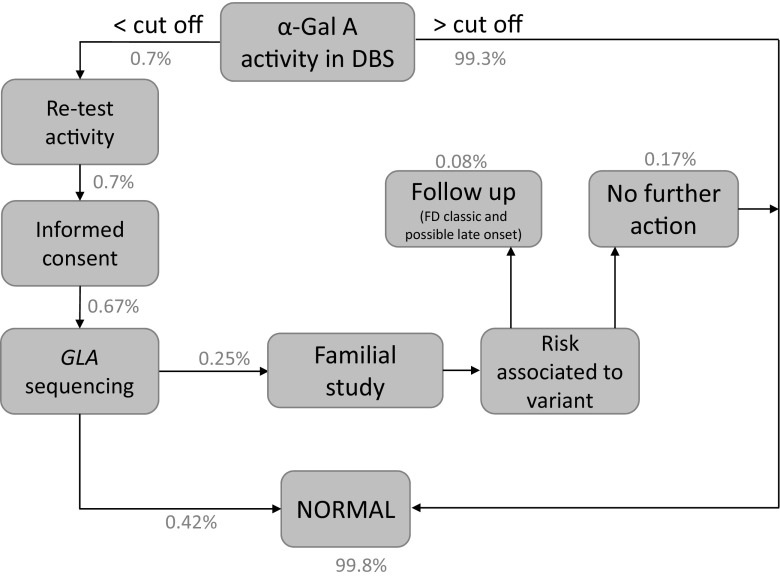
Fabry disease is an X-linked lysosomal storage disorder caused by the impairment of α-galactosidase A. Enzyme replacement therapy is available to treat patients, who often experience delayed diagnosis. A newborn screening for Fabry disease was performed to study the prevalence of the pathology and to evaluate the possibility to implement the test in systematic screenings. We collected 14,600 dried blood spot samples (7575 males and 7025 females) and carried out a diagnostic study by fluorometric measurement of α-galactosidase A enzymatic activity and GLA gene sequencing. We detected one patient with a mutation in GLA associated with classical Fabry Disease (M290I), ten subjects carrying genetic variants of uncertain diagnosis (S126G, R118C, A143T), and a girl with the non-characterized variant F18Y, which was not previously described. Additional 25 samples presented nucleotide substitutions described as polymorphisms (D313Y, rs2071225, and rs2071397). The estimated prevalence for Fabry disease in north-western Spanish males is of 0.013%.
Conclusion: These results confirm that the prevalence of Fabry disease is underestimated and systematic screening is feasible; however, further characterization of variants of uncertain clinical significance is necessary to establish protocols of patients' management. What is Known: • Fabry disease is a rare disease of delayed diagnosis, whose prevalence is underestimated. However, early diagnosis is important for better efficiency of the current available treatment. What is New: • This newborn screening for Fabry disease performed on Spanish population reveals a prevalence of genetic alterations in GLA of 0.1% in males (0.013% with classic Fabry disease) and also characterizes these modifications in order to discriminate between pathogenic mutations and genetic variants of unknown significance.
Keywords: Fabry disease; Genetic variants of unknown significance; Lysosomal storage diseases; Newborn screening.
Conflict of interest statement
Conflict of interest
Saida Ortolano has collaborated in projects sponsored by the pharmaceutical company Shire Ibérica Human Genetic Therapies. She has also been invited to attend or give a conference by Shire Ibérica Human Genetic Therapies. Cristobal Colon and Maria L. Couce organized and participated in a meeting sponsored by Shire Ibérica Human Genetic Therapies.
Ethical approval
The study has been approved by the Healthcare Ethics Committee of Santiago de Compostela University Hospital.
All procedures performed in studies involving human participants were in accordance with the ethical standards of the institutional and/or national research committee and with the 1964 Helsinki declaration and its later amendments or comparable ethical standards.
Informed consent
Legal tutors signed informed consent for all under-age subjects participating in this study. All adults enrolled in the study to perform the family analysis also signed the informed consent.
Availability of data and material
The datasets generated and/or analyzed during the current study are not publicly available to preserve privacy of the involved patients but are available from the first author or the corresponding author on reasonable request.
Funding
This studied was founded by the Spanish National Institute of Health-Instituto Carlos III/EU-FEDER, grant no. PI11-00842, to Ortolano S. and FEEL Foundation to Cristobal Colón.
Figures
References
Publication types
MeSH terms
Substances
LinkOut - more resources
Full Text Sources
Other Literature Sources
Medical
