Review
. 2017 Oct;152(2):195-206.
doi: 10.1111/imm.12780. Epub 2017 Jul 24.

Vaccine candidate discovery for the next generation of malaria vaccines

Affiliations
Review

Vaccine candidate discovery for the next generation of malaria vaccines

James Tuju et al. Immunology. 2017 Oct.

Abstract

Although epidemiological observations, IgG passive transfer studies and experimental infections in humans all support the feasibility of developing highly effective malaria vaccines, the precise antigens that induce protective immunity remain uncertain. Here, we review the methodologies applied to vaccine candidate discovery for Plasmodium falciparum malaria from the pre- to post-genomic era. Probing of genomic and cDNA libraries with antibodies of defined specificities or functional activity predominated the former, whereas reverse vaccinology encompassing high throughput in silico analyses of genomic, transcriptomic or proteomic parasite data sets is the mainstay of the latter. Antibody-guided vaccine design spanned both eras but currently benefits from technological advances facilitating high-throughput screening and downstream applications. We make the case that although we have exponentially increased our ability to identify numerous potential vaccine candidates in a relatively short space of time, a significant bottleneck remains in their validation and prioritization for evaluation in clinical trials. Longitudinal cohort studies provide supportive evidence but results are often conflicting between studies. Demonstration of antigen-specific antibody function is valuable but the relative importance of one mechanism over another with regards to protection remains undetermined. Animal models offer useful insights but may not accurately reflect human disease. Challenge studies in humans are preferable but prohibitively expensive. In the absence of reliable correlates of protection, suitable animal models or a better understanding of the mechanisms underlying protective immunity in humans, vaccine candidate discovery per se may not be sufficient to provide the paradigm shift necessary to develop the next generation of highly effective subunit malaria vaccines.

Keywords: Plasmodium falciparum; antibodies; bioinformatics; vaccines.


Figures

Figure 1
Figure 1
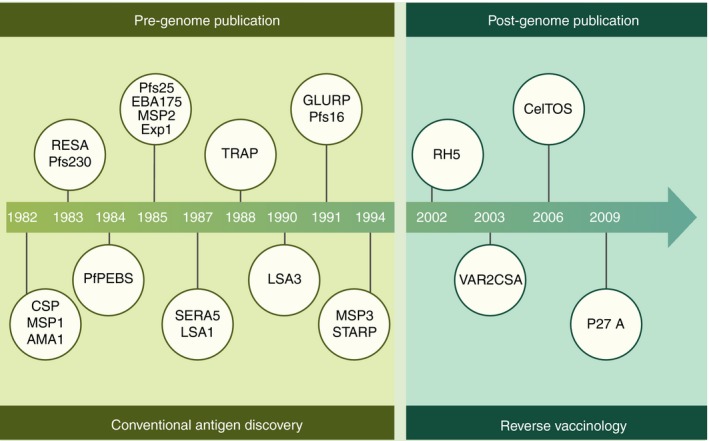
Historical timeline of vaccine candidate discovery for antigens under evaluation in clinical trials. Only 22 of the > 5400 proteins encoded in the Plasmodium falciparum genome are under evaluation in clinical trials. The majority of these were discovered in the pre‐genomic era. As illustrated for circumsporozoite protein, multiple trials for the same antigen have been conducted using different platforms and adjuvants, and in combination with a small number of other well‐studied parasite antigens. Adapted from the WHO Rainbow Tables http://www.who.int/immunization/research/development/Rainbow_tables/en/.44, 45, 46, 54, 56, 58, 59, 61, 105, 106, 107, 108, 109, 110, 111, 112, 113, 114, 115, 116, 117
Figure 2
Figure 2
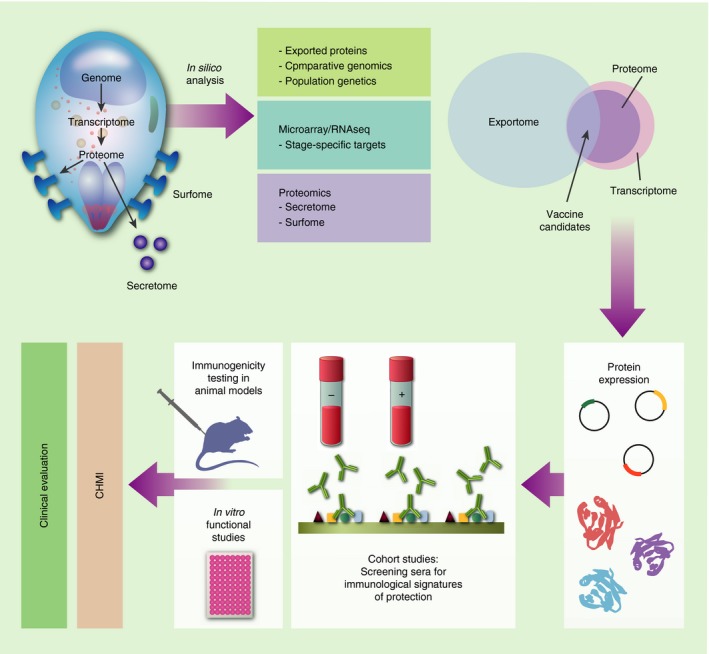
Reverse vaccinology 1·0. In the post‐genomic era, discovery of vaccine candidates is increasingly reliant on an integrated analysis of the genomic, transcriptomic and proteomic data sets. The targets that are prioritized through this approach are subsequently validated in the laboratory using in vitro assays, cohort studies and animal models before testing for immunogenicity and efficacy in humans.
Figure 3
Figure 3
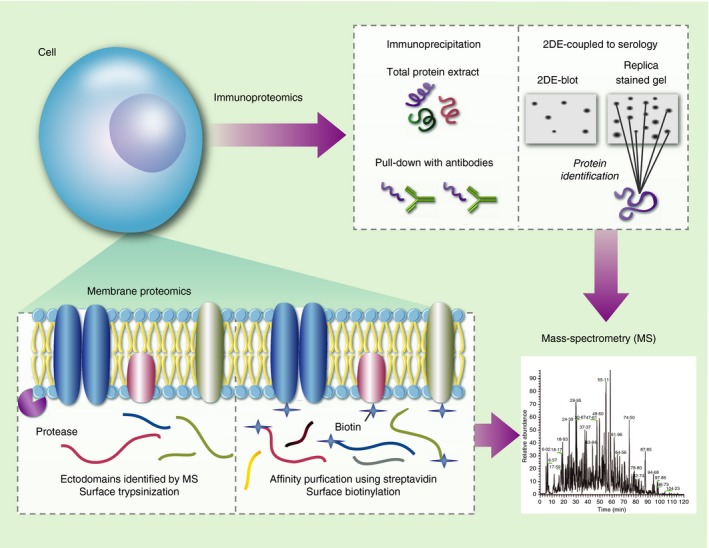
Proteomic‐based vaccine candidate discovery. This strategy identifies proteins that interact with the host immune system or that are localized to the surface of pathogens. Proteins bound to antibodies are either immune‐precipitated directly from complex mixtures or separated by two‐dimensional gel electrophoresis before probing with antibodies and identification by mass spectrometry. In surface trypsinization or surfomics, intact membranes are exposed to short‐term treatment with proteases resulting in the release of protein ectodomains. Surface proteins can also be selectively tagged with a cell‐membrane‐impermeable biotin reagent and affinity purified using streptavidin.
Figure 4
Figure 4
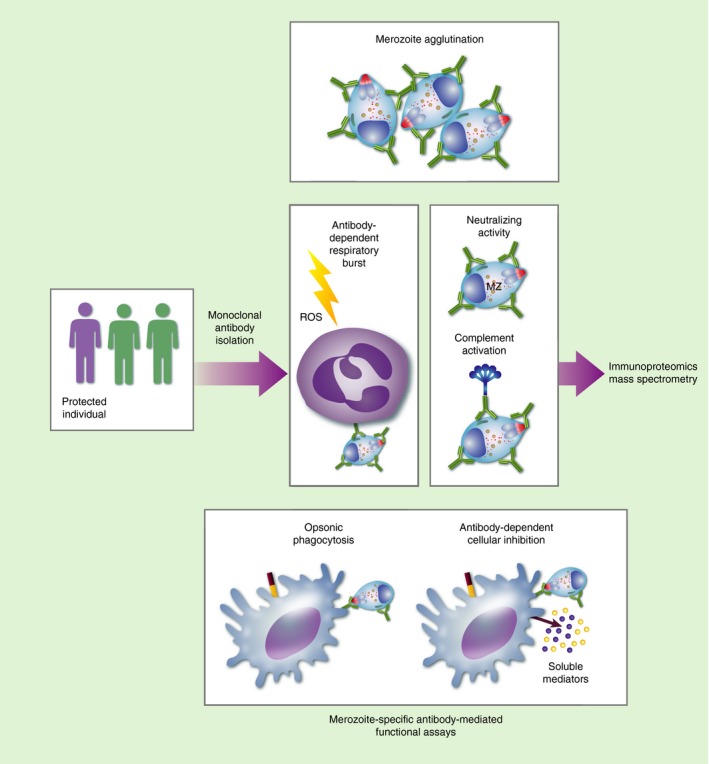
Functional antibody‐guided vaccine candidate discovery. Malaria immune donors are identified and human monoclonal antibodies are isolated from memory B cells or plasma cells. The monoclonal antibodies are screened for effector functions targeting stages of the parasite life cycle such as merozoites in assays of agglutination, neutralizing activity, complement activation, antibody‐dependent respiratory burst and antibody‐dependent cellular inhibition. Antigens or epitopes targeted by functional antibodies are identified by immunoproteomic approaches and mass spectrometry.

References

    1. WHO , Chan M. 2016. World Malaria report.
    1. Strode C, Donegan S, Garner P, Enayati AA, Hemingway J. The impact of pyrethroid resistance on the efficacy of insecticide‐treated bed nets against African Anopheline mosquitoes: systematic review and meta‐analysis. PLoS Med 2014; 11:e1001619. - PMC - PubMed
    1. Hemingway J. The role of vector control in stopping the transmission of malaria: threats and opportunities. Philos Trans R Soc Lond B Biol Sci 2014; 369:20130431. - PMC - PubMed
    1. Ménard D, Khim N, Beghain J, Adegnika AA, Shafiul‐Alam M, Amodu O et al A worldwide map of Plasmodium falciparum K13‐propeller polymorphisms. N Engl J Med 2016; 374:2453–64. - PMC - PubMed
    1. Cohen JM, Smith DL, Cotter C, Ward A, Yamey G, Sabot OJ et al Malaria resurgence: a systematic review and assessment of its causes. Malar J 2012; 11:122. - PMC - PubMed

Publication types

MeSH terms

LinkOut - more resources