. 2017 Jul 5;139(26):9053-9065.
doi: 10.1021/jacs.7b05011. Epub 2017 Jun 24.

Practical, Broadly Applicable, α-Selective, Z-Selective, Diastereoselective, and Enantioselective Addition of Allylboron Compounds to Mono-, Di-, Tri-, and Polyfluoroalkyl Ketones

Affiliations

Practical, Broadly Applicable, α-Selective, Z-Selective, Diastereoselective, and Enantioselective Addition of Allylboron Compounds to Mono-, Di-, Tri-, and Polyfluoroalkyl Ketones

Farid W van der Mei et al. J Am Chem Soc. .

Abstract

A practical method for enantioselective synthesis of fluoroalkyl-substituted Z-homoallylic tertiary alcohols has been developed. Reactions may be performed with ketones containing a polylfluoro-, trifluoro-, difluoro-, and monofluoroalkyl group along with an aryl, a heteroaryl, an alkenyl, an alkynyl, or an alkyl substituent. Readily accessible unsaturated organoboron compounds serve as reagents. Transformations were performed with 0.5-2.5 mol % of a boron-based catalyst, generated in situ from a readily accessible valine-derived aminophenol and a Z- or an E-γ-substituted boronic acid pinacol ester. With a Z organoboron reagent, additions to trifluoromethyl and polyfluoroalkyl ketones proceeded in 80-98% yield, 97:3 to >98:2 α:γ selectivity, >95:5 Z:E selectivity, and 81:19 to >99:1 enantiomeric ratio. In notable contrast to reactions with unsubstituted allylboronic acid pinacol ester, additions to ketones with a mono- or a difluoromethyl group were highly enantioselective as well. Transformations were similarly efficient and α- and Z-selective when an E-allylboronate compound was used, but enantioselectivities were lower. In certain cases, the opposite enantiomer was favored (up to 4:96 er). With a racemic allylboronate reagent that contains an allylic stereogenic center, additions were exceptionally α-selective, affording products expected from γ-addition of a crotylboron compound, in up to 97% yield, 88:12 diastereomeric ratio, and 94:6 enantiomeric ratio. Utility is highlighted by gram-scale preparation of representative products through transformations that were performed without exclusion of air or moisture and through applications in stereoselective olefin metathesis where Z-alkene substrates are required. Mechanistic investigations aided by computational (DFT) studies and offer insight into different selectivity profiles.


Figures

Scheme 1
Scheme 1
Relevant Previous Observations
Scheme 2
Scheme 2
Goals of this Study
Scheme 3
Scheme 3
Initial Examination of Reactivity and Selectivity aReactions carried out under N2 atm. Conv and α:γ ratios determined by analysis of 19F NMR spectra of unpurified product mixtures (±2%). Yields for purified α-addition products (±5%). Er determined by HPLC analysis (±1%). Experiments were run in duplicate or more. See the Supporting Information for details.
Scheme 4
Scheme 4
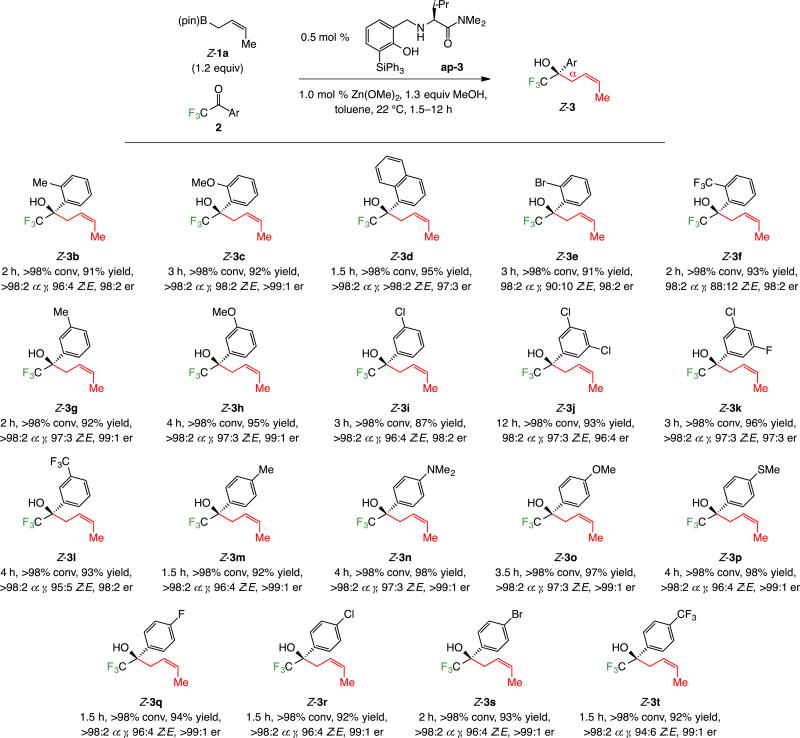
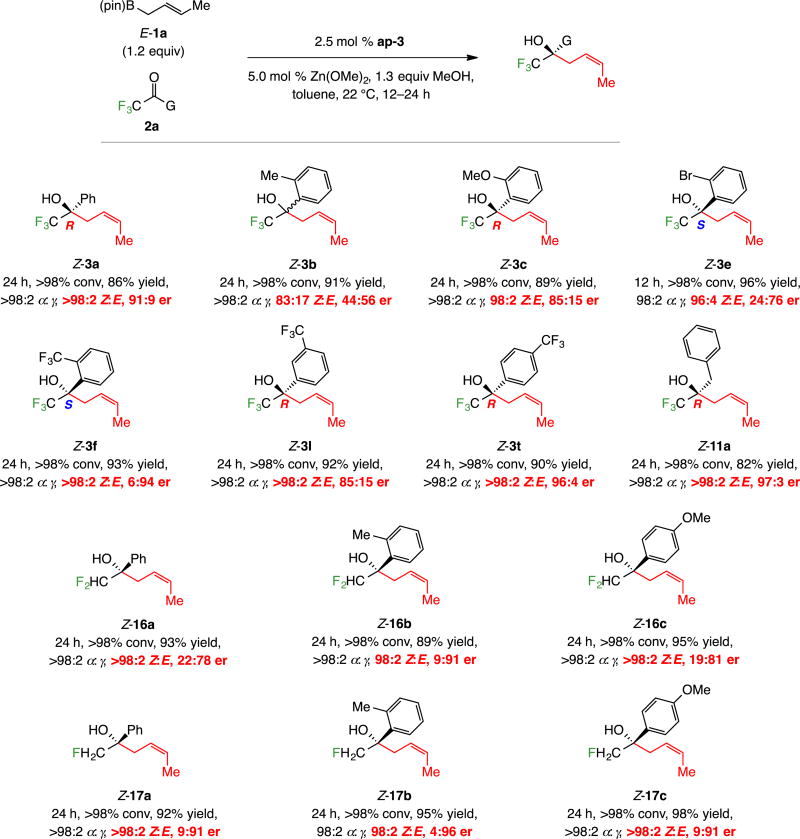
Reactions with Aryl-Substituted Trifluoromethylketonesa aReactions carried out under N2 atm. Conv, α:γ and Z:E ratios determined by analysis of 19F NMR spectra of unpurified product mixtures (±2%). Yields for purified α-addition products (±5%). Er determined by HPLC analysis (±1%). All experiments run in duplicate or more. See the Supporting Information for details.
Scheme 5
Scheme 5
Reactions with Heteroaryl-Substituted Trifluoromethyl Ketonesa aReactions carried out under N2 atm. Conv, α:γ and Z:E ratios determined by analysis of 19F NMR spectra of unpurified product mixtures (±2%). Yields for purified α-addition products (±5%). Er determined by HPLC analysis (±1%). All experiments run in duplicate or more. See the Supporting Information for details.
Scheme 6
Scheme 6
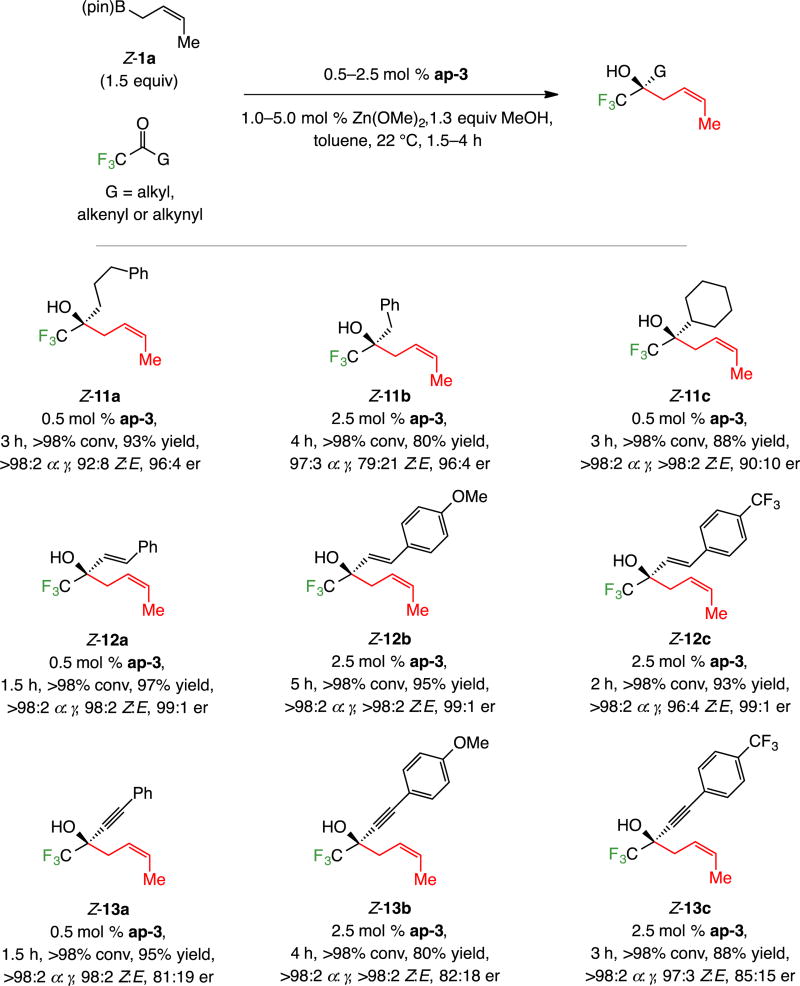
Reactions with Alkyl-, Alkenyl- and Alkynyl-Substituted Trifluoromethyl Ketonesa aReactions carried out under N2 atm. Conv, α:γ and Z:E ratios determined by analysis of 19F NMR spectra of unpurified product mixtures (±2%). Yields for purified α-addition products (±5%). Er determined by HPLC analysis (±1%). All experiments run in duplicate or more. See the Supporting Information for details.
Scheme 7
Scheme 7
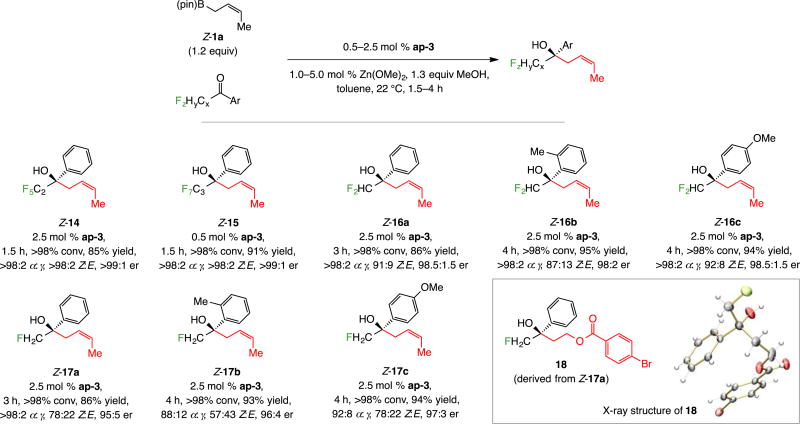
Reactions with Other Fluoroalkyl-Substituted Ketonesa aReactions carried out under N2 atm. Conv, α:γ and Z:E ratios determined by analysis of 19F NMR spectra of unpurified product mixtures (±2%). Yields for purified α-addition products except for 17b–c (±5%). Er determined by HPLC analysis (±1%). All experiments run in duplicate or more. See the Supporting Information for details.
Scheme 8
Scheme 8
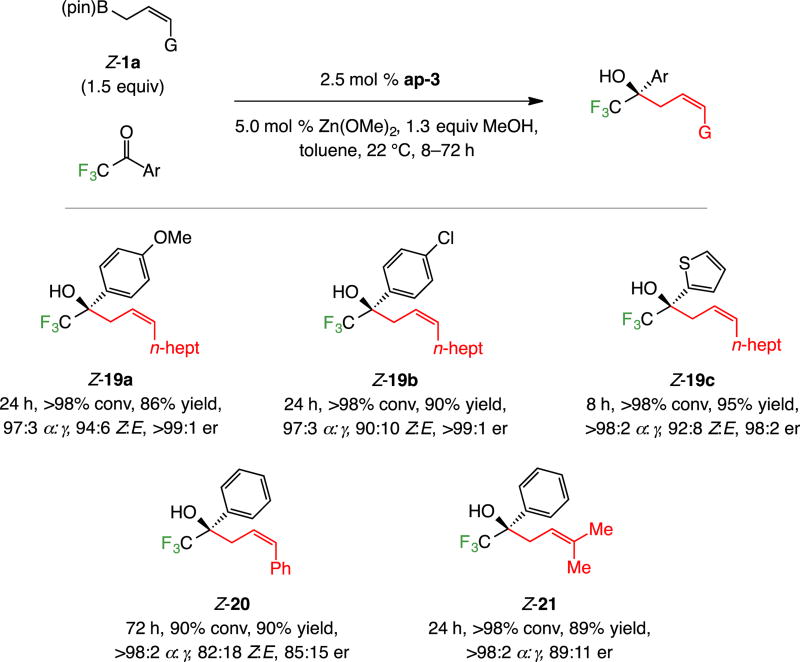
Reactions with Other γ-Substituted Allylboron Reagentsa aReactions carried out under N2 atm. Conv, α:γ and Z:E ratios determined by analysis of 19F NMR spectra of unpurified product mixtures (±2%). Yields are for purified α-addition products (±5%). Er determined by HPLC analysis (±1%). All experiments run in duplicate or more. See the Supporting Information for details.
Scheme 9
Scheme 9
Reactions with Crotylboron Compound E-1a: Substantial Variations in Enantioselectivitya aReactions carried out under N2 atm. Conv, α:γ and Z:E ratios determined by analysis of 19F NMR spectra of unpurified product mixtures (±2%). Yields for purified α-addition products (±5%). Er determined by HPLC analysis (±1%). All experiments were run in duplicate or more. See the Supporting Information for details.
Scheme 10
Scheme 10
Diastereo- and Enantioselective Additions with rac-22a aReactions carried out under N2 atm. Conv, α:γ and Z:E ratios determined by analysis of 19F NMR spectra of unpurified product mixtures (±2%). Yields for purified α-addition products (±5%). Er determined by HPLC analysis (±1%). All experiments run in duplicate or more. See the Supporting Information for details.
Scheme 11
Scheme 11
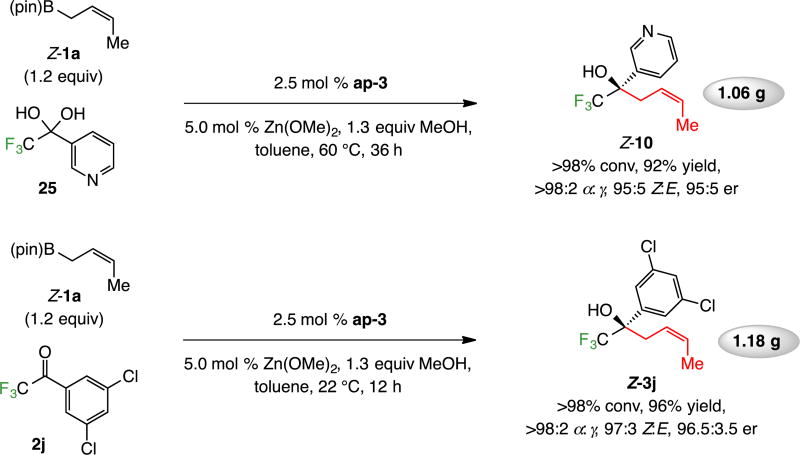
Reactions on Gram Scalea aReactions carried out without inert atmosphere. Conv, α:γ and Z:E ratios determined by analysis of 19F NMR spectra of unpurified product mixtures (±2%). Yields for purified α-addition products (±5%). Er determined by HPLC analysis (±1%). All experiments run in duplicate or more. See the Supporting Information for details.
Scheme 12
Scheme 12
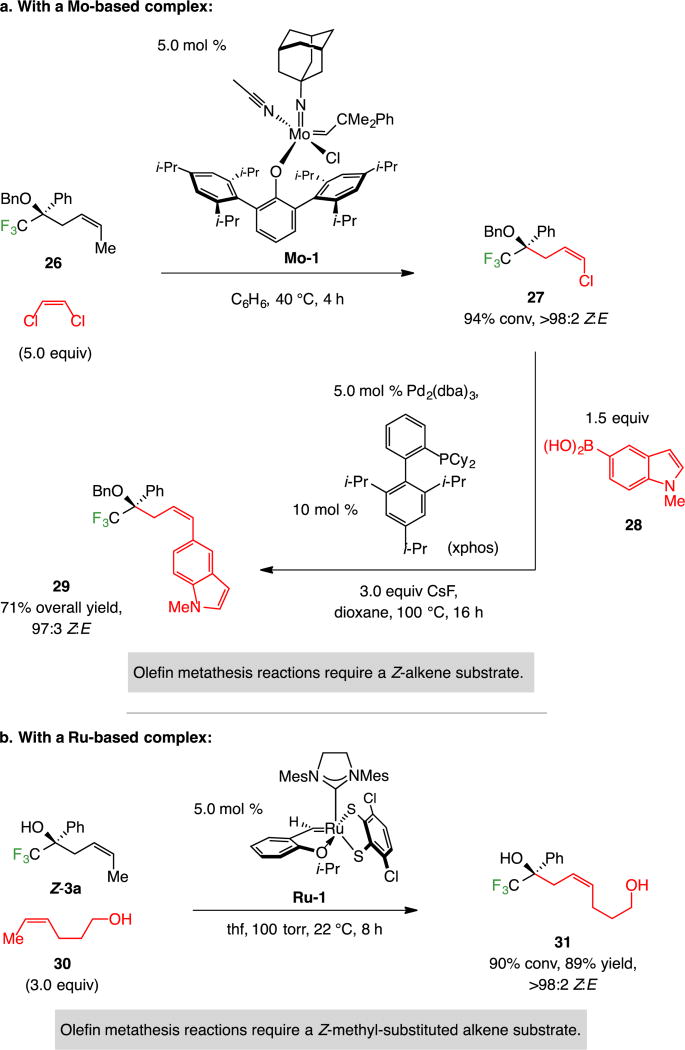
In Combination with Catalytic Z-Selective Cross-Metathesisa aConv and Z:E ratios determined by analysis of 19F NMR spectra of unpurified product mixtures (±2%). Yields are for isolated and purified α-addition products (±5%). All experiments were run in duplicate or more. See the Supporting Information for details.
Scheme 13
Scheme 13
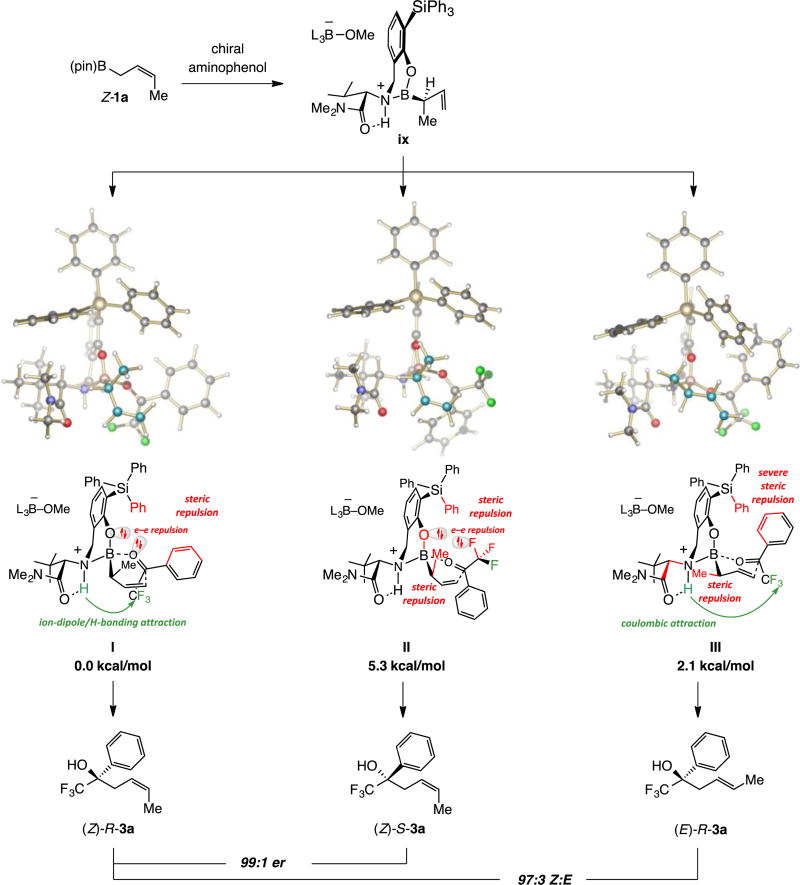
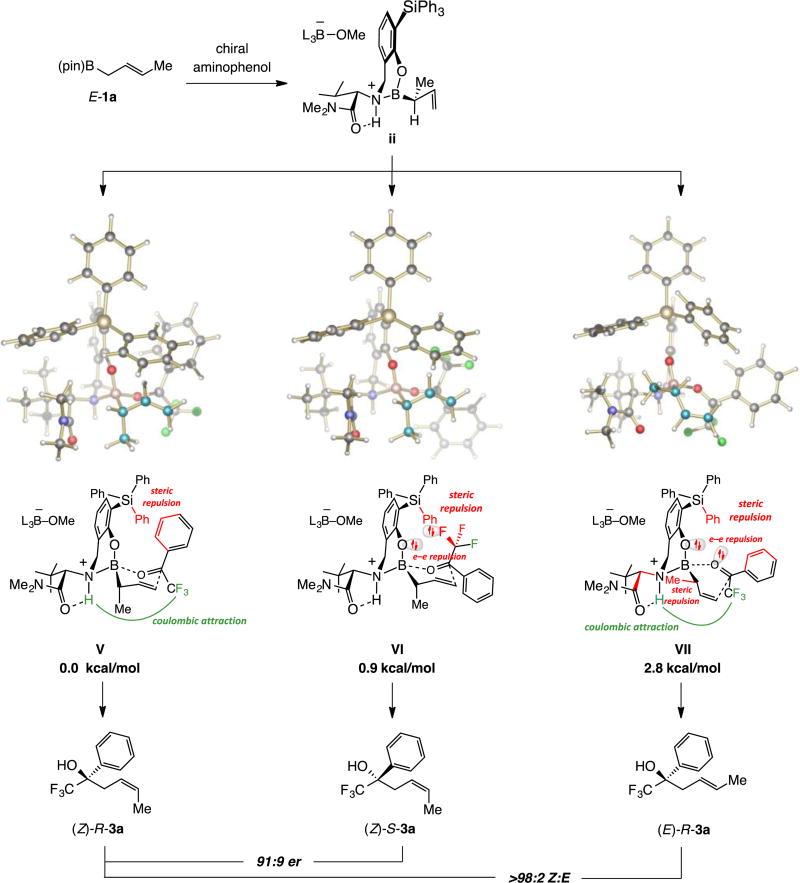
Stereochemical Models Based on DFT Studies with Z-Crotyl–B(pin)a aDFT calculations were performed at the ωB97XD/DEF2TZVPP//ωB97XD/DEF2SVPtoluene(SMD) level. Free energy values for transition states are relative to the most favorable alternative. See the Supporting Information for details.
Scheme 14
Scheme 14
Stereochemical Models Based on DFT Studies with E-Crotyl–B(pin)a aDFT calculations were performed at the ωB97XD/DEF2TZVPP//ωB97XD/DEF2SVPtoluene(SMD) level. Free energy values for transition states are relative to the most favorable alternative. See the Supporting Information for details.
Scheme 15
Scheme 15
Influence of Number of Fluorine Atoms on Stereoselectivitya aReactions carried out under N2 atm. Conv, α:γ and Z:E ratios determined by analysis of 19F NMR spectra of unpurified product mixtures (±2%). Yields are for purified α-addition products (±5%). Er determined by HPLC analysis (±1%). All experiments run in duplicate or more. See the Supporting Information for details.

References

    1. Gillis EP, Eastman KJ, Hill MD, Donnelly DJ, Meanwell NA. J. Med. Chem. 2015;58:8315–8359. - PubMed
    1. Fujiwara T, O’Hagan D. J. Fluorine Chem. 2014;167:16–29.
    1. Berger R, Resnati G, Metrangolo P, Weber E, Hulliger J. Chem. Soc. Rev. 2011;40:3496–3508. - PubMed
    1. Loh TP, Zhou J-R, Li X-R. Tetrahedron Lett. 1999;40:9333–9336.
    2. Zhang X, Chen D, Liu X, Feng X. J. Org. Chem. 2007;72:5227–5233. - PubMed
    3. Haddad TD, Hirayama LC, Taynton P, Singaram B. Tetrahedron Lett. 2008;49:508–511.
    1. For recent reviews on enantioselective synthesis through additions of allyl groups to ketones and imines and their applications, see: Yus M, González-Gómez JC, Foubelo F. Chem. Rev. 2011;111:7774–7854.For corresponding diastereoselective processes, see: Yus M, González-Gómez JC, Foubelo F. Chem. Rev. 2013;113:5595–5698.

Publication types

LinkOut - more resources