


A European randomised controlled trial of the addition of etoposide to standard vincristine and carboplatin induction as part of an 18-month treatment programme for childhood (≤16 years) low grade glioma - A final report
- PMID: 28649001
- PMCID: PMC5517338
- DOI: 10.1016/j.ejca.2017.04.019
A European randomised controlled trial of the addition of etoposide to standard vincristine and carboplatin induction as part of an 18-month treatment programme for childhood (≤16 years) low grade glioma - A final report
Erratum in
-
Corrigendum to "A European randomised controlled trial of the addition of etoposide to standard vincristine and carboplatin induction as part of an 18-month treatment programme for childhood (≤16 years) low grade glioma - A final report" [Eur J of Canc (2017) 206-225].Eur J Cancer. 2018 Feb;90:156-157. doi: 10.1016/j.ejca.2017.11.017. Epub 2017 Dec 14. Eur J Cancer. 2018. PMID: 29248309 Free PMC article. No abstract available.
Abstract
Background: The use of chemotherapy to manage newly diagnosed low grade glioma (LGG) was first introduced in the 1980s. One randomised trial has studied two- versus four-drug regimens with a duration of 12 months of treatment after resection.
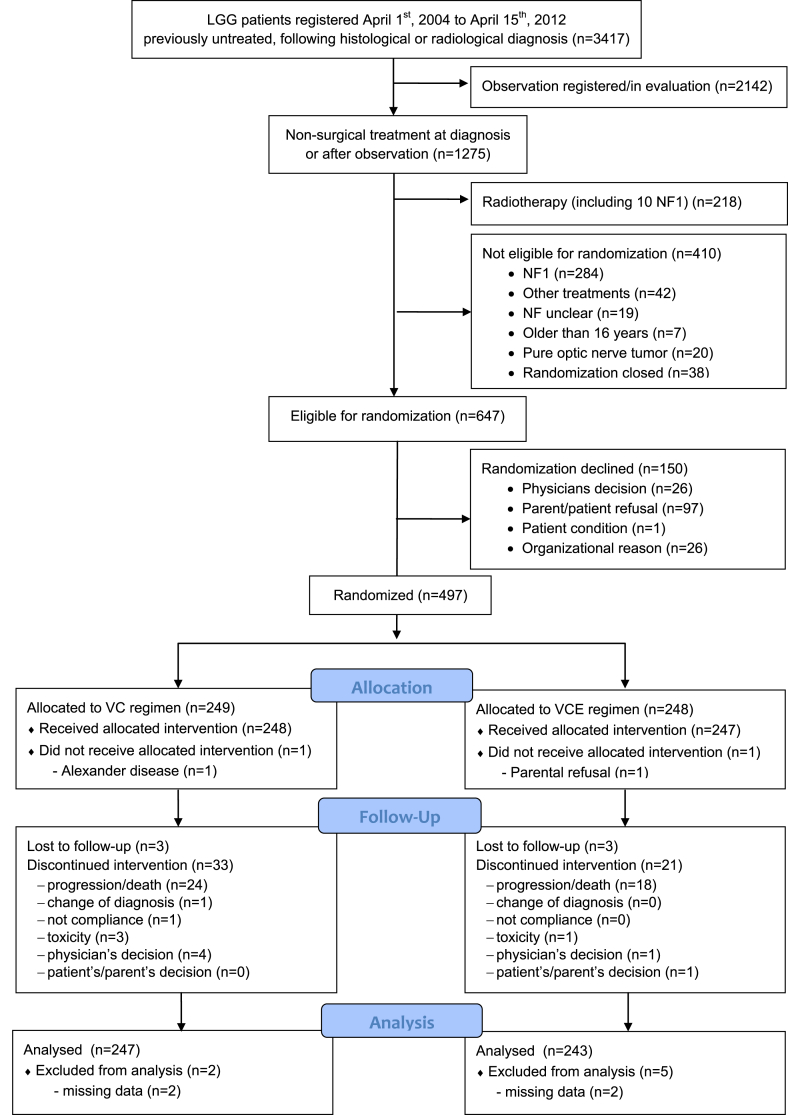
Methods: Within the European comprehensive treatment strategy for childhood LGG, the International Society of Paediatric Oncology-Low Grade Glioma (SIOP LGG) Committee launched a randomised trial involving 118 institutions and 11 countries to investigate the addition of etoposide (100 mg/m2, days 1, 2 & 3) to a four-course induction of vincristine (1.5 mg/m2 × 10 wkly) and carboplatin (550 mg/m2 q 3 weekly) as part of 18-month continuing treatment programme. Patients were recruited after imaging diagnosis, resection or biopsy with progressive disease/symptoms. Some 497 newly diagnosed patients (M/F 231/266; median age 4.26 years (interquartile range (IQR) 2.02-7.06)) were randomised to receive vincristine carboplatin (VC) (n = 249) or VC plus etoposide (VCE) during induction (n = 248), stratified by age and tumour site.
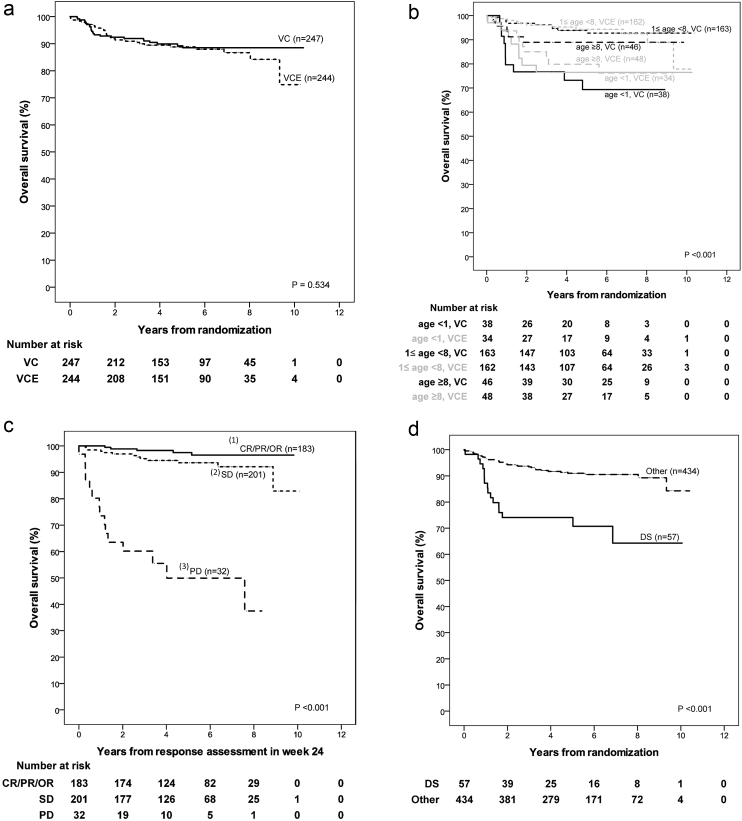
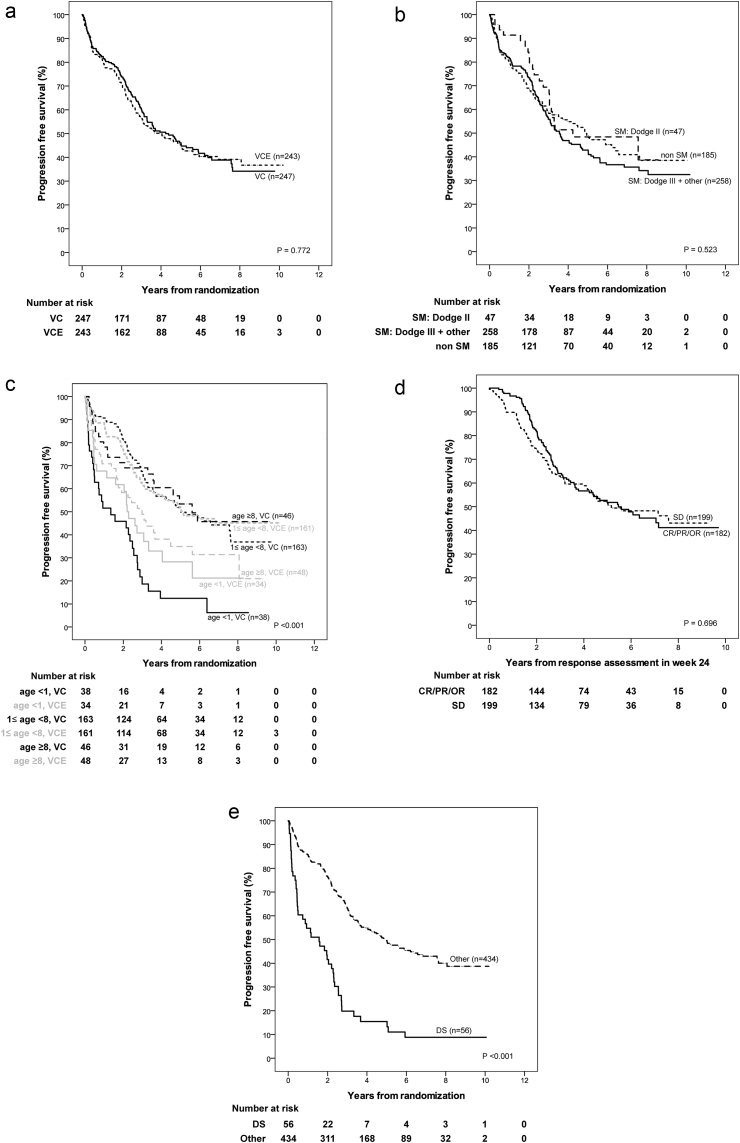
Findings: No differences between the two arms were found in term of survival and radiological response. Response and non-progression rates at 24 weeks for VC and VCE, were 46% versus 41%, and 93% versus 91% respectively; 5-year Progression-Free Survival (PFS) and Overall Survival (OS) were 46% (StDev 3.5) versus 45% (StDev 3.5) and 89% (StDev 2.1) versus 89% (StDev 2.1) respectively. Age and diencephalic syndrome are adverse clinical risk factors for PFS and OS. 5-year OS for patients in early progression at week 24 were 46% (StDev 13.8) and 49% (StDev 16.5) in the two arms, respectively.
Interpretation: The addition of etoposide to VC did not improve PFS or OS. High non-progression rates at 24 weeks justify retaining VC as standard first-line therapy. Infants with diencephalic syndrome and early progression need new treatments to be tested. Future trials should use neurological/visual and toxicity outcomes and be designed to discriminate between the impact on disease outcomes of 'duration of therapy' and 'age at stopping therapy'.
Keywords: Chemotherapy; Childhood; Low grade glioma; Randomised trial.
Copyright © 2017. Published by Elsevier Ltd.
Figures

References
-
- Gnekow A., Packer R., Kortmann R. Astrocytic tumors, low-grade: treatment considerations by primary site and tumor dissemination. In: Walker D.A., Perilongo G., Punt J.A.G., Taylor R., editors. Brain & spinal tumors of childhood. Arnold Publishers; London: 2004.
-
- Fisher P., Tihan T., Goldthwaite P. Outcome analysis of childhood low-grade astrocytomas. Pediatr Blood Cancer. 2008;51(2):245–250. - PubMed
Publication types
MeSH terms
Substances
Grants and funding
LinkOut - more resources
Full Text Sources
Other Literature Sources
Medical
