An official website of the United States government
The .gov means it’s official.
Federal government websites often end in .gov or .mil. Before
sharing sensitive information, make sure you’re on a federal
government site.
The site is secure.
The https:// ensures that you are connecting to the
official website and that any information you provide is encrypted
and transmitted securely.
According to the International Association for the Study of Pain (IASP) pain is characterized as an "unpleasant sensory and emotional experience associated with actual or potential tissue damage". The TRP super-family, compressing up to 28 isoforms in mammals, mediates a myriad of physiological and pathophysiological processes, pain among them. TRP channel might be constituted by similar or different TRP subunits, which will result in the formation of homomeric or heteromeric channels with distinct properties and functions. In this review we will discuss about the function of TRPs in pain, focusing on TRP channles that participate in the transduction of noxious sensation, especially TRPV1 and TRPA1, their expression in nociceptors and their sensitivity to a large number of physical and chemical stimuli.
Molecular structure of TRPA1 and TRPV1. (A) Scheme of TRPV1 and TRPA1 channels…
Figure 1
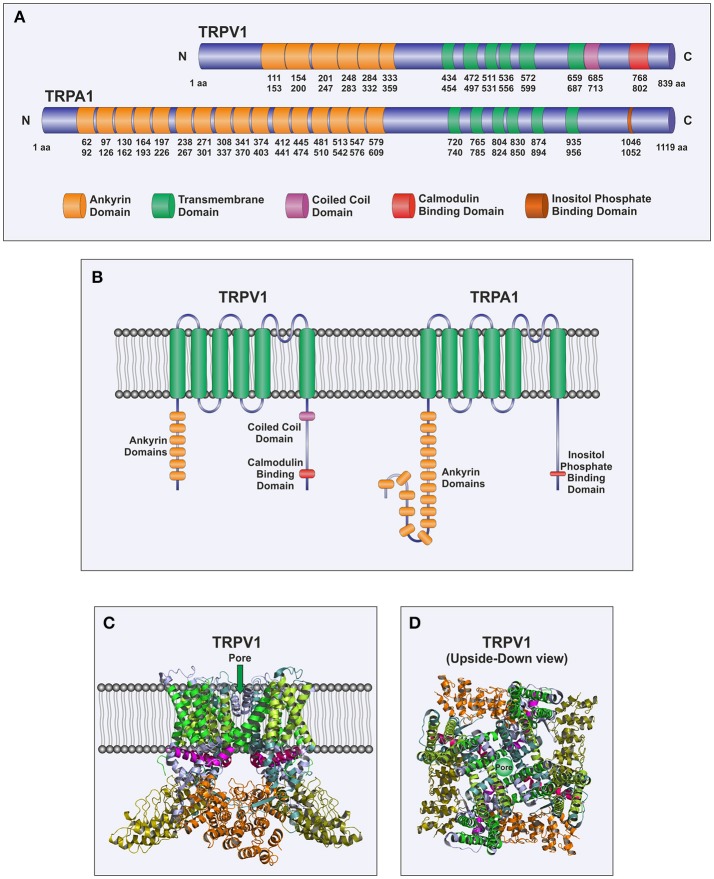
Molecular structure of TRPA1 and TRPV1. (A) Scheme of TRPV1 and TRPA1 channels depicting individual domains. Numbers correspond to amino acids positions of human TRPV1 and TRPA1, respectively. (B) Cartoon representing TRPV1 and TRPA1 monomers morphology within a bilayer membrane. The channel spans the membrane up to six times with the pore located between transmembrane domains (TM) 5 and 6, and both N-terminal and C-terminal domains situated in the cytosol. (C,D) Cartoons depicting the tetrameric assembly of TRPV1 subunits based on the X-ray crystal structure of Rattus norvegicus as described in Cao et al. (2013). As mentioned above, the ion permeation pathway is formed by TM5 and TM6, while the remaining TM domains 1–4, surround the pore. (C) Represents a frontal view of the channel while (D) sketches an upside-down perspective.
Albarran L., Lopez J. J., Dionisio N., Smani T., Salido G. M., Rosado J. A. (2013). Transient receptor potential ankyrin-1 (TRPA1) modulates store-operated Ca2+ entry by regulation of STIM1-Orai1 association. Biochim. Biophys. Acta 1833, 3025–3034. 10.1016/j.bbamcr.2013.08.014
-
DOI
-
PubMed
Alessandri-Haber N., Dina O. A., Chen X., Levine J. D. (2009). TRPC1 and TRPC6 channels cooperate with TRPV4 to mediate mechanical hyperalgesia and nociceptor sensitization. J. Neurosci. 29, 6217–6228. 10.1523/JNEUROSCI.0893-09.2009
-
DOI
-
PMC
-
PubMed
Alessandri-Haber N., Yeh J. J., Boyd A. E., Parada C. A., Chen X., Reichling D. B., et al. . (2003). Hypotonicity induces TRPV4-mediated nociception in rat. Neuron 39, 497–511. 10.1016/S0896-6273(03)00462-8
-
DOI
-
PubMed
Alkhani H., Ase A. R., Grant R., O'donnell D., Groschner K., Seguela P. (2014). Contribution of TRPC3 to store-operated calcium entry and inflammatory transductions in primary nociceptors. Mol. Pain 10:43. 10.1186/1744-8069-10-43
-
DOI
-
PMC
-
PubMed
Ambudkar I. S., Ong H. L., Liu X., Bandyopadhyay B. C., Cheng K. T. (2007). TRPC1: the link between functionally distinct store-operated calcium channels. Cell Calcium 42, 213–223. 10.1016/j.ceca.2007.01.013
-
DOI
-
PubMed