


Food availability as a major driver in the evolution of life-history strategies of sibling species
- PMID: 28649329
- PMCID: PMC5478057
- DOI: 10.1002/ece3.2909
Food availability as a major driver in the evolution of life-history strategies of sibling species
Abstract
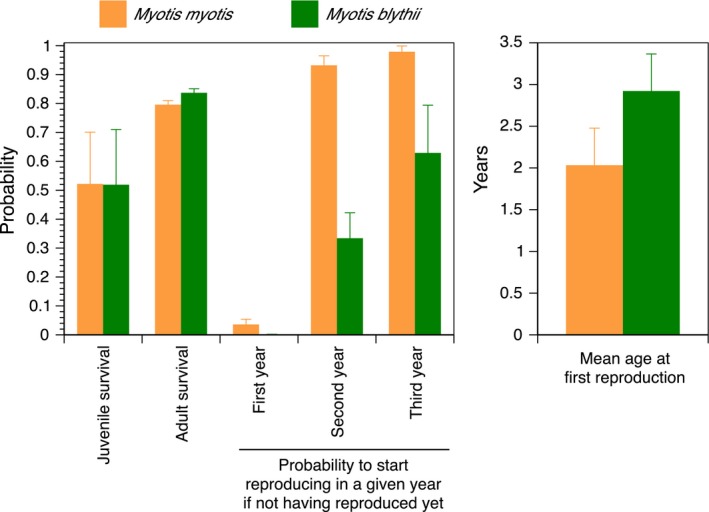
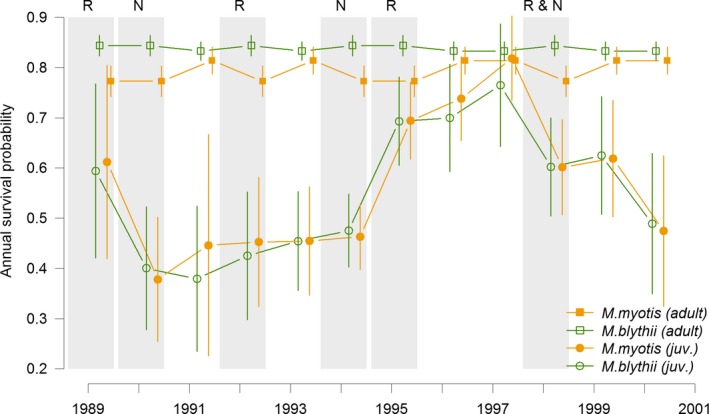
Life-history theory predicts trade-offs between reproductive and survival traits such that different strategies or environmental constraints may yield comparable lifetime reproductive success among conspecifics. Food availability is one of the most important environmental factors shaping developmental processes. It notably affects key life-history components such as reproduction and survival prospect. We investigated whether food resource availability could also operate as an ultimate driver of life-history strategy variation between species. During 13 years, we marked and recaptured young and adult sibling mouse-eared bats (Myotis myotis and Myotis blythii) at sympatric colonial sites. We tested whether distinct, species-specific trophic niches and food availability patterns may drive interspecific differences in key life-history components such as age at first reproduction and survival. We took advantage of a quasi-experimental setting in which prey availability for the two species varies between years (pulse vs. nonpulse resource years), modeling mark-recapture data for demographic comparisons. Prey availability dictated both adult survival and age at first reproduction. The bat species facing a more abundant and predictable food supply early in the season started its reproductive life earlier and showed a lower adult survival probability than the species subjected to more limited and less predictable food supply, while lifetime reproductive success was comparable in both species. The observed life-history trade-off indicates that temporal patterns in food availability can drive evolutionary divergence in life-history strategies among sympatric sibling species.
Keywords: age at first reproduction; bats; demography; life‐history trade‐off; multistate capture–recapture model; survival.
Figures
References
-
- Arlettaz, R. (1993). A female Myotis myotis (Mammalia, Chiroptera) with 2 embryos. Mammalia, 57, 148–149.
-
- Arlettaz, R. (1996). Feeding behaviour and foraging strategy of free‐living mouse‐eared bats, Myotis myotis and Myotis blythii . Animal Behaviour, 51, 1–11.
-
- Arlettaz, R. (1999). Habitat selection as a major resource partitioning mechanism between the two sympatric sibling bat species Myotis myotis and Myotis blythii . Journal of Animal Ecology, 68, 460–471.
-
- Arlettaz, R. , Baeriswyl, P.‐A. , Christe, P. , & Lugon, A. (1998). A female vespertilionid bat (Myotis blythii) lactating in October at 46 degree N latitude. Rhinolophe, 13, 17–22.
-
- Arlettaz, R. , Christe, P. , & Desfayes, M. (2002). 33 years, a new longevity record for a European bat. Mammalia, 66, 441–442.
LinkOut - more resources
Full Text Sources
Other Literature Sources
