


Resequencing and comparison of whole mitochondrial genome to gain insight into the evolutionary status of the Shennongjia golden snub-nosed monkey (SNJ R. roxellana)
- PMID: 28649355
- PMCID: PMC5478077
- DOI: 10.1002/ece3.3011
Resequencing and comparison of whole mitochondrial genome to gain insight into the evolutionary status of the Shennongjia golden snub-nosed monkey (SNJ R. roxellana)
Abstract
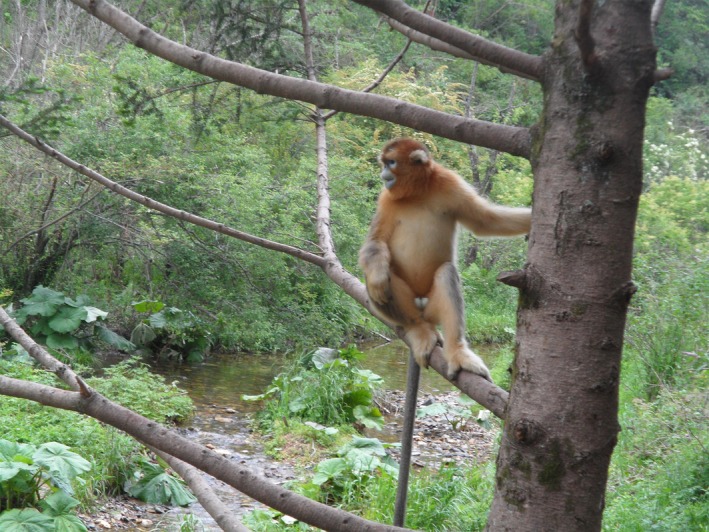
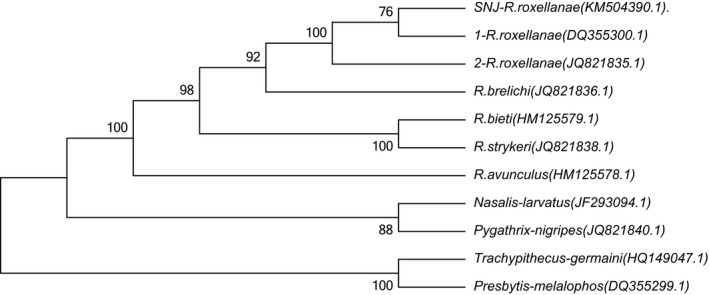
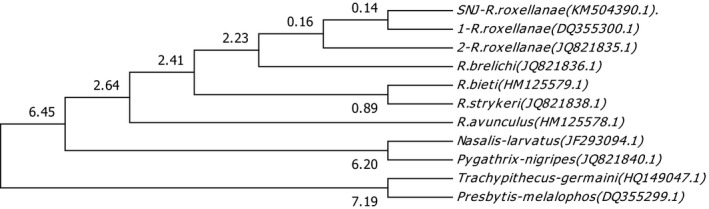
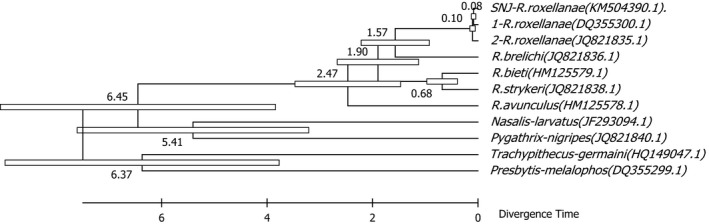
Shennongjia Rhinopithecus roxellana (SNJ R. roxellana) is the smallest geographical population of R. roxellana. The phylogenetic relationships among its genera and species and the biogeographic processes leading to their current distribution are largely unclear. To address these issues, we resequenced and obtained a new, complete mitochondrial genome of SNJ R. roxellana by next-generation sequencing and standard Sanger sequencing. We analyzed the gene composition, constructed a phylogenetic tree, inferred the divergence ages based on complete mitochondrial genome sequences, and analyzed the genetic divergence of 13 functional mtDNA genes. The phylogenetic tree and divergence ages showed that R. avunculus (the Tonkin snub-nosed monkey) was the first to diverge from the Rhinopithecus genus ca. 2.47 million years ago (Ma). Rhinopithecus bieti and Rhinopithecus strykeri formed sister groups, and the second divergence from the Rhinopithecus genus occurred ca. 1.90 Ma. R. roxellana and R. brelichi diverged from the Rhinopithecus genus third, ca. 1.57 Ma. SNJ R. roxellana was the last to diverge within R. roxellana species in 0.08 Ma, and the most recent common ancestor of R. roxellana is 0.10 Ma. The analyses on gene composition showed SNJ R. roxellana was the newest geographic population of R. roxellana. The work will help to develop a more accurate protection policy for SNJ R. roxellana and facilitate further research on selection and adaptation of R. roxellana.
Keywords: Rhinopithecus roxellana; Shennongjia Rhinopithecus roxellana; divergence ages; mitochondrial genome (mtDNA); next‐generation sequencing; phylogenetic analyses.
Figures
References
-
- Chang, Z. F. , Liu, Z. J. , Yang, J. Y. , Li, M. , & Vigilant, L. (2012). Noninvasive genetic assessment of the population trend and sex ratio of the Shennongjia population of Sichuan snub‐nosed monkeys (Rhinopithecus roxellana). Chinese Science Bulletin, (10), 1135–1141.
-
- Chang, Z. F. , Luo, M. F. , Liu, Z. J. , Yang, J. Y. , Xiang, Z. F. , Li, M. , Vigilant, L. (2012). Human influence on the population decline and loss of genetic diversity in a small and isolated population of Sichuan snub‐nosed monkeys (Rhinopithecus roxellana). Genetica, 140, 105–114. - PubMed
-
- Di, R. F. , Zambelli, A. D. , & Rioja, L. B. V. (2009). Identification of camelid specific residues in mitochondrial ATP synthase subunits. Journal of Bioenergetics and Biomembranes, 41, 223–228. - PubMed
LinkOut - more resources
Full Text Sources
Other Literature Sources
