. 2017 Jun 26:8:15909.
doi: 10.1038/ncomms15909.

Uniform electroactive fibre-like micelle nanowires for organic electronics

Affiliations

Uniform electroactive fibre-like micelle nanowires for organic electronics

Xiaoyu Li et al. Nat Commun. .

Erratum in

Abstract

Micelles formed by the self-assembly of block copolymers in selective solvents have attracted widespread attention and have uses in a wide variety of fields, whereas applications based on their electronic properties are virtually unexplored. Herein we describe studies of solution-processable, low-dispersity, electroactive fibre-like micelles of controlled length from π-conjugated diblock copolymers containing a crystalline regioregular poly(3-hexylthiophene) core and a solubilizing, amorphous regiosymmetric poly(3-hexylthiophene) or polystyrene corona. Tunnelling atomic force microscopy measurements demonstrate that the individual fibres exhibit appreciable conductivity. The fibres were subsequently incorporated as the active layer in field-effect transistors. The resulting charge carrier mobility strongly depends on both the degree of polymerization of the core-forming block and the fibre length, and is independent of corona composition. The use of uniform, colloidally stable electroactive fibre-like micelles based on common π-conjugated block copolymers highlights their significant potential to provide fundamental insight into charge carrier processes in devices, and to enable future electronic applications.


Conflict of interest statement

The authors declare no competing financial interests.

Figures
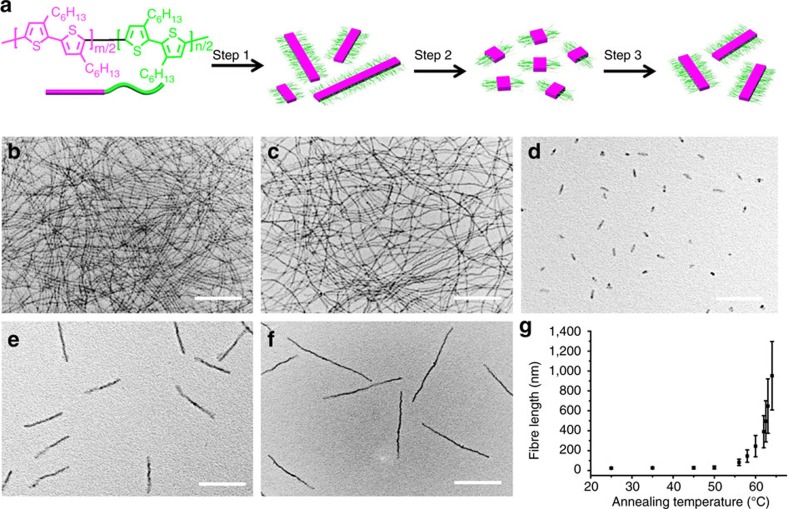
Figure 1
Figure 1. Fibres from rrP3HT-b-rsP3HT.
(a) Chemical structure of rrP3HT-b-rsP3HT diblock copolymer and the schematic illustration of Step 1, self-assembly of rrP3HT-b-rsP3HT to form fibres in anisole; Step 2, fragmentation of the fibres; and Step 3, thermal annealing to form uniform fibres. TEM images of the unfragmented fibres from (b) rrP3HT48-b-rsP3HT43 and (c) rrP3HT106-b-rsP3HT47, which were obtained by directly dispersing the polymer solid in anisole at 0.1 mg ml−1 at 80 °C for 1 h and then slowly cooling to 23 °C. Uniform fibres from rrP3HT106-b-rsP3HT47 prepared by subjecting anisole solutions of fibres (0.1 mg ml−1) to ultrasonication at 0 °C for 1 h, followed by thermal annealing at (d) 56.0 °C, (e) 62.5 °C, (f) 64.0 °C for 30 min and then slow (ca. 6 h) cooling to 23 °C. Scale bars, 500 nm. (g) Plot of the Ln of the rrP3HT106-b-rsP3HT47 fibres versus self-seeding temperatures.
Figure 2
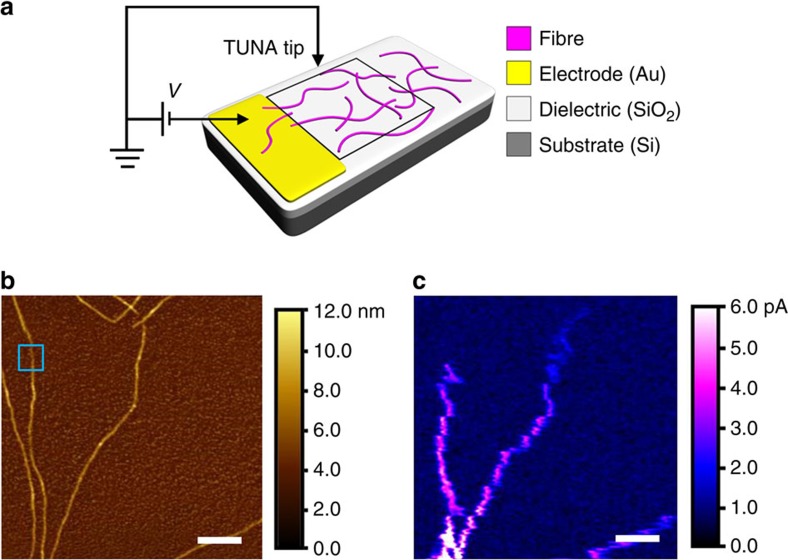
Figure 2. Tunnelling atomic force (TUNA) microscopy image of fibres.
(a) Schematic of the TUNA experiment (the black square indicates where the image was obtained). (b) Height and (c) TUNA contact current images of unfragmented rrP3HT106-b-rsP3HT47 fibres (Ln>10 μm). Scale bars, 500 nm. The fibres visible in b but not in c were disconnected from the gold electrode (break in the fibre, and thus the connection to the gold electrode, indicated in the blue box). The sub-monolayer films were prepared by spin-coating of 0.1 mg ml−1 fibre dispersions at 3,000 r.p.m. The gold electrode is positioned at the bottom of the AFM images and not imaged to avoid short-circuiting; see Supplementary Fig. 10a,b for an AFM height image showing the electrode position, as well as the TUNA contact current image at full scale, respectively.
Figure 3
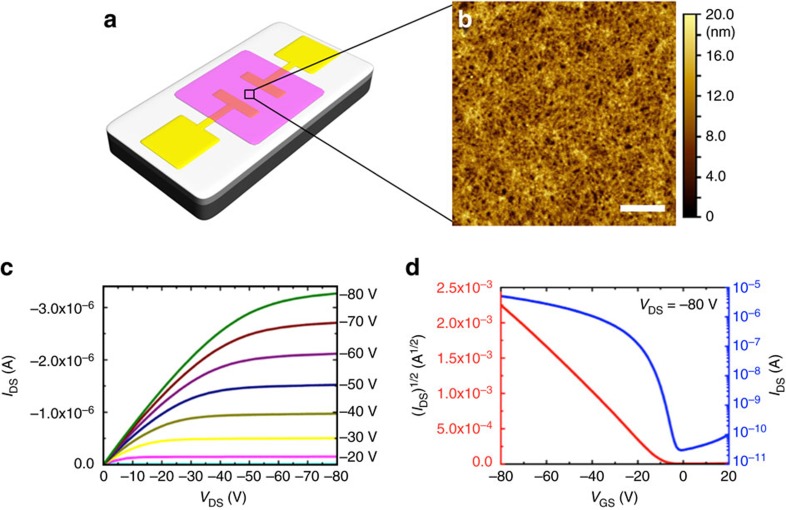
Figure 3. OFETs fabricated from the rrP3HT-b-rsP3HT and rrP3HT-b-PS fibres.
(a) Schematic illustration of the bottom-gate, bottom-contact OFET device (structures not drawn to scale; purple: semiconducting film; yellow: gold source/drain electrodes; light grey: dielectric SiO2 layer; dark grey: gate Si electrode). (b) AFM image of rrP3HT106-b-rsP3HT47 fibres (cast from 0.1 mg ml−1 anisole solution). Scale bar, 1 μm. The representative (c) output and (d) transfer characteristics of the OFET device of the unfragmented rP3HT106-b-rsP3HT47 fibres (Ln>10 μm) (IDS=drain-to-source current; VDS=drain-to-source bias; VGS=gate-to-source bias).
Figure 4
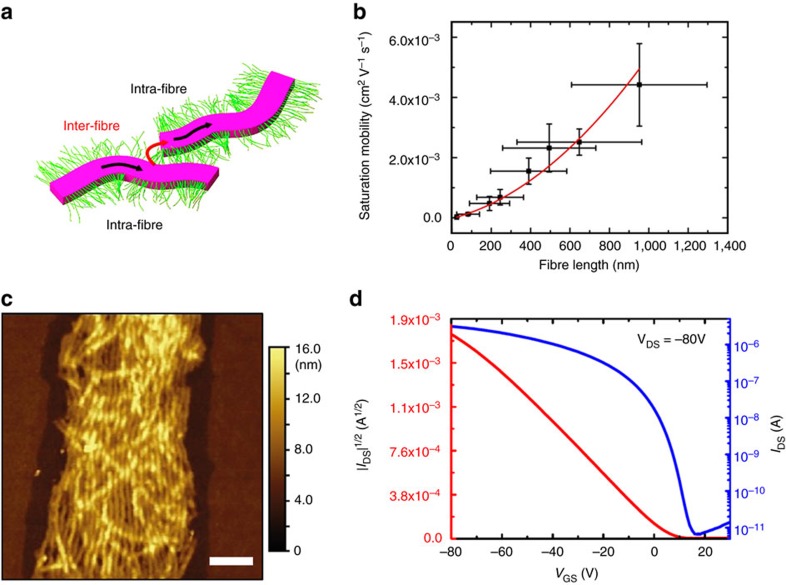
Figure 4. Field-effect mobility of devices from rrP3HT106-b-rsP3HT47 fibres.
(a) Schematic illustration of the charge-carrier transfer processes present in thin films of semiconductive fibre networks. (b) Variation of saturation mobility versus the fibre lengths after self-seeding. The red curve is a quadratic fit to the data. Each saturation mobility data point is averaged over the data from at least ten devices. (c) AFM image of the aligned and unfragmented rrP3HT106-b-rsP3HT47 fibres (Ln>10 μm). Scale bar, 200 nm. (d) Transfer characteristics of the OFET device of the aligned and unfragmented rP3HT106-b-rsP3HT47 fibres.

References

    1. Mai Y. & Eisenberg A. Self-assembly of block copolymers. Chem. Soc. Rev. 41, 5969–5985 (2012). - PubMed
    1. Geng Y. et al. Shape effects of filaments versus spherical particles in flow and drug delivery. Nat. Nanotechnol. 2, 249–255 (2007). - PMC - PubMed
    1. Zheng R., Liu G., Devlin M., Hux K. & Jao T. Friction reduction of lubricant base oil by micelles and crosslinked micelles of block copolymers. Tribol. Trans. 53, 97–107 (2009).
    1. Liu J. et al. Toughening of epoxies with block copolymer micelles of wormlike morphology. Macromolecules 43, 7238–7243 (2010).
    1. Gould O. E. C. et al. Transformation and patterning of supermicelles using dynamic holographic assembly. Nat. Commun. 6, 10009 (2015). - PMC - PubMed

Publication types