. 2017 Jun 26;11(6):e0005670.
doi: 10.1371/journal.pntd.0005670. eCollection 2017 Jun.

Point-of-care testing for Toxoplasma gondii IgG/IgM using Toxoplasma ICT IgG-IgM test with sera from the United States and implications for developing countries

Affiliations

Point-of-care testing for Toxoplasma gondii IgG/IgM using Toxoplasma ICT IgG-IgM test with sera from the United States and implications for developing countries

Ian J Begeman et al. PLoS Negl Trop Dis. .

Abstract

Background: Congenital toxoplasmosis is a serious but preventable and treatable disease. Gestational screening facilitates early detection and treatment of primary acquisition. Thus, fetal infection can be promptly diagnosed and treated and outcomes can be improved.

Methods: We tested 180 sera with the Toxoplasma ICT IgG-IgM point-of-care (POC) test. Sera were from 116 chronically infected persons (48 serotype II; 14 serotype I-III; 25 serotype I-IIIa; 28 serotype Atypical, haplogroup 12; 1 not typed). These represent strains of parasites infecting mothers of congenitally infected children in the U.S. 51 seronegative samples and 13 samples from recently infected persons known to be IgG/IgM positive within the prior 2.7 months also were tested. Interpretation was confirmed by two blinded observers. A comparison of costs for POC vs. commercial laboratory testing methods was performed.

Results: We found that this new Toxoplasma ICT IgG-IgM POC test was highly sensitive (100%) and specific (100%) for distinguishing IgG/IgM-positive from negative sera. Use of such reliable POC tests can be cost-saving and benefit patients.

Conclusions: Our work demonstrates that the Toxoplasma ICT IgG-IgM test can function reliably as a point-of-care test to diagnose Toxoplasma gondii infection in the U.S. This provides an opportunity to improve maternal-fetal care by using approaches, diagnostic tools, and medicines already available. This infection has serious, lifelong consequences for infected persons and their families. From the present study, it appears a simple, low-cost POC test is now available to help prevent morbidity/disability, decrease cost, and make gestational screening feasible. It also offers new options for improved prenatal care in low- and middle-income countries.


Conflict of interest statement

I have read the journal's policy and the authors of this manuscript have the following competing interests: Dr. Rima McLeod is working on a literature review for Sanofi Pasteur.

Figures
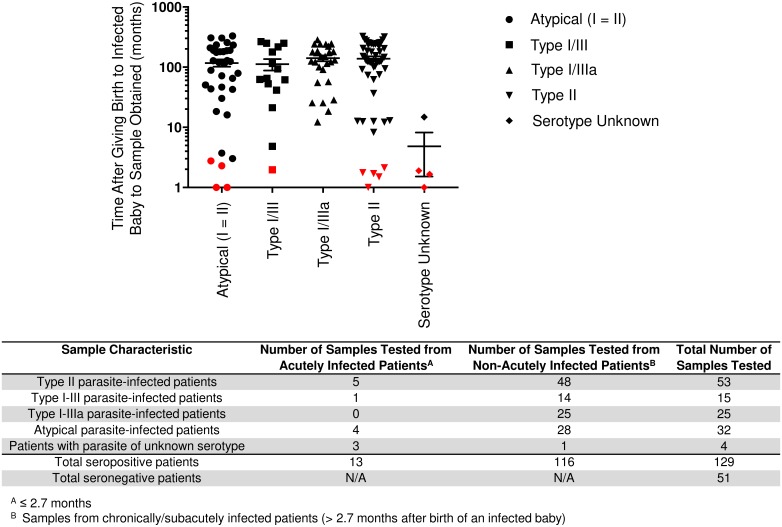
Fig 1
Fig 1. Chronically/Subacutely infected patients by parasite serotype as a function of time from birth of congenitally infected baby to sample obtained and seronegative patients.
Toxoplasma ICT IgG-IgM test results and parasite serotype. Results were obtained using sera from chronically, subacutely, and acutely infected persons with differing parasite serotype as a function of time from birth of this congenitally infected infant to when the sample was obtained. These are results from sera that have been stored at varying times after visits of families to the NCCCTS. Acute sera were collected ≤2.7 months after the birth of the congenitally infected person and are shown with red symbols. Chronic subacute sera, shown with black symbols, were from 145 to 9500 days after the birth of the congenitally infected person. Almost all persons had been serotyped earlier in the study. There was one father tested and one congenitally infected adult. The serum samples, otherwise, were from mothers at the times from birth of the infected person. S1 Table presents these detailed data. This S1 Table also presents the mother’s serologic test results at the time of the congenitally infected person’s birth or in the case of congenitally infected persons missed at birth and presenting later in life (historical cohort) at the time of the first visit to Chicago. These data demonstrate functioning of the Toxoplasma ICT IgG-IgM with sera from parasites that have caused congenital toxoplasmosis in the U.S. They are not from pregnant women. This was already tested in France where this test has performed well. Duration from birth provides relatively precise time for the chronic infection in persons who have been carefully followed longitudinally, prospectively. The data presented had no statistically significant difference (P > 0.05) between time from the birth of a congenitally infected baby and obtaining the serum sample related to serotype, as determined by ANOVA (P = 0.59) and secondarily confirmed by Kruskal-Wallis (P = 0.52). This timing indicates that the Toxoplasma ICT IgG-IgM POC test is reliable in identifying acutely infected U.S. persons and subacutely and chronically infected U.S. persons even many years after infection. The 13 acute sera, ≤2.7 months from time of birth, were also positive. Mean and standard deviation are indicated. a In S1 Table, samples from chronically/subacutely infected persons (>2.7 months after birth of an infected baby); b Total includes samples from persons who are either acutely (≤2.7 months after birth of an infected infant) and chronically/subacutely infected.
Fig 2
Fig 2. Gestational screening to save mothers’ and children’s lives and health care costs.
Screening pregnant women for acquisition of T. gondii infection during gestation using inexpensive point-of-care tests will help in countries with limited resources as well as in countries that have abundant resources but do not have gestational screening programs, such as the U.S. a Photograph reproduced with permission.
Fig 3
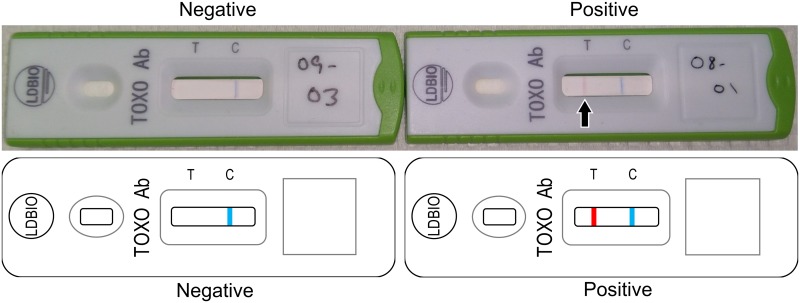
Fig 3. Implementation of Toxoplasma ICT IgG-IgM POC testing with separation of serum at point of care and representative Toxoplasma ICT IgG-IgM test negative and positive test results for sera.
This involves a lancet to obtain the sample with fingerprick ($0.13 for the lancet and a very low cost for alcohol wipes), a small centrifuge tube to separate the serum, a small Class II biosafety cabinet ($6546) for safe handling of samples, and a small centrifuge for separating serum ($228), from which serum can be removed easily and be tested. The following methodology is described in Chapey [17]: Briefly: the Toxoplasma ICT IgG-IgM assay is based on a lateral flow chromatographic immunoassay (LFCI) technology that allows the simultaneous detection of T. gondii IgG or IgM antibodies in human serum/plasma [17]. A minimum sample volume of 30–50 μL of serum/plasma is required [17]. Each cassette contains: a) a nitrocellulose strip on which there are two reactive bands, one with the Toxoplasma gondii antigen (from whole cell lysate) called the “test” band (T band) and one with the rabbit gamma globulins called the “control” band (C band); b) a fiberglass support (conjugate pad) which is impregnated with red latex particles coupled with Toxoplasma antigens (“test” latex = T latex) and blue latex particles coupled with goat anti-rabbit IgG (“control” latex = C latex) [17]. The test is run by dispensing the serum/plasma and an eluting solution (eluent) in the “sample well” of the cassette [17]. With the addition of the eluent, starts the concomitant migration (chromatography) of the serum/plasma and the latex particles [17]. If anti-Toxoplasma antibodies (IgG or IgM or both) are present in the sample, a complex is formed between the T latex and the patient’s antibodies, which is then captured by the T band, and it results in the appearance of a red line (positive test) [17]. The direct capture of the C latex by the C band results in the appearance of a control blue line which indicates that the chromatography performed well [17]. The results are read 20–30 minutes after the eluent solution has been dispensed into the well [17]. Representative example of U.S. sera, negative (left) and positive (right) results. This is the new simple POC test, based on lateral-flow-chromatographic-immunoassay method, already commercially available in France, that detects simultaneously both Toxoplasma IgG and IgM antibodies and costs only $4 (the cost we were charged) per test, as opposed to a $650 cost for testing at a commercial laboratory in the U.S.

References

    1. Lykins J, Wang K, Wheeler K, Clouser F, Dixon A, El Bissati K, et al. Understanding Toxoplasmosis in the United States Through "Large Data" Analyses. Clin Infect Dis. 2016;63(4):468–75. doi: 10.1093/cid/ciw356 - DOI - PMC - PubMed
    1. McLeod R, Lee D, Clouser F, Boyer K. Toxoplasmosis in the Fetus and Newborn Infant In: Stevenson DK, Cohen RS, Sunshine P, editors. Neonatology: Clinical Practice and Procedures. 1st ed New York: McGraw Hill; 2015. p. 821–76.
    1. McLeod R, Kieffer F, Sautter M, Hosten T, Pelloux H. Why prevent, diagnose and treat congenital toxoplasmosis? Mem Inst Oswaldo Cruz. 2009;104(2):320–44. - PMC - PubMed
    1. Montoya JG, Remington JS. Management of Toxoplasma gondii infection during pregnancy. Clin Infect Dis. 2008;47(4):554–66. doi: 10.1086/590149 - DOI - PubMed
    1. Torgerson PR, Mastroiacovo P. The global burden of congenital toxoplasmosis: a systematic review. Bull World Health Organ. 2013;91(7):501–8. doi: 10.2471/BLT.12.111732 - DOI - PMC - PubMed