


Responses of lichen communities to 18 years of natural and experimental warming
- PMID: 28651333
- PMCID: PMC5737088
- DOI: 10.1093/aob/mcx053
Responses of lichen communities to 18 years of natural and experimental warming
Abstract
Background and aims: Climate change is expected to have major impacts on high alpine and arctic ecosystems in the future, but empirical data on the impact of long-term warming on lichen diversity and richness are sparse. This study report the effects of 18 years of ambient and experimental warming on lichens and vascular plant cover in two alpine plant communities, a dry heath with sparse canopy cover (54 %) and a mesic meadow with a more developed (67 %) canopy cover, in sub-arctic Sweden.
Methods: The effects of long-term passive experimental warming using open top chambers (OTCs) on lichens and total vascular plant cover, and the impact of plant cover on lichen community parameters, were analysed.
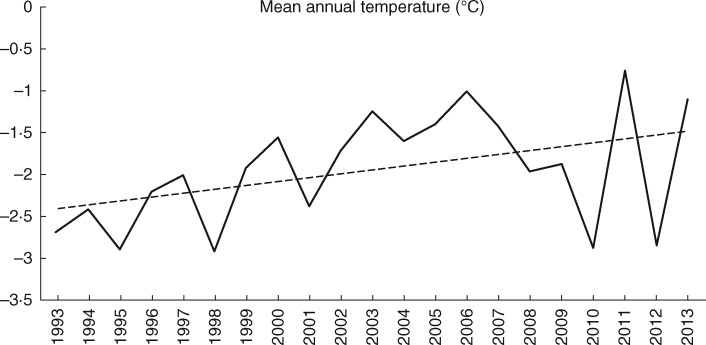
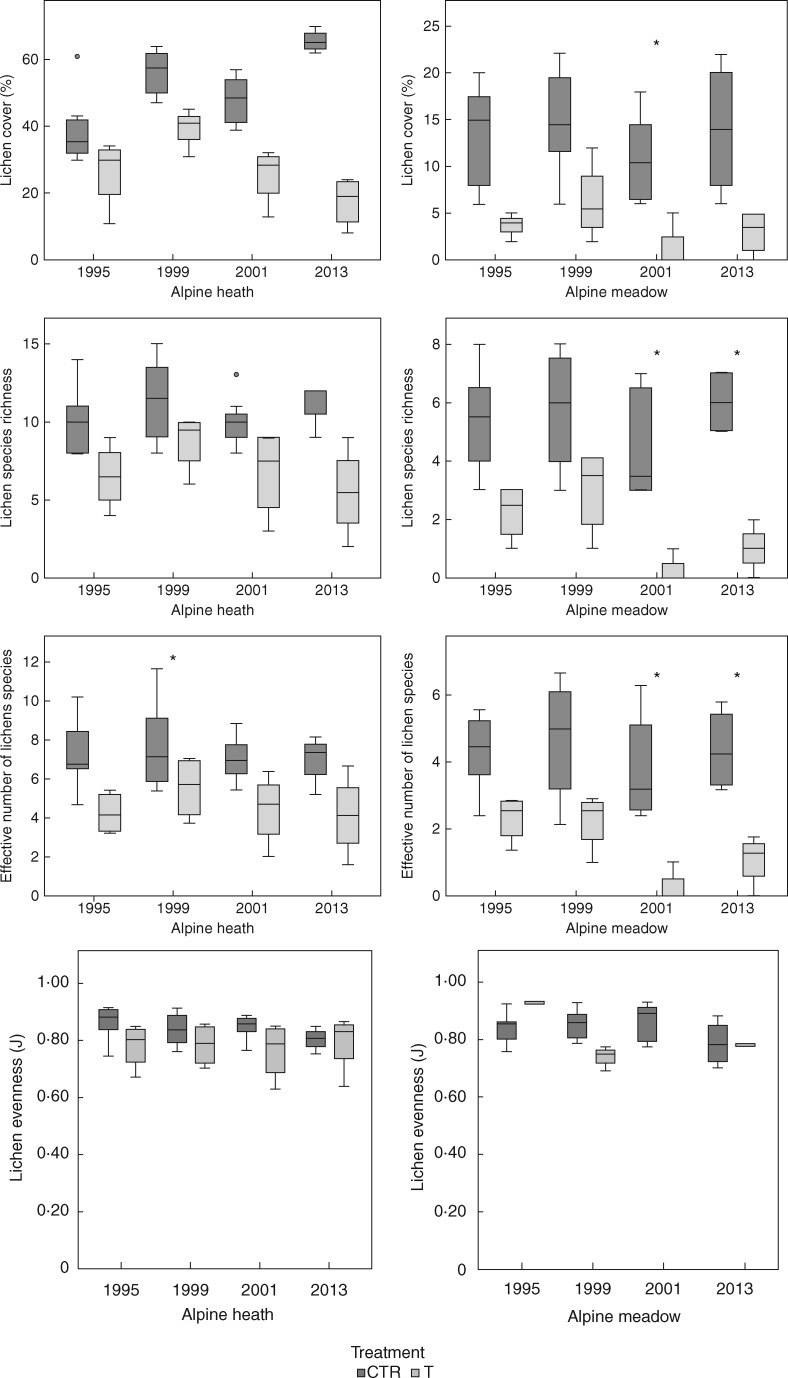
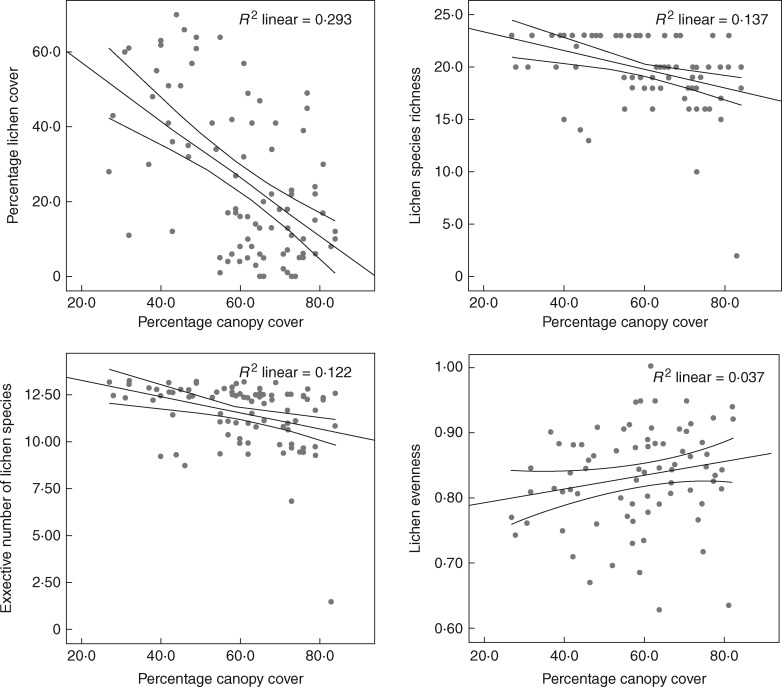
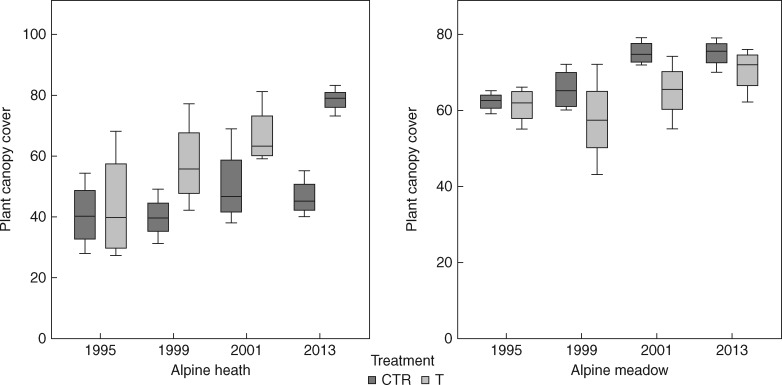
Key results: Between 1993 and 2013, mean annual temperature increased about 2 °C. Both site and experimental warming had a significant effect on cover, species richness, effective number of species evenness of lichens, and total plant canopy cover. Lichen cover increased in the heath under ambient conditions, and remained more stable under experimental warming. The negative effect on species richness and effective number of species was driven by a decrease in lichens under experimental warming in the meadow. Lichen cover, species richness, effective number of species evenness were negatively correlated with plant canopy cover. There was a significant negative impact on one species and a non-significant tendency of lower abundance of the most common species in response to experimental warming.
Conclusions: The results from the long-term warming study imply that arctic and high alpine lichen communities are likely to be negatively affected by climate change and an increase in plant canopy cover. Both biotic and abiotic factors are thus important for future impacts of climate change on lichens.
Keywords: Arctic; climate change; effective number of species; global warming; plant–climate interactions; species richness; tundra.
© The Author 2017. Published by Oxford University Press on behalf of the Annals of Botany Company. All rights reserved. For Permissions, please email: journals.permissions@oup.com
Figures
References
-
- Alatalo J. 1998. Climate change: impacts on structure and biodiversity of subarctic plant communities. PhD Thesis, Göteborg University, Sweden.
-
- Alatalo JM, Totland Ø.. 1997. Response to simulated climatic change in an alpine and subarctic pollen-risk strategist, Silene acaulis. Global Change Biology 3: 74–79.
-
- Alatalo JM, Jägerbrand AK, Molau U.. 2014a. Climate change and climatic events: community-, functional- and species-level responses of bryophytes and lichens to constant, stepwise, and pulse experimental warming in an alpine tundra. Alpine Botany 124: 81–91.
-
- Alatalo JM, Jägerbrand AK, Molau U.. 2015a. Testing reliability of short-term responses to predict longer-term responses of bryophytes and lichens to environmental change. Ecological Indicators 58: 77–85.
MeSH terms
LinkOut - more resources
Full Text Sources
Other Literature Sources
Medical
Molecular Biology Databases
