. 2017 Oct;145(13):2827-2837.
doi: 10.1017/S0950268817001285. Epub 2017 Jun 27.

The association between measurements of antimicrobial use and resistance in the faeces microbiota of finisher batches

Affiliations

The association between measurements of antimicrobial use and resistance in the faeces microbiota of finisher batches

V D Andersen et al. Epidemiol Infect. 2017 Oct.

Abstract

The objectives were to present three approaches for calculating antimicrobial (AM) use in pigs that take into account the rearing period and rearing site, and to study the association between these measurements and phenotypical resistance and abundance of resistance genes in faeces samples from 10 finisher batches. The AM use was calculated relative to the rearing period of the batches as (i) 'Finisher Unit Exposure' at unit level, (ii) 'Lifetime Exposure' at batch level and (iii) 'Herd Exposure' at herd level. A significant effect on the occurrence of tetracycline resistance measured by cultivation was identified for Lifetime Exposure for the AM class: tetracycline. Furthermore, for Lifetime Exposure for the AM classes: macrolide, broad-spectrum penicillin, sulfonamide and tetracycline use as well as Herd Unit Exposure for the AM classes: aminoglycoside, lincosamide and tetracycline use, a significant effect was observed on the occurrence of genes coding for the AM resistance classes: aminoglycoside, lincosamide, macrolide, β-lactam, sulfonamide and tetracycline. No effect was observed for Finisher Unit Exposure. Overall, the study shows that Lifetime Exposure is an efficient measurement of AM use in finisher batches, and has a significant effect on the occurrence of resistance, measured either by cultivation or metagenomics.

Keywords: Antimicrobial drugs; antimicrobial resistance in agricultural settings; cultivation; metagenomic; pigs.


Conflict of interest statement

None.

Figures
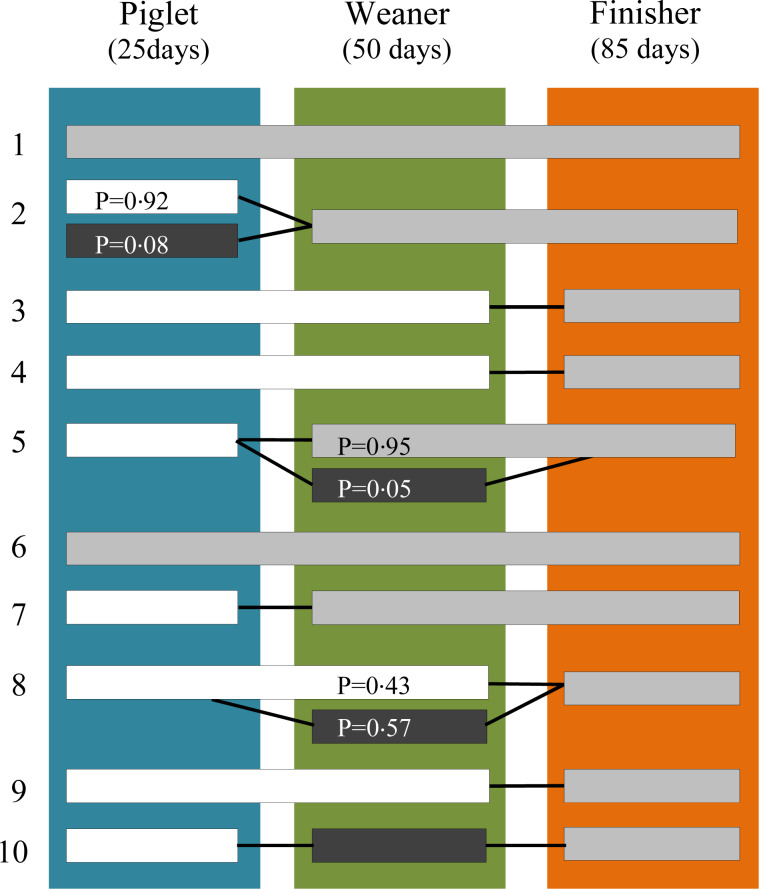
Fig. 1.
Fig. 1.
The rearing pathway of each of the 10 finisher batches from birth site to finisher site compared with the day of sampling. The 10 horizontal bars depict the movements of the batches. A colour shift in a bar denotes that a farm has a different geographical location to the farm where sampling took place and P denotes the proportion of pigs being moved. Bars without P are equal to one. Numbers 1–5 denote the initially high users and 6–10 depict the initially low users. The three vertical coloured bars represent the assumed days of exposure to AM in the: sow-piglet (farrowing) unit, weaner unit and finisher unit.
Fig. 2.
Fig. 2.
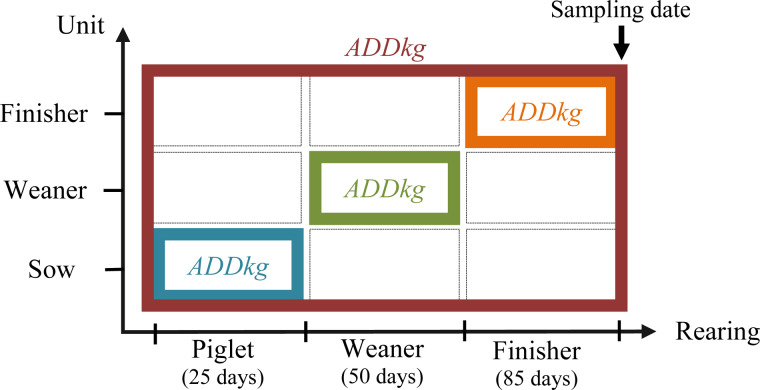
The exposure measurements of AM usage. The orange square applies to Finisher Unit Exposure and therefore comprises the AM usage in the finisher-rearing period in the finisher unit. Lifetime Exposure applies to the orange, green and blue squares, and therefore comprises the AM usage in the piglet-rearing period in the sow unit, the weaning-rearing period in the weaning unit and the finisher-rearing period in the finisher unit. The red square applies to Herd Exposure, and therefore comprises AM usage throughout the entire rearing period in all units.
Fig. 3.
Fig. 3.
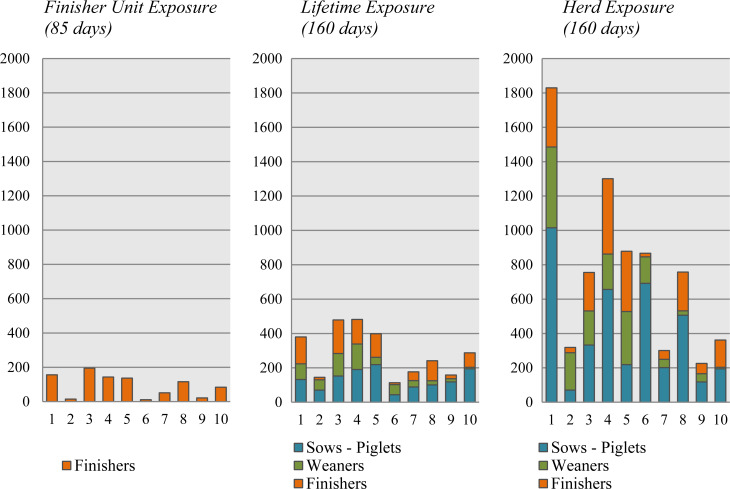
Finisher Unit Exposure, Lifetime Exposure and Herd Exposure. The total AM use and the distribution between sow piglets, weaners and finishers within the 10 finisher batches. Numbers 1–5 denote the initially high users and 6–10 depict the initially low users.
Fig. 4.
Fig. 4.
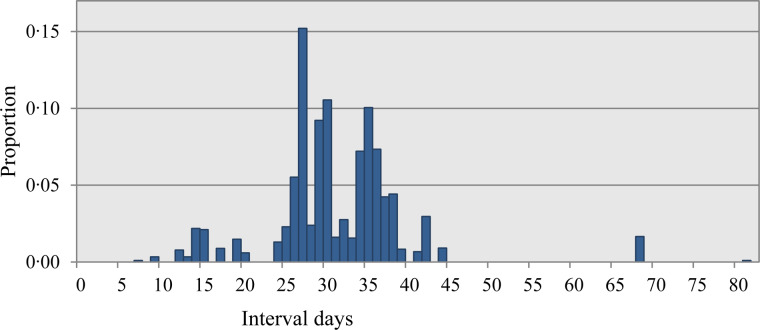
The distribution of prescription interval days – days between two prescriptions.
Fig. 5.
Fig. 5.
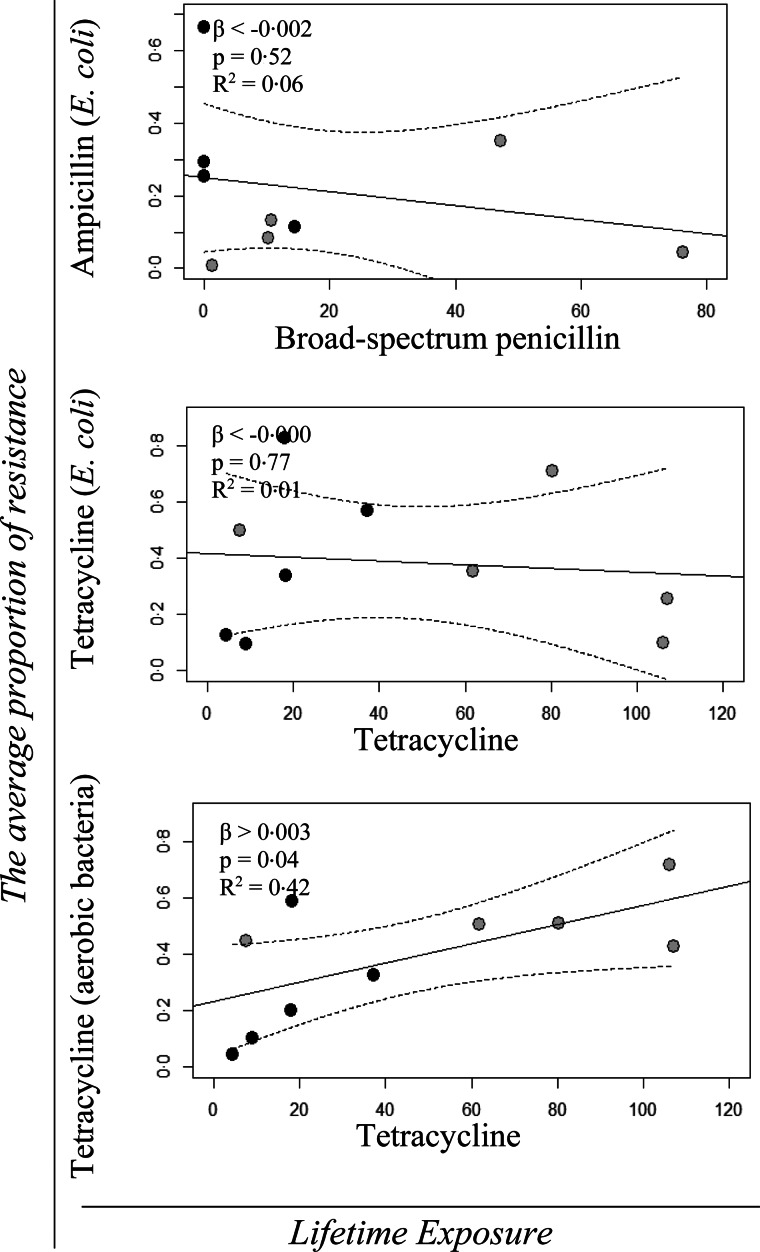
Univariable linear regression plots (solid line) and 95% confidence interval (dotted lines) of the average resistance proportion of ampicillin and tetracycline resistance from cultivation of Escherichia coli on MacConkey agar with and without ampicillin and tetracycline, as a function of Lifetime Exposure for the AM classes; broad-spectrum penicillin and tetracycline, respectively, and the average resistance proportion of tetracycline resistance from cultivation of aerobic bacteria on LB agar with and without tetracycline, as a function of Lifetime Exposure for the AMc; tetracycline. The grey points denote the initially high users and the black points depict the initially low users. The effect (β), the P-value (P) and the R2 value are shown in the top left corner of each model.
Fig. 6.
Fig. 6.
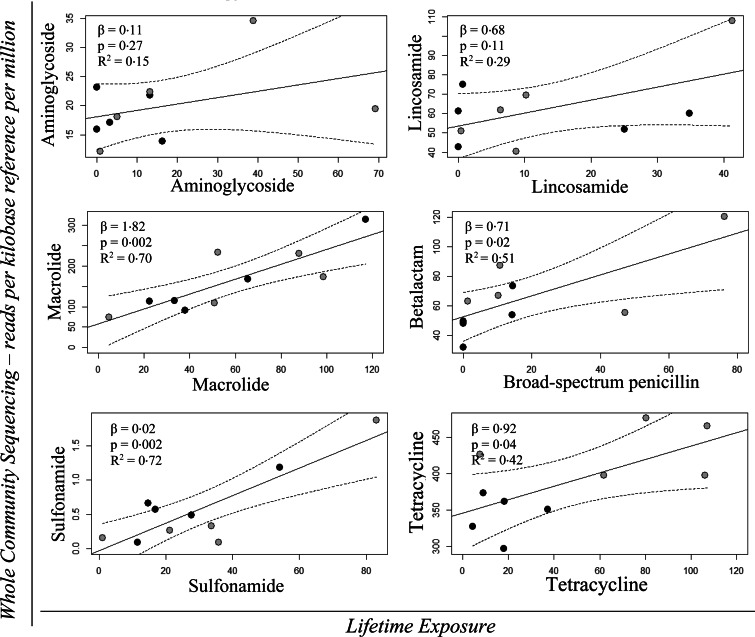
Univariable linear regression plots (solid line) with 95% confidence interval (dotted lines) of WCS – RPKM of the AMR genes for: aminoglycoside, lincosamide, macrolide, β-lactam, sulfonamide and tetracycline as a function of Lifetime Exposure for the AM classes: aminoglycoside, lincosamide, macrolide, broad-spectrum penicillin, sulfonamide and tetracycline, respectively. The grey points denote the initially high users and the black points depict the initially low users. The effect (β), the P-value (P) and the R2 value are shown in the top left corner of each model.
Fig. 7.
Fig. 7.
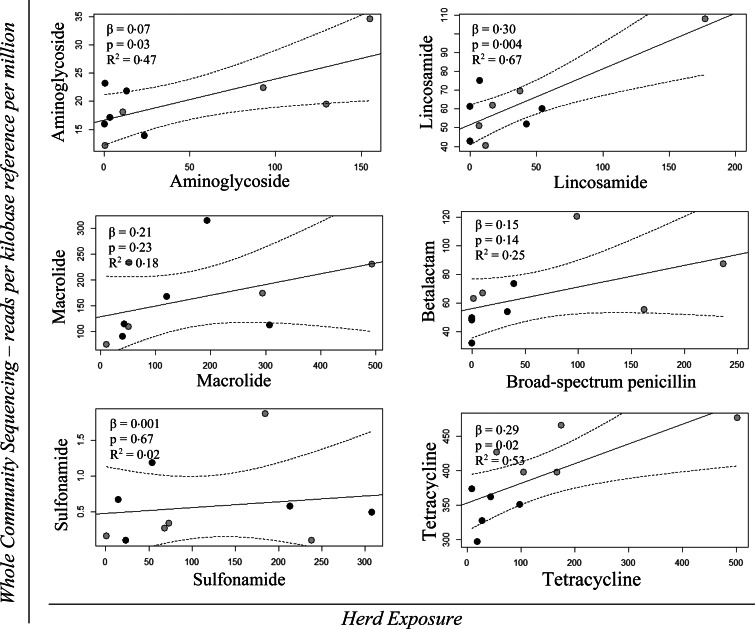
Univariable linear regression plots (solid plot) with 95% confidence interval (dotted lines) of WCS – RPKM of the AMR genes for: aminoglycoside, lincosamide, macrolide, β-lactam, sulfonamide and tetracycline as a function of Herd Exposure for the AM classes: aminoglycoside, lincosamide, macrolide, broad-spectrum penicillin, sulfonamide and tetracycline, respectively. The grey points denote the initially high users and the black points depict the initially low users. The effect (β), the P-value (P) and the R2 value are shown in the top left corner of each model.

References

    1. WHO. The evolving threat of antimicrobial resistance – options for action. World Health Organization, 2012. http://www.who.int/patientsafety/implementation/amr/publication/en/index... (accessed 11 January 2017).
    1. ECDC/EMEA. Joint Technical Report: the bacterial challenge: time to react, 2009. http://ecdc.europa.eu/en/publications/_layouts/forms/Publication_DispFor... (accessed 11 January 2017).
    1. Munk P, et al. A sampling and metagenomic sequencing-based methodology for monitoring antimicrobial resistance in swine herds. Journal of Antimicrobial Chemotherapy 2017; 72(2): 385–392. doi: 10.1093/jac/dkw415. - DOI - PubMed
    1. Swann MM, et al. Joint Committee on the use of Antibiotics in Animal Husbandry and Veterinary Medicine (Swann Report). London: H.M.S.O, 1969.
    1. Martel J-L, et al. New trends in regulatory rules and surveillance of antimicrobial resistance in bacteria of animal origin. Veterinary Research 2001; 32: 381–392. doi: 10.1051/vetres:2001131. - DOI - PubMed

Publication types

MeSH terms

Substances