


Erythrocyte omega-3 fatty acids are inversely associated with incident dementia: Secondary analyses of longitudinal data from the Women's Health Initiative Memory Study (WHIMS)
- PMID: 28651700
- PMCID: PMC5564209
- DOI: 10.1016/j.plefa.2017.06.006
Erythrocyte omega-3 fatty acids are inversely associated with incident dementia: Secondary analyses of longitudinal data from the Women's Health Initiative Memory Study (WHIMS)
Abstract
Objective: To assess whether red blood cell (RBC) docosahexaenoic acid and eicosapentaenoic acid (DHA+EPA) levels have a protective association with the risk of dementia in older women.
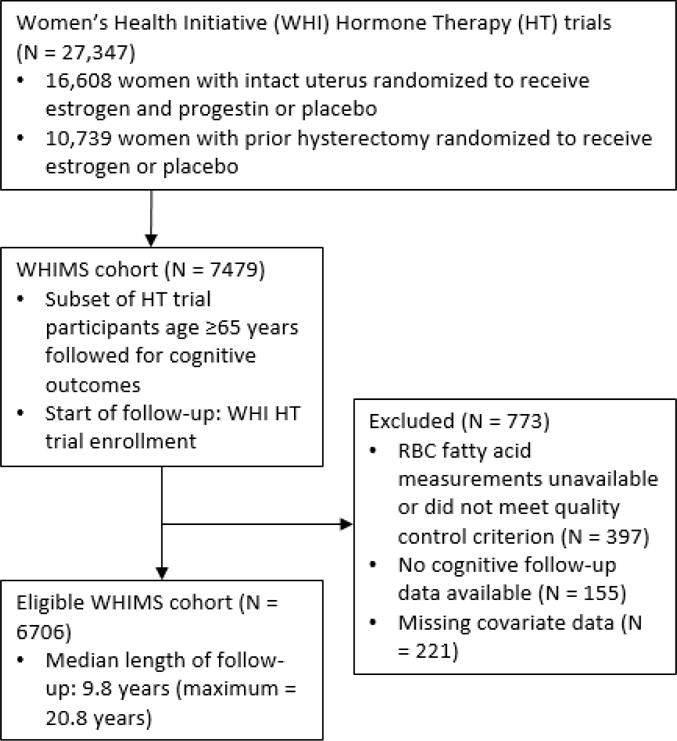
Methods: RBC DHA+EPA levels were assessed at baseline, and cognitive status was evaluated annually in a cohort of 6706 women aged ≥65 years who participated in the Women's Health Initiative Memory Study (WHIMS). Cox regression was used to quantify the association between RBC DHA+EPA and the risk of probable dementia, independent of major dementia risk factors.
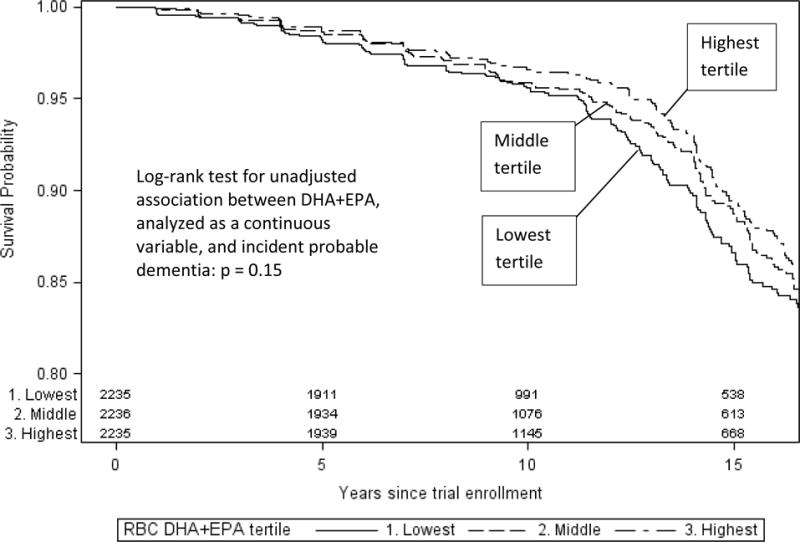
Results: During a median follow-up period of 9.8 years, 587 incident cases of probable dementia were identified. After adjusting for demographic, clinical, and behavioral risk factors, a one standard deviation increase in DHA+EPA levels was associated with a significantly lower risk of dementia (HR = 0.92, 95% CI: 0.84, 1.00; p < 0.05). This effect estimate did not meaningfully change after further adjustment for baseline cognitive function and APOE genotype. For women with high DHA+EPA exposure (1SD above mean) compared to low exposure (1SD below mean), the adjusted 15-year absolute risk difference for dementia was 2.1% (95% CI: 0.2%, 4.0%). In secondary analyses, we also observed a protective association with longitudinal change in Modified Mini-Mental State (3MS) Exam scores, but no significant association with incident MCI, PD/MCI, or baseline 3MS scores.
Discussion: Higher levels of DHA+EPA may help protect against the development of dementia. Results from prospective randomized controlled trials of DHA+EPA supplementation are needed to help clarify whether this association is causal.
Keywords: All cognitive disorders/dementia; Alzheimer's Disease; Biomarkers; Cohort studies; Omega-3 fatty acids; Women.
Copyright © 2017 Elsevier Ltd. All rights reserved.
Figures
References
-
- Seshadri S, Wolf PA, Beiser A, Au R, McNulty K, White R, D’Agostino RB. Lifetime risk of dementia and Alzheimer’s disease. The impact of mortality on risk estimates in the Framingham Study. Neurology. 1997;49:1498–1504. - PubMed
-
- Arterburn LM, Hall EB, Oken H. Distribution, interconversion, and dose response of n-3 fatty acids in humans. Am J Clin Nutr. 2006;83:1467S–1476S. - PubMed
MeSH terms
Substances
Grants and funding
LinkOut - more resources
Full Text Sources
Other Literature Sources
Medical
Research Materials
Miscellaneous
