


Association of high-sensitivity cardiac troponin T with mortality and cardiovascular events in a community-based prospective study in Beijing
- PMID: 28652289
- PMCID: PMC5541394
- DOI: 10.1136/bmjopen-2016-013431
Association of high-sensitivity cardiac troponin T with mortality and cardiovascular events in a community-based prospective study in Beijing
Abstract
Objective: The prognostic value of cardiac troponins in apparently healthy populations is not well established. The aim of this study was to investigate the prognostic properties of high-sensitivity cardiac troponin T (hs-cTnT) for long-term adverse outcomes.
Setting: A community-dwelling prospective survey of residents from two communities in Beijing.
Participants: From September 2007 to January 2009, 1680 participants were initially enrolled. Of these, 1499 (870 females, mean age: 61.4 years) participants completed the survey and were followed up for a median of 4.8 years (IQR: 4.5-5.2).
Outcome measures: The primary outcome was the occurrence of all-cause mortality and major cardiovascular events.
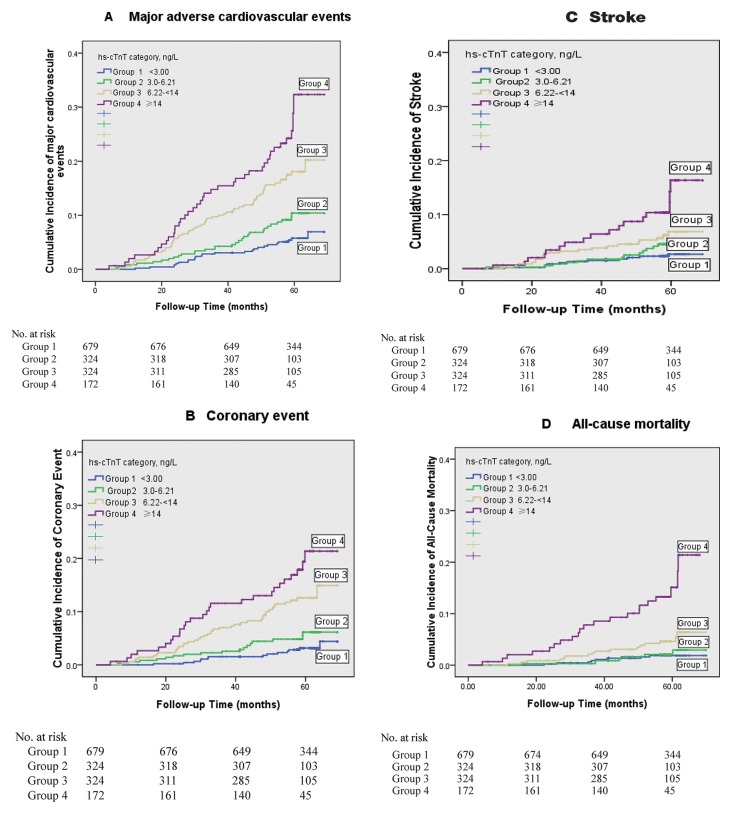
Results: Overall, 820 individuals (54.7%) had detectable hs-cTnT levels. During the follow-up, 52 participants (3.5%) died, 154 (10.3%) had major cardiovascular events and 99 (6.6%) experienced new-onset coronary events. Compared with those with undetectable hs-cTnT levels, participants with hs-cTnT levels in the highest category (≥14 ng/L) had a significantly increased risk for all-cause mortality (adjusted HR (aHR): 2.07, 95% CI 1.05 to 3.01), major cardiovascular events (aHR: 3.27, 95% CI 1.88 to 5.70) and coronary events (aHR: 4.50, 95% CI 2.26 to 9.02) in covariate-adjusted analyses. No differences in stroke incidence were found (aHR: 1.27, 95% CI 0.69 to 2.62). Also, significant associations were presented when hs-cTnT levels were modelled as a continuous variable and when analysing changes in hs-cTnT levels over time with adverse outcomes. The addition of troponin T levels to clinical variables led to significant increases in risk prediction with a marked improvement in the C-statistics (p=0.003 or lower).
Conclusions: In this cohort of individuals from a community-based population, cTnT levels measured with a highly sensitive assay were associated with increases in the subsequent risk for all-cause mortality and major cardiovascular events. These results might support screening for at-risk individuals.
Keywords: biomarkers; cardiovascular diseases; high-sensitivity cardiac troponin T; prognosis; risk assessment..
© Article author(s) (or their employer(s) unless otherwise stated in the text of the article) 2017. All rights reserved. No commercial use is permitted unless otherwise expressly granted.
Conflict of interest statement
Competing interests: None declared.
Figures
References
Publication types
MeSH terms
Substances
Associated data
LinkOut - more resources
Full Text Sources
Other Literature Sources
Research Materials
Miscellaneous
