


Emotion shapes the diffusion of moralized content in social networks
- PMID: 28652356
- PMCID: PMC5514704
- DOI: 10.1073/pnas.1618923114
Emotion shapes the diffusion of moralized content in social networks
Abstract
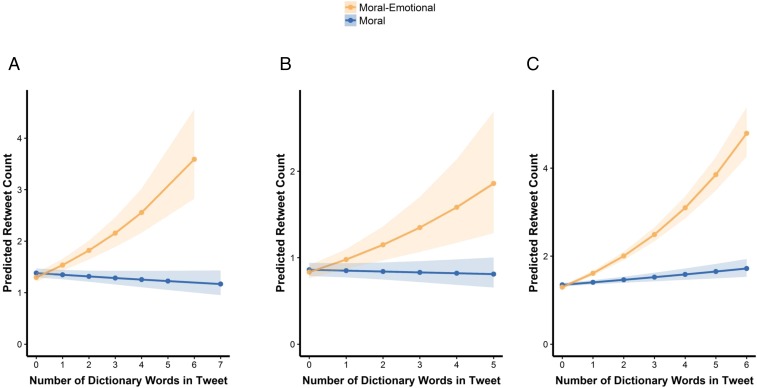
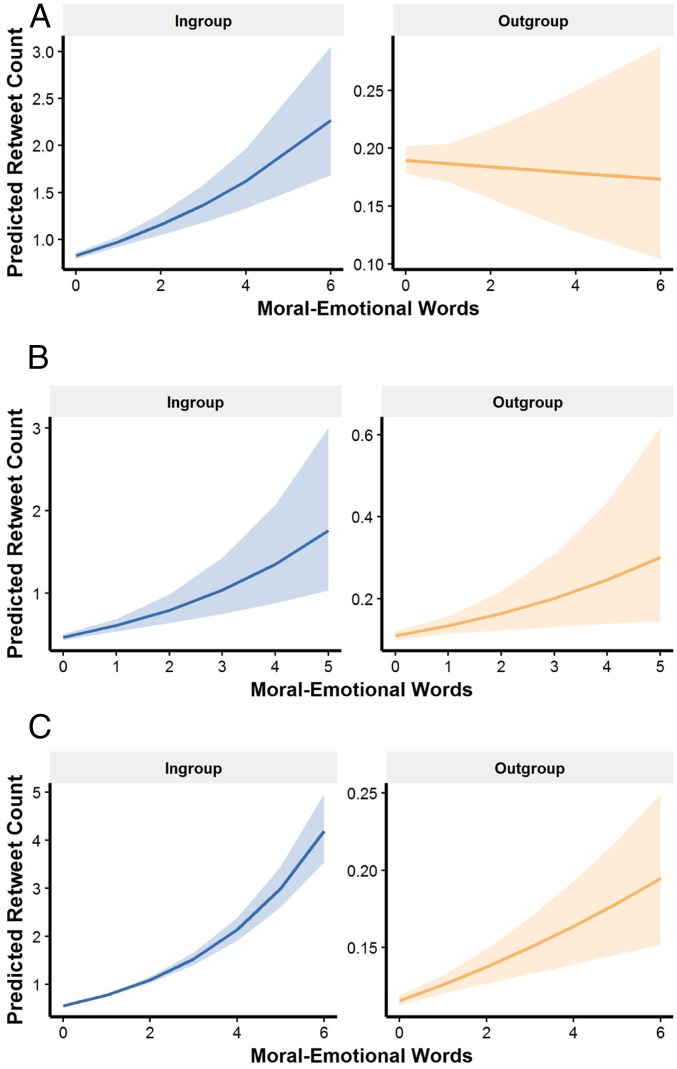
Political debate concerning moralized issues is increasingly common in online social networks. However, moral psychology has yet to incorporate the study of social networks to investigate processes by which some moral ideas spread more rapidly or broadly than others. Here, we show that the expression of moral emotion is key for the spread of moral and political ideas in online social networks, a process we call "moral contagion." Using a large sample of social media communications about three polarizing moral/political issues (n = 563,312), we observed that the presence of moral-emotional words in messages increased their diffusion by a factor of 20% for each additional word. Furthermore, we found that moral contagion was bounded by group membership; moral-emotional language increased diffusion more strongly within liberal and conservative networks, and less between them. Our results highlight the importance of emotion in the social transmission of moral ideas and also demonstrate the utility of social network methods for studying morality. These findings offer insights into how people are exposed to moral and political ideas through social networks, thus expanding models of social influence and group polarization as people become increasingly immersed in social media networks.
Keywords: emotion; morality; politics; social media; social networks.
Conflict of interest statement
The authors declare no conflict of interest.
Figures
References
-
- Haidt J. The emotional dog and its rational tail: A social intuitionist approach to moral judgment. Psychol Rev. 2001;108:814–834. - PubMed
-
- Kohlberg L. Stage and sequence: The cognitive-developmental approach to socialization. In: Goslin DA, editor. Handbook of Socialization: Theory and Research. Rand McNally; Chicago: 1969. pp. 347–480.
-
- Rozin P, Lowery L, Imada S, Haidt J. The CAD triad hypothesis: A mapping between three moral emotions (contempt, anger, disgust) and three moral codes (community, autonomy, divinity) J Pers Soc Psychol. 1999;76:574–586. - PubMed
-
- Van Bavel JJ, FeldmanHall O, Mende-Siedlecki P. The neuroscience of moral cognition: From dual processes to dynamic systems. Curr Opin Psychol. 2015;6:167–172.
Publication types
MeSH terms
LinkOut - more resources
Full Text Sources
Other Literature Sources
Miscellaneous
