. 2017 Feb:1:2470547017698140.
doi: 10.1177/2470547017698140. Epub 2017 Apr 10.

Neuroclinical Framework for the Role of Stress in Addiction

Affiliations

Neuroclinical Framework for the Role of Stress in Addiction

Laura E Kwako et al. Chronic Stress (Thousand Oaks). 2017 Feb.

Abstract

Addiction has been conceptualized as a three-stage cycle-binge/intoxication, withdrawal/negative affect, and preoccupation/anticipation-that worsens over time and involves allostatic changes in hedonic function via changes in the brain reward and stress systems. Using the withdrawal/negative affect stage and negative reinforcement as an important source of motivation for compulsive drug seeking, we outline the neurobiology of the stress component of the withdrawal/negative affect stage and relate it to a derivative of the Research Domain Criteria research construct for the study of psychiatric disease, known as the Addictions Neuroclinical Assessment. Using the Addictions Neuroclinical Assessment, we outline five subdomains of negative emotional states that can be operationally measured in human laboratory settings and paralleled by animal models. We hypothesize that a focus on negative emotionality and stress is closely related to the acute neurobiological alterations that are experienced in addiction and may serve as a bridge to a reformulation of the addiction nosology to better capture individual differences in patients for whom the withdrawal/negative affect stage drives compulsive drug taking.

Keywords: Addiction; alcohol; negative affect; neuroscience; stress.


Conflict of interest statement

Declaration of Conflicting Interests: The author(s) declared no potential conflicts of interest with respect to the research, authorship, and/or publication of this article.

Figures
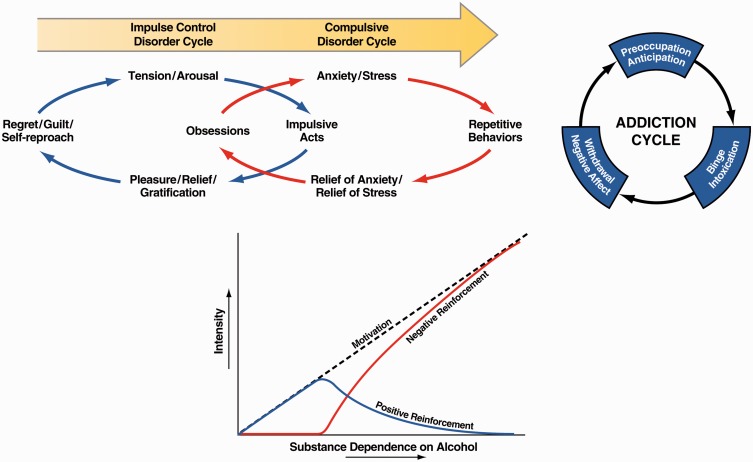
Figure 1.
Figure 1.
(Top left) Diagram showing the stages of impulse control disorder and compulsive disorder cycles related to the sources of reinforcement. In impulse control disorders, an increasing tension and arousal occurs before the impulsive act, with pleasure, gratification, or relief during the act. Following the act, there may or may not be regret or guilt. In compulsive disorders, there are recurrent and persistent thoughts (obsessions) that cause marked anxiety and stress followed by repetitive behaviors (compulsions) that are aimed at preventing or reducing distress. Positive reinforcement (pleasure/gratification) is more closely associated with impulse control disorders. Negative reinforcement (relief of anxiety or relief of stress) is more closely associated with compulsive disorders (taken with permission from Koob). (Top right) Collapsing the cycles of impulsivity and compulsivity results in the addiction cycle, conceptualized as three major components: preoccupation/anticipation, binge/intoxication, and withdrawal/negative affect [taken with permission from Koob). (Bottom) Change in the relative contribution of positive and negative reinforcement constructs during the development of substance dependence on alcohol (taken with permission from Koob).
Figure 2.
Figure 2.
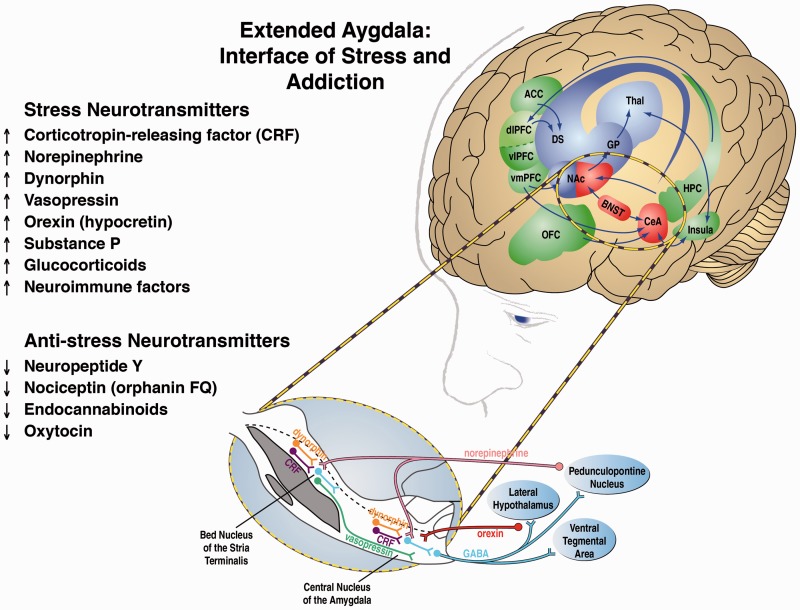
Neural circuitry associated with the three stages of the addiction cycle, with a focus on the withdrawal/negative affect stage and extended amygdala. The targets identified in this review that are relevant to the withdrawal/negative affect stage are listed on the left. On the right is the neurocircuitry of the pathophysiology of addiction. Binge/intoxication stage (blue): Drugs may engage associative mechanisms and reward neurotransmitters (such as dopamine and opioid peptides) in the nucleus accumbens shell and core (incentive salience, defined as a motivational response of the brain to reward-predicting stimuli) and then engage stimulus-response habits that depend on the dorsal striatum. Withdrawal/negative affect stage (red): The negative emotional state of withdrawal engages activation of the extended amygdala. The extended amygdala is composed of several basal forebrain structures, including the bed nucleus of the stria terminalis, central nucleus of the amygdala, and a transition zone in the medial portion (or shell) of the nucleus accumbens. Neurotransmitter systems engaged in the neurocircuitry of the extended amygdala that convey negative emotional states are indicated by upward-pointing arrows, and neurotransmitter systems that may buffer negative emotional states are indicated by downward-pointing arrows. Preoccupation/anticipation (craving) stage (green): This stage involves the prefrontal cortex and includes representations of contingencies, representations of outcomes, and executive function. An important neurotransmitter that is engaged in craving responses is glutamate. The magnified section (blue oval) illustrates the extended amygdala in detail. A major neurotransmitter in the extended amygdala is CRF, which projects to the brainstem where noradrenergic neurons provide a major projection reciprocally to the extended amygdala. Green/blue arrows indicate glutamatergic projections. Acb, nucleus accumbens; ACC, anterior cingulate cortex; BLA, basolateral amygdala; BNST, bed nucleus of the stria terminalis; CeA, central nucleus of the amygdala; CRF, corticotropin-releasing factor; DGP, dorsal globus pallidus; dlPFC, dorsolateral prefrontal cortex; NE, norepinephrine; OFC, orbitofrontal cortex; SNc, substantia nigra pars compacta; VGP, ventral globus pallidus; vlPFC and vmPFC, ventral prefrontal cortex; VTA, ventral tegmental area (modified with permission from Koob and Volkow; see also Koob and Koob and Mason).
Figure 3.
Figure 3.
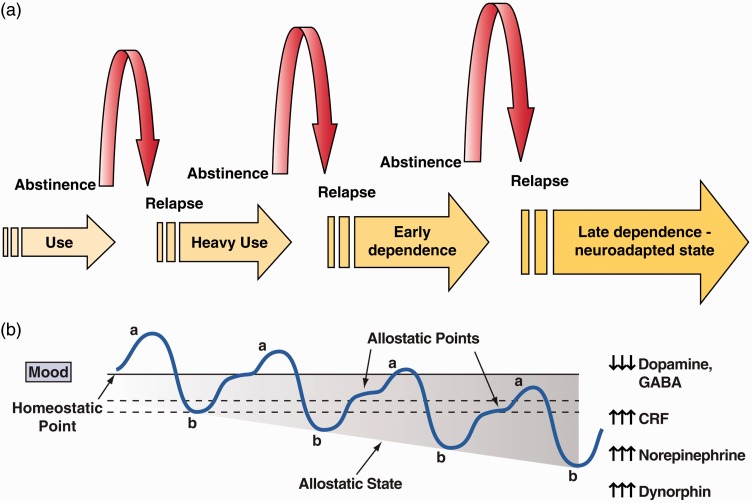
(a) Schematic of the progression of drug and alcohol dependence over time, illustrating the shift in underlying motivational mechanisms. From initial, positive-reinforcing, pleasurable effects of drugs and alcohol, the addiction process progresses over time to being maintained by negative-reinforcing relief from a negative emotional state. Neuroadaptations that encompass the recruitment of extrahypothalamic CRF systems are key to this shift (taken with permission from Heilig and Koob). (b) The a-process represents a positive hedonic or positive mood state, and the b-process represents the negative hedonic or negative mood state. The affective stimulus (state) has been argued to be the sum of both the a-process and the b-process. An individual who experiences a positive hedonic mood state from a drug of abuse with sufficient time between re-administering the drug is hypothesized to retain the a-process. An appropriate counteradaptive opponent process (b-process) that balances the activational process (a-process) does not lead to an allostatic state. The changes in the affective stimulus (state) in an individual with repeated frequent drug use may represent a transition to an allostatic state in the brain reward systems and, by extrapolation, a transition to addiction (see text). Notice that the apparent b-process never returns to the original homeostatic level before drug taking begins again, thus creating a greater and greater allostatic state in the brain reward system. The counteradaptive opponent-process (b-process) does not balance the activational process (a-process) but in fact shows a residual hysteresis. Although these changes that are illustrated in the figure are exaggerated and condensed over time, the hypothesis is that even during post-detoxification (a period of “protracted abstinence”), the reward system still bears allostatic changes. The following definitions apply: allostasis, the process of achieving stability through change; allostatic state, a state of chronic deviation of the regulatory system from its normal (homeostatic) operating level; allostatic load, the cost to the brain and body of the deviation, accumulating over time, and reflecting in many cases pathological states and accumulation of damage (Modified with permission from Koob and Le Moal).

References

    1. Selye H. A syndrome produced by diverse nocuous agents. Nature 1936; 138: 32. - PubMed
    1. Burchfield S. The stress response: a new perspective. Psychosom Med 1979; 41: 661–672. - PubMed
    1. Mason JW. A re-evaluation of the concept of “non-specificity” in stress theory. J Psychiatr Res 1971; 8: 323–333. - PubMed
    1. Vale W, Spiess J, Rivier C, et al. Characterization of a 41-residue ovine hypothalamic peptide that stimulates the secretion of corticotropin and -endorphin. Science 1981; 213: 1394–1397. - PubMed
    1. Goldstein R, Smith SM, Chou SP, et al. The epidemiology of DSM-5 post traumatic stress disorder in the United States. Soc Psychiatry Psychiatr Epidemiol 2016; 51: 1137–1148. - PMC - PubMed

LinkOut - more resources