. 2017 Aug;55(8):10.1002/dvg.23044.
doi: 10.1002/dvg.23044. Epub 2017 Jul 12.

RICE CRISPR: Rapidly increased cut ends by an exonuclease Cas9 fusion in zebrafish

Affiliations

RICE CRISPR: Rapidly increased cut ends by an exonuclease Cas9 fusion in zebrafish

Thomas P Clements et al. Genesis. 2017 Aug.

Abstract

Application of CRISPR-Cas9 technology in diverse organisms has resulted in an explosion of genome modification efforts. To expand the toolbox of applications, we have created an E. coli Exonuclease I (sbcB)-Cas9 fusion that has altered enzymatic activity in zebrafish embryos. This Cas9 variant has increased mutation efficiency and favors longer deletions relative to wild-type Cas9. We anticipate that this variant will allow for more efficient screening for F0 phenotypes and mutation of a larger spectrum of genomic targets including deletion of regulatory regions and creating loss of function mutations in transcription units with poor sequence conservation such as lncRNAs where larger deletions may be required for loss of function.

Keywords: Danio rerio; S. pyogenes Cas9; targeted mutagenesis.


Conflict of interest statement

The authors have no conflicts to declare.

Figures
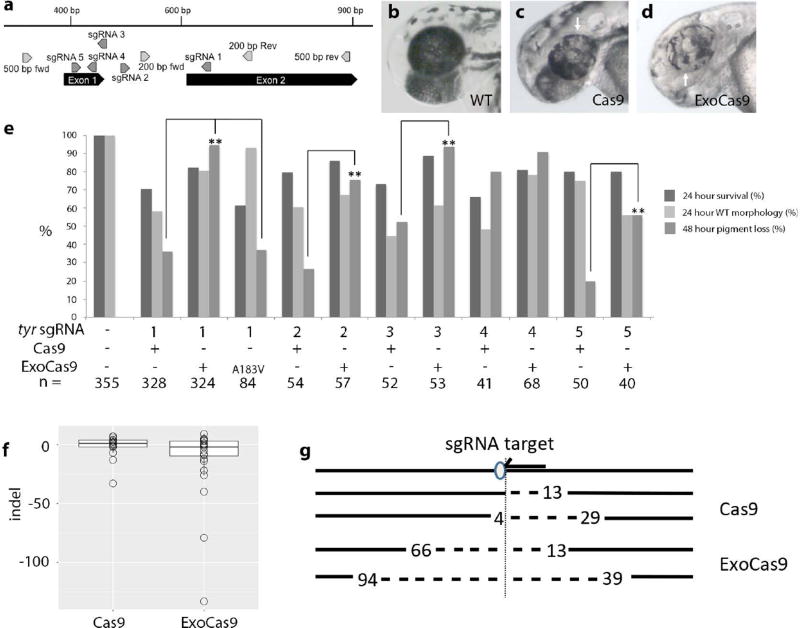
Figure 1
Figure 1. Visualization of CRISPR targeting, frequency of lesions produced by ExoCas9 and Cas9 in tyrosinase in the F0 generation, and quantification
(a) Gene diagram for region of interest in tyrosinase. (b–d) tyrosinase targeting results in mosaic loss of pigment 2 dpf; wild type (b), Cas9 mutant (c), and ExoCas9 mutant (d). Areas of pigment loss in the eye are indicated by a white arrow in (c–d). (e) Survival and pigment loss induced with 5 different tyrosinase sgRNAs at 48 hpf for Cas9, ExoCas9 and A183V ExoCas9 (* = p < 0.05 and ** = p < 0.005). (f) Box and whisker plots of insertions and deletions produced by Cas9 (left) and ExoCas9 (right). The line in the middle of the box is the median value. The box itself represents surrounds the middle 50%, with the whiskers are first 25th (top) percentile and last 75th percentile (bottom). (g) Directionality of deletions shown relative sgRNA target (arrow) and protospacer adjacent motif (PAM, oval), followed by the two largest Cas9 deletions (dotted line and length relative to the PAM is indicated numerically), followed by the two largest ExoCas9 deletions
Figure 2
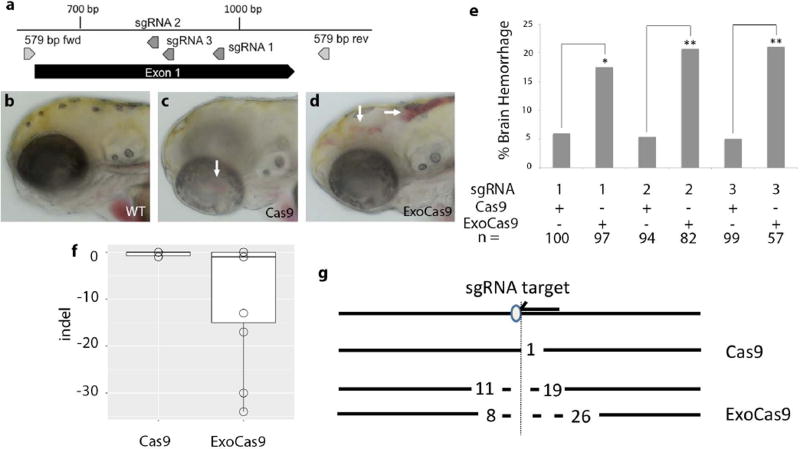
Figure 2. Visualization of CRISPR targeting, frequency of lesions produced by ExoCas9 and Cas9 in tgfbr2b in the F0 generation, and quantification
(a) Gene diagram for region of interest in tgfbr2b. (b–d) tgfbr2b targeting results in brain hemorrhage 3 dpf; wild type (b), Cas9 mutant (c), and ExoCas9 mutant (d). Areas of brain hemorrhage indicated by a white arrows in (c–d). (e) tgfbr2b CRISPR induced brain hemorrhage rates from 3–5 dpf. (f) Box and whisker plots of insertions and deletions produced by Cas9 (left) and ExoCas9 (right). (g) Directionality of deletions shown relative sgRNA target (arrow) and protospacer adjacent motif (PAM, oval), followed by the two largest Cas9 deletions (dotted line and length relative to the PAM is indicated numerically), followed by the two largest ExoCas9 deletions.
Figure 3
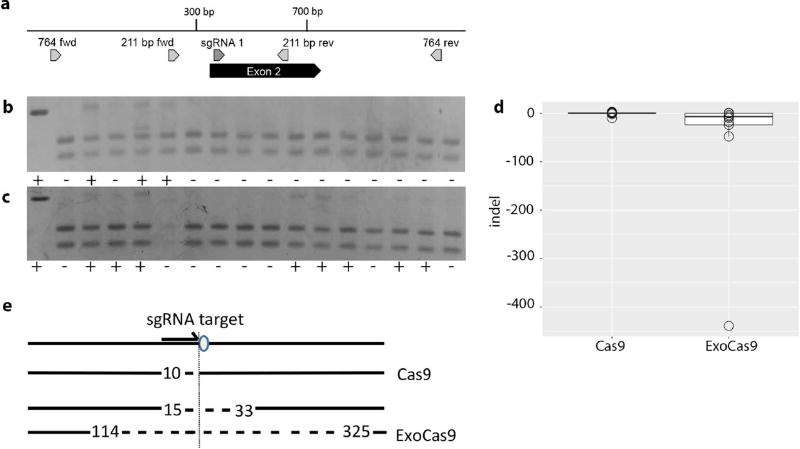
Figure 3. Frequency of lesions produced by ExoCas9 and Cas9 in ripk4 in the F0 generation and quantification
(a) Gene diagram for region of interest in ripk4. (b) ripk4 Cas9 and (c) ripk4 ExoCas9 targeting is confirmed and quantified through RFLP analysis, positive (+) (WT uncut) and negative (−) in the first box to the left followed by the experimental runs to the right. (d). Box and whisker plots of insertions and deletions produced by Cas9 (left) and ExoCas9 (right). (e) Directionality of deletions shown relative sgRNA target (arrow) and protospacer adjacent motif (PAM, oval), followed by the largest Cas9 deletion (length relative to the PAM is indicated numerically), followed by the two largest ExoCas9 deletions.

References

    1. Carrington B, Varshney GK, Burgess SM, Sood R. CRISPR-STAT: an easy and reliable PCR-based method to evaluate target-specific sgRNA activity. Nucleic Acids Res. 2015 gkv802. - PMC - PubMed
    1. Chen B, Gilbert LA, Cimini BA, Schnitzbauer J, Zhang W, Li G-W, Park J, Blackburn EH, Weissman JS, Qi LS, et al. Dynamic Imaging of Genomic Loci in Living Human Cells by an Optimized CRISPR/Cas System. Cell. 2013;155:1479–1491. - PMC - PubMed
    1. Fatica A, Bozzoni I. Long non-coding RNAs: new players in cell differentiation and development. Nat. Rev. Genet. 2014;15:7–21. - PubMed
    1. Gagnon JA, Valen E, Thyme SB, Huang P, Ahkmetova L, Pauli A, Montague TG, Zimmerman S, Richter C, Schier AF. Efficient Mutagenesis by Cas9 Protein-Mediated Oligonucleotide Insertion and Large-Scale Assessment of Single-Guide RNAs. PLoS ONE. 2014;9:e98186. - PMC - PubMed
    1. Haeussler M, Schönig K, Eckert H, Eschstruth A, Mianné J, Renaud J-B, Schneider-Maunoury S, Shkumatava A, Teboul L, Kent J, et al. Evaluation of off-target and on-target scoring algorithms and integration into the guide RNA selection tool CRISPOR. Genome Biol. 2016;17:148. - PMC - PubMed

Substances

LinkOut - more resources