


The role of IL-23 and the IL-23/TH 17 immune axis in the pathogenesis and treatment of psoriasis
- PMID: 28653490
- PMCID: PMC5697699
- DOI: 10.1111/jdv.14433
The role of IL-23 and the IL-23/TH 17 immune axis in the pathogenesis and treatment of psoriasis
Abstract
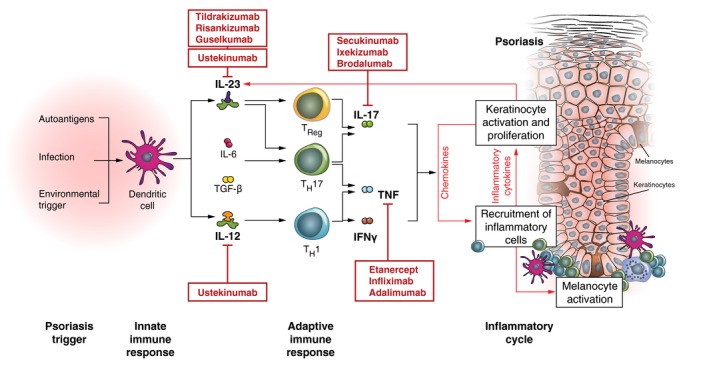
Psoriasis is a chronic, immune-mediated disease affecting more than 100 million people worldwide and up to 2.2% of the UK population. The aetiology of psoriasis is thought to originate from an interplay of genetic, environmental, infectious and lifestyle factors. The manner in which genetic and environmental factors interact to contribute to the molecular disease mechanisms has remained elusive. However, the interleukin 23 (IL-23)/T-helper 17 (TH 17) immune axis has been identified as a major immune pathway in psoriasis disease pathogenesis. Central to this pathway is the cytokine IL-23, a heterodimer composed of a p40 subunit also found in IL-12 and a p19 subunit exclusive to IL-23. IL-23 is important for maintaining TH 17 responses, and levels of IL-23 are elevated in psoriatic skin compared with non-lesional skin. A number of agents that specifically inhibit IL-23p19 are currently in development for the treatment of moderate-to-severe plaque psoriasis, with recent clinical trials demonstrating efficacy with a good safety and tolerability profile. These data support the role of this cytokine in the pathogenesis of psoriasis. A better understanding of the IL-23/TH 17 immune axis is vital and will promote the development of additional targets for psoriasis and other inflammatory diseases that share similar genetic aetiology and pathogenetic pathways.
© 2017 The Authors. Journal of the European Academy of Dermatology and Venereology published by John Wiley & Sons Ltd on behalf of European Academy of Dermatology and Venereology.
Figures
References
Publication types
MeSH terms
Substances
LinkOut - more resources
Full Text Sources
Other Literature Sources
Medical
