


Circulating Endocannabinoids: From Whence Do They Come and Where are They Going?
- PMID: 28653665
- PMCID: PMC5719092
- DOI: 10.1038/npp.2017.130
Circulating Endocannabinoids: From Whence Do They Come and Where are They Going?
Abstract
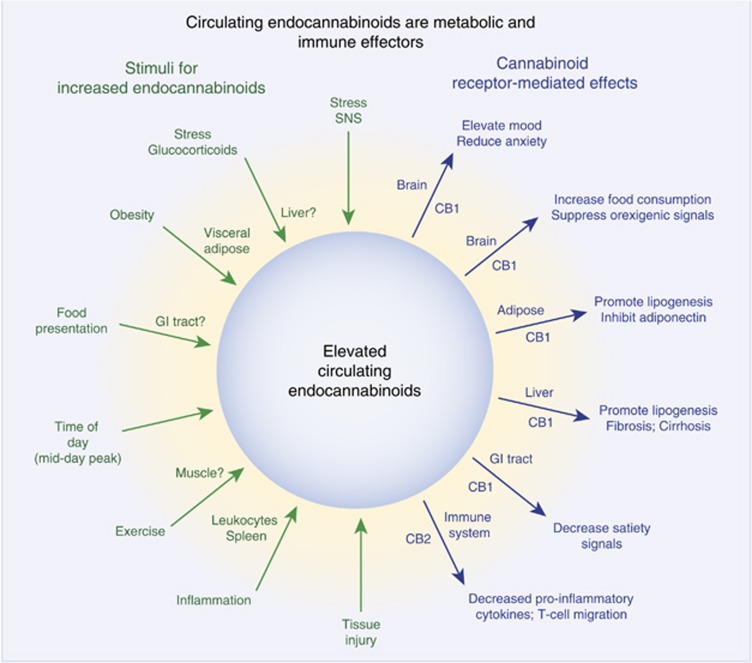
The goal of this review is to summarize studies in which concentrations of circulating endocannabinoids in humans have been examined in relationship to physiological measurements and pathological status. The roles of endocannabinoids in the regulation of energy intake and storage have been well studied and the data obtained consistently support the hypothesis that endocannabinoid signaling is associated with increased consumption and storage of energy. Physical exercise mobilizes endocannabinoids, which could contribute to refilling of energy stores and also to the analgesic and mood-elevating effects of exercise. Circulating concentrations of 2-arachidonoylglycerol are very significantly circadian and dysregulated when sleep is disrupted. Other conditions under which circulating endocannabinoids are altered include inflammation and pain. A second important role for endocannabinoid signaling is to restore homeostasis following stress. Circulating endocannabinoids are stress-responsive and there is evidence that their concentrations are altered in disorders associated with excessive stress, including post-traumatic stress disorder. Although determination of circulating endocannabinoids can provide important information about the state of endocannabinoid signaling and thus allow for hypotheses to be defined and tested, the large number of physiological factors that contribute to their circulating concentrations makes it difficult to use them in isolation as a biomarker for a specific disorder.
Figures
References
-
- Abdulnour J, Yasari S, Rabasa-Lhoret R, Faraj M, Petrosino S, Piscitelli F et al (2014). Circulating endocannabinoids in insulin sensitive vs. insulin resistant obese postmenopausal women. A MONET group study. Obesity (Silver Spring) 22: 211–216. - PubMed
-
- Allen AP, Kennedy PJ, Cryan JF, Dinan TG, Clarke G (2014). Biological and psychological markers of stress in humans: focus on the Trier Social Stress Test. Neurosci Biobehav Rev 38: 94–124. - PubMed
-
- Altamura C, Ventriglia M, Martini MG, Montesano D, Errante Y, Piscitelli F et al (2015). Elevation of plasma 2-arachidonoylglycerol levels in Alzheimer's disease patients as a potential protective mechanism against neurodegenerative decline. J Alzheimers Dis 46: 497–506. - PubMed
-
- Amoako AA, Marczylo TH, Lam PM, Willets JM, Derry A, Elson J et al (2010). Quantitative analysis of anandamide and related acylethanolamides in human seminal plasma by ultra performance liquid chromatography tandem mass spectrometry. J Chromatogr B Analyt Technol Biomed Life Sci 878: 3231–3237. - PubMed
-
- Antunes HK, Leite GS, Lee KS, Barreto AT, Santos RV, Souza Hde S et al (2016). Exercise deprivation increases negative mood in exercise-addicted subjects and modifies their biochemical markers. Physiol Behav 156: 182–190. - PubMed
Publication types
MeSH terms
Substances
Grants and funding
LinkOut - more resources
Full Text Sources
Other Literature Sources
Medical
