Effect of Electroacupuncture on Urinary Leakage Among Women With Stress Urinary Incontinence: A Randomized Clinical Trial
- PMID: 28655016
- PMCID: PMC5815072
- DOI: 10.1001/jama.2017.7220
Effect of Electroacupuncture on Urinary Leakage Among Women With Stress Urinary Incontinence: A Randomized Clinical Trial
Abstract
Importance: Electroacupuncture involving the lumbosacral region may be effective for women with stress urinary incontinence (SUI), but evidence is limited.
Objective: To assess the effect of electroacupuncture vs sham electroacupuncture for women with SUI.
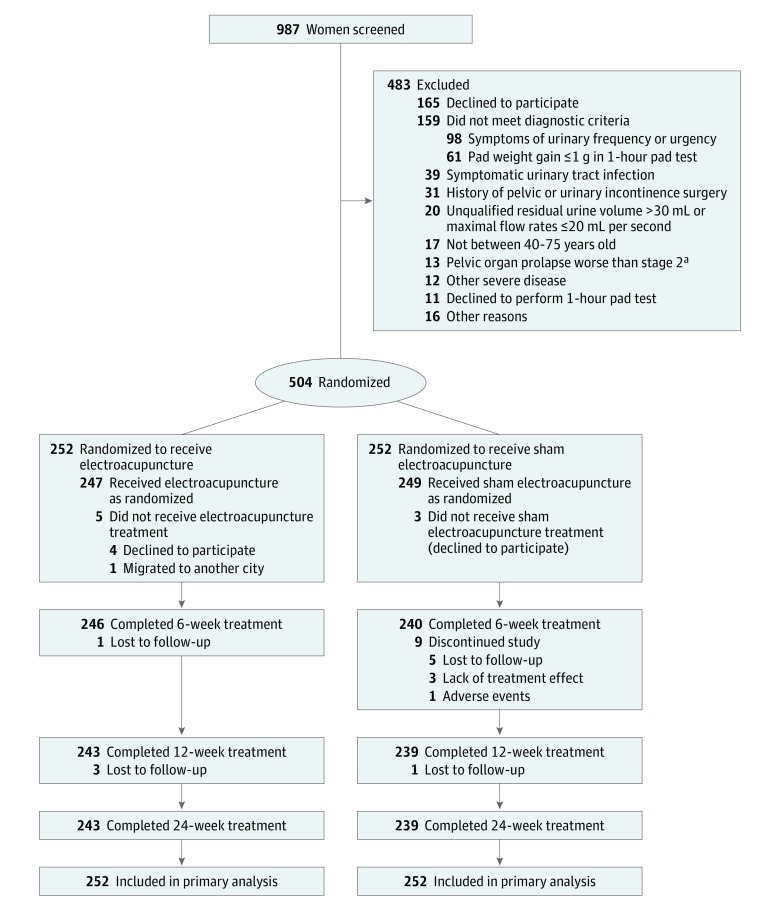
Design, setting, and participants: Multicenter, randomized clinical trial conducted at 12 hospitals in China and enrolling 504 women with SUI between October 2013 and May 2015, with data collection completed in December 2015.
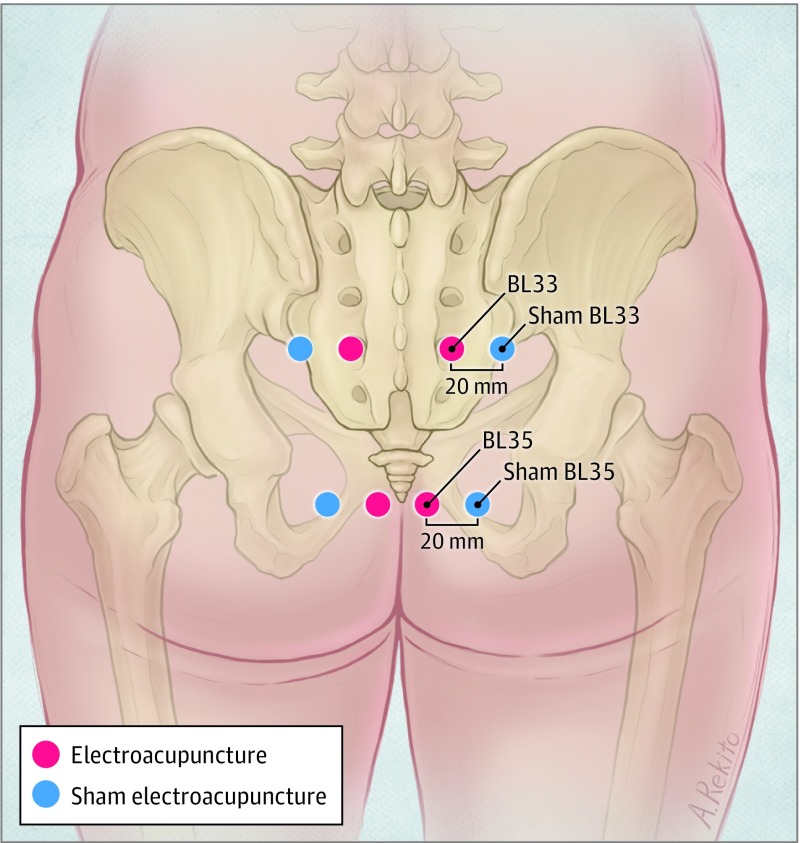
Interventions: Participants were randomly assigned (1:1) to receive 18 sessions (over 6 weeks) of electroacupuncture involving the lumbosacral region (n = 252) or sham electroacupuncture (n = 252) with no skin penetration on sham acupoints.
Main outcomes and measures: The primary outcome was change from baseline to week 6 in the amount of urine leakage, measured by the 1-hour pad test. Secondary outcomes included mean 72-hour urinary incontinence episodes measured by a 72-hour bladder diary (72-hour incontinence episodes).
Results: Among the 504 randomized participants (mean [SD] age, 55.3 [8.4] years), 482 completed the study. Mean urine leakage at baseline was 18.4 g for the electroacupuncture group and 19.1 g for the sham electroacupuncture group. Mean 72-hour incontinence episodes were 7.9 for the electroacupuncture group and 7.7 for the sham electroacupuncture group. At week 6, the electroacupuncture group had greater decrease in mean urine leakage (-9.9 g) than the sham electroacupuncture group (-2.6 g) with a mean difference of 7.4 g (95% CI, 4.8 to 10.0; P < .001). During some time periods, the change in the mean 72-hour incontinence episodes from baseline was greater with electroacupuncture than sham electroacupuncture with between-group differences of 1.0 episode in weeks 1 to 6 (95% CI, 0.2-1.7; P = .01), 2.0 episodes in weeks 15 to 18 (95% CI, 1.3-2.7; P < .001), and 2.1 episodes in weeks 27 to 30 (95% CI, 1.3-2.8; P < .001). The incidence of treatment-related adverse events was 1.6% in the electroacupuncture group and 2.0% in the sham electroacupuncture group, and all events were classified as mild.
Conclusions and relevance: Among women with stress urinary incontinence, treatment with electroacupuncture involving the lumbosacral region, compared with sham electroacupuncture, resulted in less urine leakage after 6 weeks. Further research is needed to understand long-term efficacy and the mechanism of action of this intervention.
Trial registration: clinicaltrials.gov Identifier: NCT01784172.
Conflict of interest statement
Figures
Comment in
-
Acupuncture and the Complex Connections Between the Mind and the Body.JAMA. 2017 Jun 27;317(24):2489-2490. doi: 10.1001/jama.2017.7214. JAMA. 2017. PMID: 28654992 No abstract available.
-
Acupuncture for Stress Urinary Incontinence.JAMA. 2017 Oct 17;318(15):1500. doi: 10.1001/jama.2017.13424. JAMA. 2017. PMID: 29049649 No abstract available.
-
Electroacupuncture Reduces Incontinence Episodes in Women With Stress Urinary Incontinence.Explore (NY). 2018 Jan-Feb;14(1):96-98. doi: 10.1016/j.explore.2017.10.007. Epub 2017 Nov 21. Explore (NY). 2018. PMID: 29217222 No abstract available.
-
Re: Effect of Electroacupuncture on Urinary Leakage among Women with Stress Urinary Incontinence: A Randomized Clinical Trial.J Urol. 2018 Jan;199(1):34-35. doi: 10.1016/j.juro.2017.09.111. Epub 2017 Oct 10. J Urol. 2018. PMID: 29310197 No abstract available.
-
Re: Effect of Electroacupuncture on Urinary Leakage among Women with Stress Urinary Incontinence: A Randomized Clinical Trial.J Urol. 2018 Jan;199(1):35-36. doi: 10.1016/j.juro.2017.09.112. Epub 2017 Oct 10. J Urol. 2018. PMID: 29310198 No abstract available.
References
-
- Abrams P, Cardozo L, Fall M, et al. ; Standardisation Sub-Committee of the International Continence Society . The standardisation of terminology in lower urinary tract function: report from the standardisation sub-committee of the International Continence Society. Urology. 2003;61(1):37-49. - PubMed
-
- Kobashi KC, Albo ME, Dmochowski RR, et al. Surgical Treatment of Female Stress Urinary Incontinence (SUI): AUA/SUFU Guideline. 2017. http://www.auanet.org/guidelines/stress-urinary-incontinence-(sui)-new-(aua/sufu-guideline-2017). Accessed May 20, 2017.
-
- Sinclair AJ, Ramsay IN. The psychosocial impact of urinary incontinence in women. The Obstetrician & Gynaecologist. 2011;13(3):143-148. doi: 10.1576/toag.13.3.143.27665 - DOI
-
- Mo Q, Ma X, Liu Z. Curative effect observation on the treatment of female stress urinary incontinence with electro-acupuncture [Article in Chinese]. Beijing Journal of Traditional Chinese Medicine. 2013;32(6):434-436.
Publication types
MeSH terms
Associated data
LinkOut - more resources
Full Text Sources
Other Literature Sources
Medical