Review
. 2017 Dec 8;31(1):1-10.
doi: 10.1093/ajh/hpx109.

Air Pollution and Cardiometabolic Disease: An Update and Call for Clinical Trials

Affiliations
Review

Air Pollution and Cardiometabolic Disease: An Update and Call for Clinical Trials

Robert D Brook et al. Am J Hypertens. .

Abstract

Fine particulate matter <2.5 µm (PM2.5) air pollution is a leading cause of global morbidity and mortality. The largest portion of deaths is now known to be due to cardiovascular disorders. Several air pollutants can trigger acute events (e.g., myocardial infarctions, strokes, heart failure). However, mounting evidence additionally supports that longer-term exposures pose a greater magnified risk to cardiovascular health. One explanation may be that PM2.5 has proven capable of promoting the development of chronic cardiometabolic conditions including atherosclerosis, hypertension, and diabetes mellitus. Here, we provide an updated overview of recent major studies regarding the impact of PM2.5 on cardiometabolic health and outline key remaining scientific questions. We discuss the relevance of emerging trials evaluating personal-level strategies (e.g., facemasks) to prevent the harmful effects of PM2.5, and close with a call for large-scale outcome trials to allow for the promulgation of formal evidence-base recommendations regarding their appropriate usage in the global battle against air pollution.

Keywords: blood pressure; cardiovascular; diabetes mellitus; hypertension; morbidity; pollutants; prevention.


Figures

Figure 1.
Figure 1.
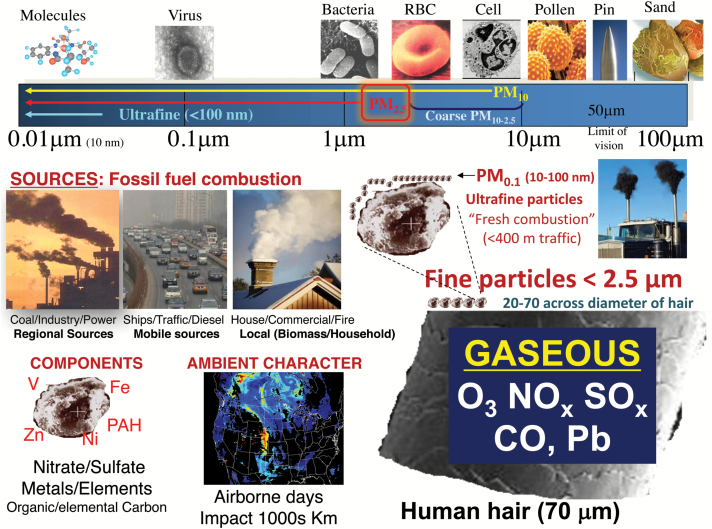
The complex mixture of air pollution. The combustion of from fossil fuels (coal, oil, gas, diesel) from a variety of sources (industry, traffic, power-generation, shipping) produces gaseous and particulate pollutants. Ultrafine particles (UFP) smaller than 100 nm are generally short-lived species (airborne hours) directly derived from and at highest concentrations nearby (<100–400 m) fresh combustion sources (traffic, diesel). Fine particles <2.5 µm in diameter (PM2.5) are larger yet still many times smaller than the diameter of a human hair. They are a heterogenous amalgam of numerous compounds formed from combustion (metals, carbon species) or secondarily involving reactions in the atmosphere (nitrates, sulfates). PM2.5 may be longer-lived (airborne days) and transported hundreds of miles impacting entire regions, all of which is influenced by geography and meteorological conditions. PM concentration is measured in µg/m3, with WHO AQG set at <10 µg/m3 for an annual average. For typical days in US cities, the levels range within 24-hour standards (5–35 µg/m3). In China, peak levels exceed 250–500 µg/m3 which is on par with that of secondhand smoke in indoor venues. However, the exposure dose from the active smoking of a pack of cigarettes is at least 100 times greater. Abbreviations: CO, carbon monoxide; NOx, nitrogen oxides; O3, ozone; PAH, polycyclic aromatic hydrocarbon; SOx, oxides of sulfur.
Figure 2.
Figure 2.
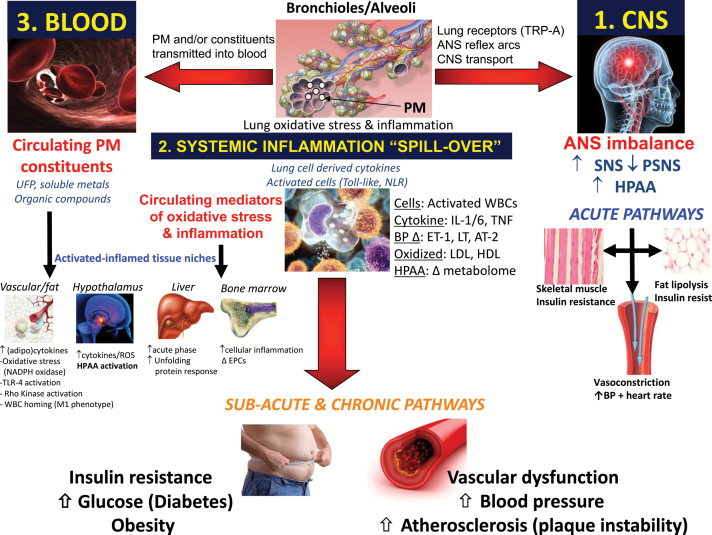
Biological pathways whereby PM2.5 promotes cardiovascular events. Inhaled PM2.5 deposit deep within pulmonary tissues (i.e., alveoli) and interact/activate local cells (e.g., resident macrophages, dendritic cells, alveolar/endothelial cells) and modify endogenous structures (e.g., cell membranes, surfactant lipids, antioxidants). Mediators of oxidative stress (e.g., free radicals) directly generated by particulate compounds (metals, organic species) or secondarily produced (e.g., modified phospholipids) by activated cellular enzyme systems (e.g., NADPH oxidase) can instigate a local inflammatory response. Several innate immune pathways may be important in coordinating this response such as via activated toll-like receptors (TLR). In pathway 1, the inhaled particles and/or oxidative stress impact a variety of afferent nerves (e.g., transient receptor potential receptors [TRP]) and rapidly alter central nervous system (CNS) autonomic nervous system (ANS) balance typically favoring sympathetic (SNS) activity over parasympathetic (PSNS) nervous system activity. In pathway 2, numerous mediators of inflammation and oxidative stress generated in the lungs (e.g., cytokines, activated immune cells, oxidized lipids) “spill-over” into the systemic circulation and thereafter carry this danger signal to remote cardiovascular tissues. In hypothetical pathway 3, nanoparticles (10–30 nm) or particulate components penetrate lung barriers and are carried within immune cells or lipoproteins or directly reach the systemic circulation. Harmful chemicals (organic carbon species, metals) deposit into cardiovascular tissues and elicit inflammatory-oxidative stress responses without the need for the signal to be indirectly transmitted via pathway 2. Abbreviations: BP, blood pressure; HPAA, hypothalamic pituitary adrenal axis; PM, particulate matter; UFP, ultrafine particles.

References

    1. Brook RD, Weder AB, Rajagopalan S. “Environmental hypertensionology” the effects of environmental factors on blood pressure in clinical practice and research. J Clin Hypertens (Greenwich) 2011; 13:836–842. - PMC - PubMed
    1. Lelieveld J, Evans JS, Fnais M, Giannadaki D, Pozzer A. The contribution of outdoor air pollution sources to premature mortality on a global scale. Nature 2015; 525:367–371. - PubMed
    1. World Health Organization, Health Topics: Air Pollution. <http://www.who.int/topics/air_pollution/en/>. Accessed 20 February 17.
    1. GBD 2015 Risk Factors Collaborators. Global, regional, and national comparative risk assessment of 79 behavioural, environmental and occupational, and metabolic risks or clusters of risks, 1990–2015: a systematic analysis for the Global Burden of Disease Study 2015. Lancet 2016; 388:1659–1724. - PMC - PubMed
    1. Baldauf RW, Devlin RB, Gehr P, Giannelli R, Hassett-Sipple B, Jung H, Martini G, McDonald J, Sacks JD, Walker K. Ultrafine particle metrics and research considerations: review of the 2015 UFP Workshop. Int J Environ Res Public Health 2016; 13:E1054. - PMC - PubMed

MeSH terms

Substances