. 2017 Dec 21;38(48):3579-3587.
doi: 10.1093/eurheartj/ehx315.

TRAK2, a novel regulator of ABCA1 expression, cholesterol efflux and HDL biogenesis

Affiliations

TRAK2, a novel regulator of ABCA1 expression, cholesterol efflux and HDL biogenesis

Nicole J Lake et al. Eur Heart J. .

Abstract

Aims: The recent failures of HDL-raising therapies have underscored our incomplete understanding of HDL biology. Therefore there is an urgent need to comprehensively investigate HDL metabolism to enable the development of effective HDL-centric therapies. To identify novel regulators of HDL metabolism, we performed a joint analysis of human genetic, transcriptomic, and plasma HDL-cholesterol (HDL-C) concentration data and identified a novel association between trafficking protein, kinesin binding 2 (TRAK2) and HDL-C concentration. Here we characterize the molecular basis of the novel association between TRAK2 and HDL-cholesterol concentration.

Methods and results: Analysis of lymphocyte transcriptomic data together with plasma HDL from the San Antonio Family Heart Study (n = 1240) revealed a significant negative correlation between TRAK2 mRNA levels and HDL-C concentration, HDL particle diameter and HDL subspecies heterogeneity. TRAK2 siRNA-mediated knockdown significantly increased cholesterol efflux to apolipoprotein A-I and isolated HDL from human macrophage (THP-1) and liver (HepG2) cells by increasing the mRNA and protein expression of the cholesterol transporter ATP-binding cassette, sub-family A member 1 (ABCA1). The effect of TRAK2 knockdown on cholesterol efflux was abolished in the absence of ABCA1, indicating that TRAK2 functions in an ABCA1-dependent efflux pathway. TRAK2 knockdown significantly increased liver X receptor (LXR) binding at the ABCA1 promoter, establishing TRAK2 as a regulator of LXR-mediated transcription of ABCA1.

Conclusion: We show, for the first time, that TRAK2 is a novel regulator of LXR-mediated ABCA1 expression, cholesterol efflux, and HDL biogenesis. TRAK2 may therefore be an important target in the development of anti-atherosclerotic therapies.

Keywords: ABCA1; Atherosclerosis; Cholesterol; Genetics; HDL; TRAK2.


Figures

Figure 1
Figure 1
TRAK2 siRNA-mediated knockdown induces cholesterol efflux and apoA-I expression. (A) siRNA-mediated gene knockdown significantly decreased TRAK2 expression in hepatic HepG2, THP-1 macrophage, and FHs74INT intestinal cells relative to non-targeting control (NTGC) siRNA; n = 4 independent experiments. (B) Cholesterol efflux to apoA-I and HDL was significantly increased following siRNA-mediated knockdown of TRAK2 in HepG2 and THP-1 macrophage cells, relative to NTGC siRNA. Transfection of FHs74INT cells with TRAK2 siRNA did not significantly affect cholesterol efflux; n = 3–4 independent experiments. (C) siRNA-mediated knockdown of TRAK2 significantly increased HDL production in HepG2 cells relative to NTGC siRNA; n = 5 biological replicates. (D) TRAK2 knockdown significantly increased APOA1 mRNA expression relative to NTGC siRNA in HepG2 cells; n = 5 independent experiments. Data are represented as the mean ± standard deviation of n.
Figure 2
Figure 2
The effect of TRAK2 on ABCA1, ABCG1, and SR-BI expression. (A) TRAK2 knockdown in HepG2 and THP-1 macrophage cells significantly increased ABCA1 mRNA expression, significantly decreased SCARB1 mRNA levels, but had no significant effect on ABCG1 mRNA expression levels relative to non-targeting control (NTGC) siRNA; n = 4. (B) siRNA-mediated knockdown of TRAK2 increased ABCA1 abundance but had no marked effect on ABCG1 or SR-BI protein levels relative to NTGC siRNA in HepG2 cells. (C) TRAK2 knockdown significantly increased ABCA1 protein levels. There was no significant difference in ABCG1 or SR-BI protein expression; n = 2. Data are represented as the mean ± standard deviation of n independent experiments.
Figure 3
Figure 3
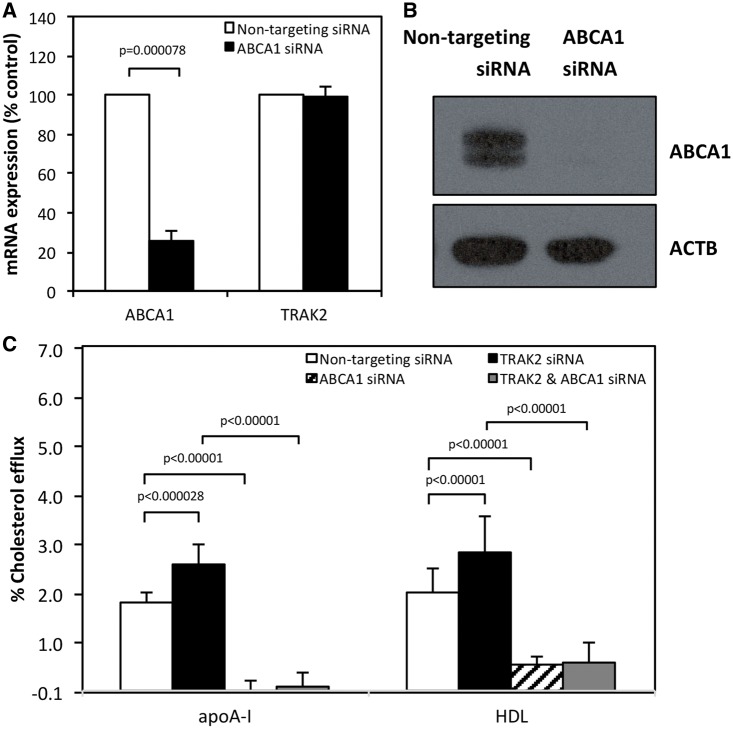
TRAK2’s effect on cholesterol efflux is dependent on ABCA1. (A) siRNA-mediated gene knockdown of ABCA1 significantly decreased ABCA1 mRNA expression relative to non-targeting control (NTGC) siRNA in HepG2 cells. TRAK2 mRNA expression was not affected by knockdown of ABCA1; n = 3. (B) siRNA-mediated knockdown of ABCA1 ablated protein expression in HepG2 cells. (C) TRAK2 siRNA treatment significantly increased cholesterol efflux while transfection with ABCA1 siRNA, or with both TRAK2 and ABCA1 siRNA, ablated cholesterol efflux to apoA-I and to HDL relative to NTGC siRNA in HepG2 cells; n = 3. Data are represented as the mean ± standard deviation of n independent experiments.
Figure 4
Figure 4
The effect of Cyclosporine A (CsA) treatment on cholesterol efflux and ABCA1 gene expression. (A) ABCA1 mRNA expression was significantly reduced in HepG2 cells treated with CsA relative to vehicle control. TRAK2 knockdown significantly increased the expression of ABCA1 in cells treated with CsA relative to non-targeting control (NTGC) siRNA; n = 2. (B) CsA treatment suppressed cholesterol efflux to apoA-I in HepG2 cells transfected with NTGC siRNA. TRAK2 siRNA treatment significantly increased cholesterol efflux to apoA-I relative to NTGC siRNA; n = 3. Data are represented as the mean ± standard deviation of n independent experiments.
Figure 5
Figure 5
TRAK2 siRNA-mediated knockdown increases LXR-α binding to the ABCA1 promoter in HepG2 cells. TO901317 treatment and siRNA-mediated knockdown of TRAK2 treatment significantly increased LXR-α binding to LXR-α response element regions within the ABCA1 promoter relative to control. Treatment with TO901317 diminished the effect of TRAK2 knockdown. Data are represented as the mean ± standard deviation of three independent experiments.
Figure 6
Figure 6
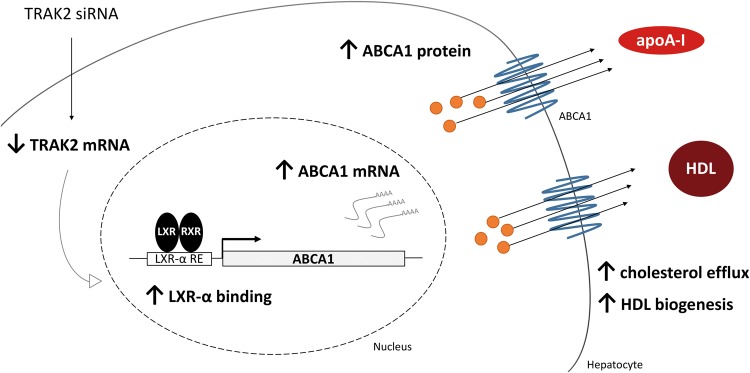
Summary of key findings. TRAK2 siRNA-mediated knockdown significantly increases LXR-α binding at LXR response elements (LXR RE) in the ABCA1 promoter, which increases ABCA1 mRNA and protein expression. This leads to an increase in cholesterol efflux to both apoA-I and isolated HDL particles. Therefore low-TRAK2 levels can promote both HDL biogenesis and RCT.

Comment in

  • Making sense of a seemingly odd connection.
    Fogelman AM, Reddy ST. Fogelman AM, et al. Eur Heart J. 2017 Dec 21;38(48):3588-3589. doi: 10.1093/eurheartj/ehx506. Eur Heart J. 2017. PMID: 29020393 Free PMC article. No abstract available.

References

    1. Kingwell BA, Chapman MJ, Kontush A, Miller NE.. HDL-targeted therapies: progress, failures and future. Nat Rev Drug Discov 2014;13:445–464. - PubMed
    1. Khera AV, Cuchel M, de la Llera-Moya M, Rodrigues A, Burke MF, Jafri K, French BC, Phillips JA, Mucksavage ML, Wilensky RL, Mohler ER, Rothblat GH, Rader DJ.. Cholesterol efflux capacity, high-density lipoprotein function, and atherosclerosis. N Engl J Med 2011;364:127–135. - PMC - PubMed
    1. Cuchel M, Rader DJ.. Macrophage reverse cholesterol transport: key to the regression of atherosclerosis? Circulation 2006;113:2548–2555. - PubMed
    1. Zhao C, Dahlman-Wright K.. Liver X receptor in cholesterol metabolism. J Endocrinol 2010;204:233–240. - PubMed
    1. Sabol SL, Brewer HB Jr, Santamarina-Fojo S.. The human ABCG1 gene: identification of LXR response elements that modulate expression in macrophages and liver. J Lipid Res 2005;46:2151–2167. - PubMed

Publication types

MeSH terms