


25 (OH) D3 levels, incidence and recurrence of different clinical forms of benig paroxysmal positional vertigo
- PMID: 28655524
- PMCID: PMC9449225
- DOI: 10.1016/j.bjorl.2017.05.007
25 (OH) D3 levels, incidence and recurrence of different clinical forms of benig paroxysmal positional vertigo
Abstract
Introduction: Benign paroxysmal positional vertigo is the most common cause of dizziness in the general population. It is a condition with potential impact of reduced levels of vitamin D on its recurrent attacks.
Objectives: The aim of this study was to measure the serum levels of 25-hydroxyvitamin D3 (25-OH D3) in patients with benign paroxysmal positional vertigo and determine whether there is a difference in the serum levels of vitamin D3 between patients with and without recurrence, as well as between the different clinical forms of benign paroxysmal positional vertigo.
Methods: The study included 40 patients who came to the regular medical examination, diagnosed with posterior canal-benign paroxysmal positional vertigo based on the positive Dix-Hallpike's test. All patients underwent Epley manoeuvre after the diagnosis. Patients were classified according to current guidelines for levels of vitamin D3 in the serum in three groups: the deficiency, insufficiency and adequate level.
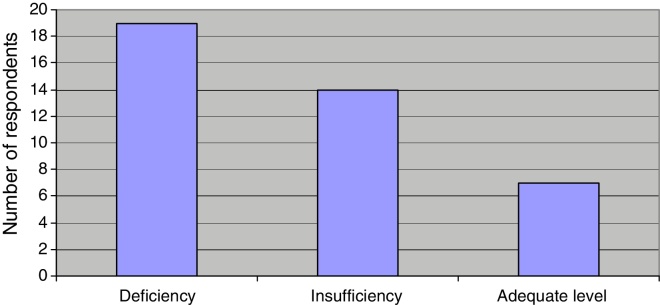
Results: The average serum level of 25-OH D3 among respondents was 20.78ng/mL, indicating a lack or insufficiency of the aforementioned 25-OH D3. According to the levels of 25-OH D3, most patients suffer from deficiency (47.5%). 7 (17.5%) respondents had adequate blood level of 25-OH D3, and 14 (35%) respondents suffer from insufficiency. A significant difference was not found in the serum level of 25-OH D3 between patients with and without benign paroxysmal positional vertigo recurrence. There was a significant difference in the serum levels of 25-OH D3 in comparison to the clinical form of the disease. Lower 25-OH D3 values were found in patients with canalithiasis compared to those with cupulolithiasis.
Conclusions: There were no significant differences in the vitamin D3 serum level in patients with and without recurrence. The study showed a low level of serum vitamin D3 in most patients, indicating the need for supplemental therapy.
Introdução: Vertigem posicional paroxística benigna é a causa mais comum de tonturas na população em geral. É uma condição no qual níveis reduzidos de vitamina D podem ter um potencial impacto para o desenvolvimento de crises recorrentes.
Objetivos: O objetivo desse estudo foi medir os níveis séricos de 25-hidroxivitamina D3 (25-OH D3) em pacientes com vertigem posicional paroxística benigna e determinar se há diferença nos níveis séricos de vitamina D3 entre pacientes com e sem recorrência, bem como entre as diferentes formas clínicas de vertigem posicional paroxística benigna.
Método: O estudo incluiu 40 pacientes submetidos a exame médico regular, diagnosticados com vertigem posicional paroxística benigna de canal posterior baseado no resultado positivo do teste de Dix-Hallpike. Todos os pacientes foram submetidos à manobra de Epley após o diagnóstico. Os pacientes foram classificados de acordo com as diretrizes atuais para os níveis de vitamina D3 sérica em três grupos: deficiência, insuficiência e nível adequado.
Resultados: O nível sérico médio de 25-OH D3 entre os indivíduos avaliados foi de 20,78 ng/mL, indicando falta ou insuficiência desta vitamina. De acordo com os níveis de 25-OH D3, a maioria dos pacientes apresentou deficiência (47,5%). Sete indivíduos (17,5%) entrevistados tinham nível sanguíneo adequado de 25-OH D3 e 14 (35%) apresentavam insuficiência. Não foi encontrada diferença significativa no nível sérico de 25-OH D3 entre pacientes com e sem recidiva de vertigem posicional paroxística benigna. Houve uma diferença significativa nos níveis séricos de 25-OH D3 de acordo com a forma clínica da doença. Baixos níveis de 25-OH D3 foram mais encontrados em pacientes com canalitíase em comparação com aqueles com cupulolitíase.
Conclusões: Não houve diferenças significativas no nível sérico de vitamina D3 em pacientes com e sem recorrência. O estudo mostrou um baixo nível de vitamina D3 sérica na maioria dos pacientes, indicando a necessidade de terapia suplementar.
Keywords: Benign paroxysmal positional vertigo; Clinical forms; Formas clínicas; Insuficiência da vitamina D3; Recorrência; Recurrence; Vertigem posicional paroxística benigna; Vitamin D3 insufficiency.
Copyright © 2017 Associação Brasileira de Otorrinolaringologia e Cirurgia Cérvico-Facial. Published by Elsevier Editora Ltda. All rights reserved.
Figures
References
-
- Imai T., Ito M., Takeda N., Uno A., Matsunaga T., Sekine K., et al. Natural course of the remission of vertigo in patients with benign paroxysmal positional vertigo. Neurology. 2005;64:920–921. - PubMed
-
- Schuknecht H.F. Cupulolithiasis. Arch Otolaryngol. 1969;90:765. - PubMed
-
- Baloh R.W., Honubria V., Jacobson K. Benign positional vertigo: clinical and oculographic features in 240 cases. Neurology. 1987;37:371–378. - PubMed
-
- Motin M., Keren O., Groswasser Z., Gordon C.R. Benign paroxysmal positional vertigo as the cause of dizziness in patients after severe traumatic brain injury: diagnosis and treatment. Brain Inj. 2005;19:693–697. - PubMed
MeSH terms
Substances
LinkOut - more resources
Full Text Sources
Other Literature Sources
Medical
