Comparative Study
. 2017 Sep 1;292(35):14695-14703.
doi: 10.1074/jbc.M117.798298. Epub 2017 Jun 27.

Three distinct 3-methylcytidine (m3C) methyltransferases modify tRNA and mRNA in mice and humans

Affiliations
Comparative Study

Three distinct 3-methylcytidine (m3C) methyltransferases modify tRNA and mRNA in mice and humans

Luang Xu et al. J Biol Chem. .

Abstract

Chemical RNA modifications are central features of epitranscriptomics, highlighted by the discovery of modified ribonucleosides in mRNA and exemplified by the critical roles of RNA modifications in normal physiology and disease. Despite a resurgent interest in these modifications, the biochemistry of 3-methylcytidine (m3C) formation in mammalian RNAs is still poorly understood. However, the recent discovery of trm141 as the second gene responsible for m3C presence in RNA in fission yeast raises the possibility that multiple enzymes are involved in m3C formation in mammals as well. Here, we report the discovery and characterization of three distinct m3C-contributing enzymes in mice and humans. We found that methyltransferase-like (METTL) 2 and 6 contribute m3C in specific tRNAs and that METTL8 only contributes m3C to mRNA. MS analysis revealed that there is an ∼30-40% and ∼10-15% reduction, respectively, in METTL2 and -6 null-mutant cells, of m3C in total tRNA, and primer extension analysis located METTL2-modified m3C at position 32 of tRNAThr isoacceptors and tRNAArg(CCU) We also noted that METTL6 interacts with seryl-tRNA synthetase in an RNA-dependent manner, suggesting a role for METTL6 in modifying serine tRNA isoacceptors. METTL8, however, modified only mRNA, as determined by biochemical and genetic analyses in Mettl8 null-mutant mice and two human METTL8 mutant cell lines. Our findings provide the first evidence of the existence of m3C modification in mRNA, and the discovery of METTL8 as an mRNA m3C writer enzyme opens the door to future studies of other m3C epitranscriptomic reader and eraser functions.

Keywords: Mettl2; Mettl6; Mettl8; RNA methyltransferase; human; m3C; mRNA; mice; mouse; transfer RNA (tRNA).


Conflict of interest statement

The authors declare that they have no conflicts of interest with the contents of this article

Figures
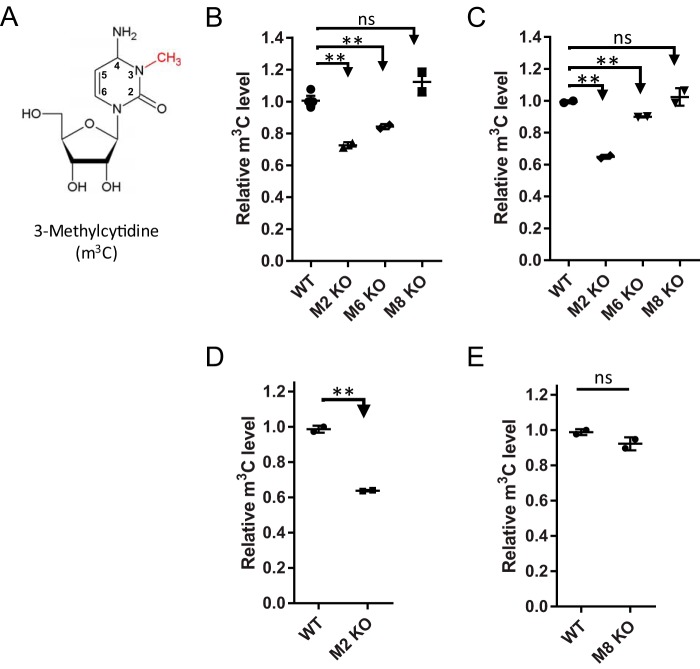
Figure 1.
Figure 1.
Contribution of METTL2 and METTL6 to tRNA m3C in mouse and human cell lines. A, structure of m3C. Positions 2–4 are involved in Watson-Crick base pairing, with the N3-methylation serving as a block to polymerases. This polymerase-blocking phenomenon was exploited to map the location of methylations in tRNA. B and C, relative m3C levels in tRNA isolated liver and brain tissues, respectively. Samples from wild-type (WT), Mettl2 KO (M2 KO), Mettl6 mutant (M6 KO), and Mettl8 KO (M8 KO) mice were analyzed. D, relative m3C levels in HEK293T wild-type and METTL2 KO cell lines (loss of both METTL2A and -2B). E, relative m3C levels in HCT116 METTL8 wild-type and knock-out sample. m3C modification levels were normalized against levels of canonical cytidine. Data represent mean ± S.D. for at least three biological replicates, with asterisks denoting significant differences by Student's t test; **, p < 0.01. ns, not significant.
Figure 2.
Figure 2.
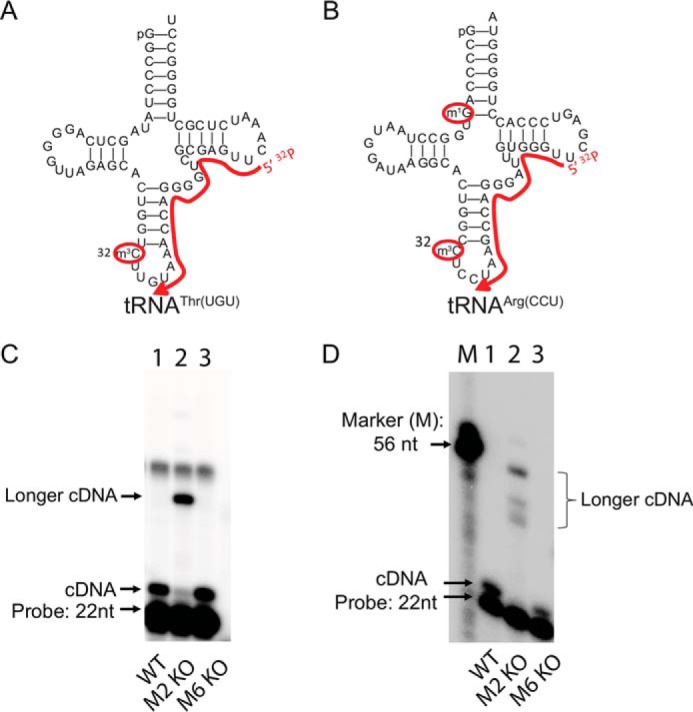
Mouse METTL2 is responsible for position 32 modification of tRNAThr(UGU) and tRNAArg(CCU). A and B, schematic showing one tRNAThr(UGU) and one tRNAArg(CCU) isoacceptor from mice, with red curved lines denoting the coverage of probes used in primer extension assay to map polymerase-blocking modification at position C32. C, primer extension assay using probes targeting tRNAThr(UGU) using RNA from wild type (WT), Mettl2 KO (M2 KO), and Mettl6 (M6 KO) mutants. Free probes are 22 nt long. D, primer extension for tRNAArg(CCU). Marker lane (M) contains a 56-nt-long ssDNA probe.
Figure 3.
Figure 3.
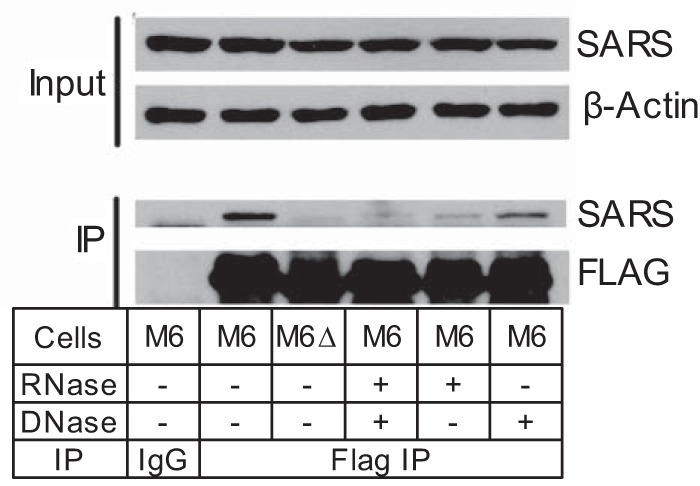
RNA-dependent interaction between METTL6 and SARS. HEK293T cells were transfected with either FLAG-METTL6 (M6) or FLAG-METTL6-ΔSAM (M6Δ). Equal amounts (protein level) of cell extracts were immunoprecipitated (IP) with either nonspecific IgG as a control or FLAG antibody, and treated with either buffer (−), RNase (+), or DNase (+), followed by SDS-PAGE, blotting, and probing with SARS or FLAG antibodies. Blots with Input cell extracts were probed with SARS and β-actin antibodies.
Figure 4.
Figure 4.
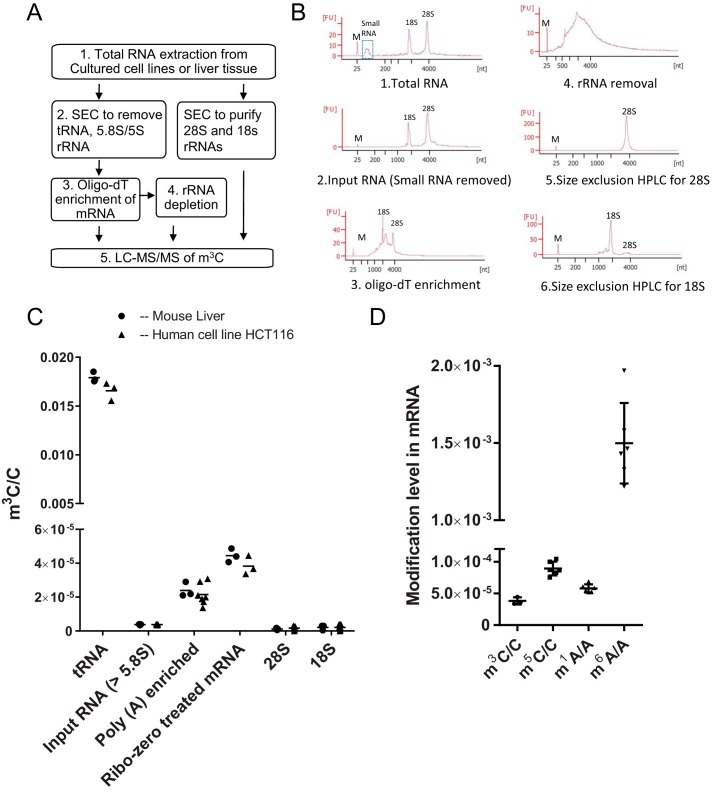
Poly(A) mRNA enrichment and m3C levels monitored during purification. A, schematics of poly(A) mRNA enrichment and separation of 28S and 18S rRNA. B, typical electropherogram for the following: 1. total RNA; 2. RNA >5.8S isolated by SEC; 3. poly(A) RNA enriched by oligo(dT) selection; 4. poly(A)-enriched mRNA after rRNA depletion; 5. 28S; and 6. 18S rRNA purified by SEC. C, LC-MS/MS quantitation of m3C level in tRNA, RNA larger than 5.8S rRNA, oligo(dT)-enriched mRNA, ribo-zero-treated mRNA, 18S rRNA, 28S rRNA. D, LC-MS/MS quantitation of m3C, m5C, m1A, and m6A in human HCT116 mRNA purified by SEC, poly(A)-enrichment, and rRNA depletion. (The level of each modified ribonucleoside is expressed relative to its unmodified form. Data represent mean ± S.D. for n > = 3.)
Figure 5.
Figure 5.
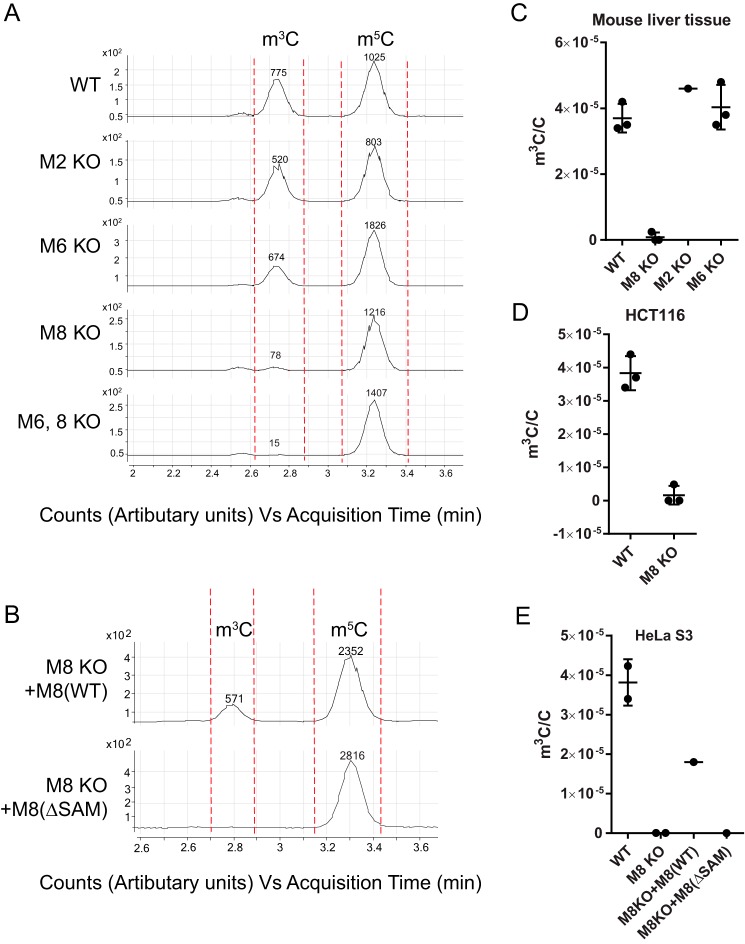
METTL8 catalyzes formation of m3C in mRNA in mouse liver tissues and human cell lines. mRNA was isolated from mouse liver tissue, human HCT116, and HeLa S3 cells using the purification scheme shown in Fig. 4A. A, LC-MS/MS chromatogram for m3C, m4C, and m5C in wild-type mice (WT) and mice lacking Mettl2 (M2 KO), Mettl6 (M6 KO), or Mettl8 (M8 KO), as well as a double knock-out for METTL6 and -8 (M6,8 KO). Peak areas are noted numerically above each peak. B, LC-MS/MS chromatogram for m3C, m4C, and m5C in HeLa S3 METTL8 KO cells transfected with a vector expressing either wild-type (M8(WT)) or a SAM-binding mutant METTL8 (M8SAM)). Peak areas are noted numerically above each peak. C–E, LC-MS/MS quantification of m3C levels in mouse liver tissue (C), HCT116 cells (D), and HeLa S3 cells (E). Abbreviations are the same as in A and B. (The level of m3C is expressed relative to canonical cytidine. Data with error bars represent mean ± S.D. for at least three biological replicates.)

Comment in

References

    1. O'Connell M. (2015) RNA modification and the epitranscriptome; the next frontier. RNA 21, 703–704 - PMC - PubMed
    1. Zhao B. S., Roundtree I. A., and He C. (2017) Post-transcriptional gene regulation by mRNA modifications. Nat. Rev. Mol. Cell Biol. 18, 31–42 - PMC - PubMed
    1. Chan C. T., Deng W., Li F., DeMott M. S., Babu I. R., Begley T. J., and Dedon P. C. (2015) Highly predictive reprogramming of tRNA modifications is linked to selective expression of codon-biased genes. Chem. Res. Toxicol. 28, 978–988 - PMC - PubMed
    1. Chionh Y. H., McBee M., Babu I. R., Hia F., Lin W., Zhao W., Cao J., Dziergowska A., Malkiewicz A., Begley T. J., Alonso S., and Dedon P. C. (2016) tRNA-mediated codon-biased translation in mycobacterial hypoxic persistence. Nat. Commun. 7, 13302. - PMC - PubMed
    1. Lewis C. J., Pan T., and Kalsotra A. (2017) RNA modifications and structures cooperate to guide RNA-protein interactions. Nat. Rev. Mol. Cell Biol. 18, 202–210 - PMC - PubMed

Publication types

MeSH terms