


Neural correlates of atomoxetine improving inhibitory control and visual processing in Drug-naïve adults with attention-deficit/hyperactivity disorder
- PMID: 28657141
- PMCID: PMC6867141
- DOI: 10.1002/hbm.23683
Neural correlates of atomoxetine improving inhibitory control and visual processing in Drug-naïve adults with attention-deficit/hyperactivity disorder
Abstract
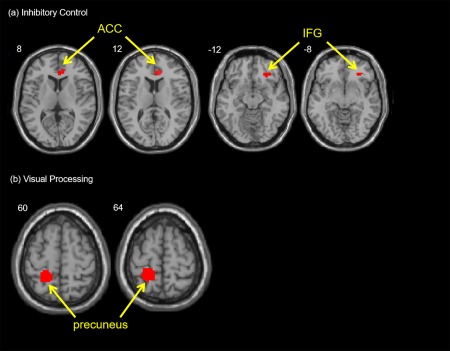
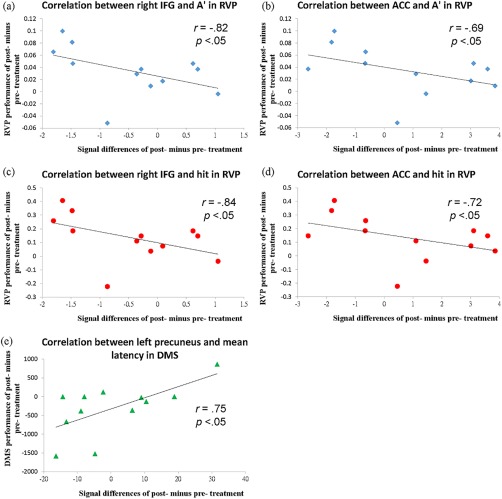
Atomoxetine improves inhibitory control and visual processing in healthy volunteers and adults with attention-deficit/hyperactivity disorder (ADHD). However, little is known about the neural correlates of these two functions after chronic treatment with atomoxetine. This study aimed to use the counting Stroop task with functional magnetic resonance imaging (fMRI) and the Cambridge Neuropsychological Test Automated Battery (CANTAB) to investigate the changes related to inhibitory control and visual processing in adults with ADHD. This study is an 8-week, placebo-controlled, double-blind, randomized clinical trial of atomoxetine in 24 drug-naïve adults with ADHD. We investigated the changes of treatment with atomoxetine compared to placebo-treated counterparts using the counting Stroop fMRI and two CANTAB tests: rapid visual information processing (RVP) for inhibitory control and delayed matching to sample (DMS) for visual processing. Atomoxetine decreased activations in the right inferior frontal gyrus and anterior cingulate cortex, which were correlated with the improvement in inhibitory control assessed by the RVP. Also, atomoxetine increased activation in the left precuneus, which was correlated with the improvement in the mean latency of correct responses assessed by the DMS. Moreover, anterior cingulate activation in the pre-treatment was able to predict the improvements of clinical symptoms. Treatment with atomoxetine may improve inhibitory control to suppress interference and may enhance the visual processing to process numbers. In addition, the anterior cingulate cortex might play an important role as a biological marker for the treatment effectiveness of atomoxetine. Hum Brain Mapp 38:4850-4864, 2017. © 2017 Wiley Periodicals, Inc.
Keywords: CANTAB; atomoxetine; counting Stroop fMRI; inhibitory control; visual processing.
© 2017 Wiley Periodicals, Inc.
Figures
References
-
- Burock MA, Buckner RL, Woldorff MG, Rosen BR, Dale AM (1998): Randomized event‐related experimental designs allow for extremely rapid presentation rates using functional MRI. Neuroreport 9:3735–3739. - PubMed
-
- Cavanna AE, Trimble MR (2006): The precuneus: A review of its functional anatomy and behavioural correlates. Brain 129:564–583. - PubMed
-
- Chamberlain SR, Hampshire A, Müller U, Rubia K, Campo ND, Craig K, Regenthal R, Suckling J, Roiser JP, Grant JE, Bullmore ET, Robbins TW, Sahakian BJ (2009): Atomoxetine modulates right inferior frontal activation during inhibitory control: A pharmacological functional magnetic resonance imaging study. Biol Psychiatry 65:550–555. - PubMed
Publication types
MeSH terms
Substances
LinkOut - more resources
Full Text Sources
Other Literature Sources
Medical
