Additive effect of rikkunshito, an herbal medicine, on chemotherapy-induced nausea, vomiting, and anorexia in uterine cervical or corpus cancer patients treated with cisplatin and paclitaxel: results of a randomized phase II study (JORTC KMP-02)
- PMID: 28657216
- PMCID: PMC5540714
- DOI: 10.3802/jgo.2017.28.e44
Additive effect of rikkunshito, an herbal medicine, on chemotherapy-induced nausea, vomiting, and anorexia in uterine cervical or corpus cancer patients treated with cisplatin and paclitaxel: results of a randomized phase II study (JORTC KMP-02)
Abstract
Objective: Rikkunshito, an herbal medicine, is widely prescribed in Japan for the treatment of anorexia and functional dyspepsia, and has been reported to recover reductions in food intake caused by cisplatin. We investigated whether rikkunshito could improve chemotherapy-induced nausea and vomiting (CINV) and anorexia in patients treated with cisplatin.
Methods: Patients with uterine cervical or corpus cancer who were to receive cisplatin (50 mg/m² day 1) and paclitaxel (135 mg/m² day 0) as first-line chemotherapy were randomly assigned to the rikkunshito group receiving oral administration on days 0-13 with standard antiemetics, or the control group receiving antiemetics only. The primary endpoint was the rate of complete control (CC: no emesis, no rescue medication, and no significant nausea) in the overall phase (0-120 hours). Two-tailed p<0.20 was considered significant in the planned analysis.
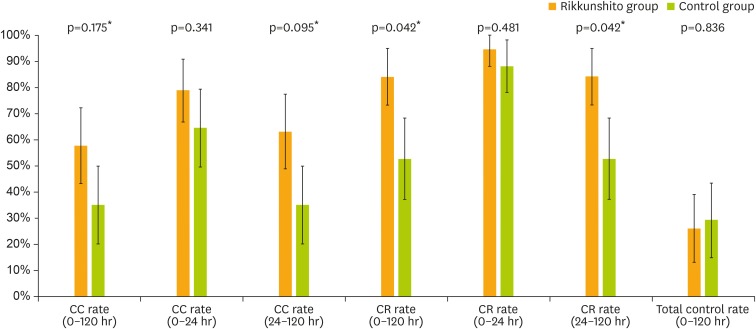
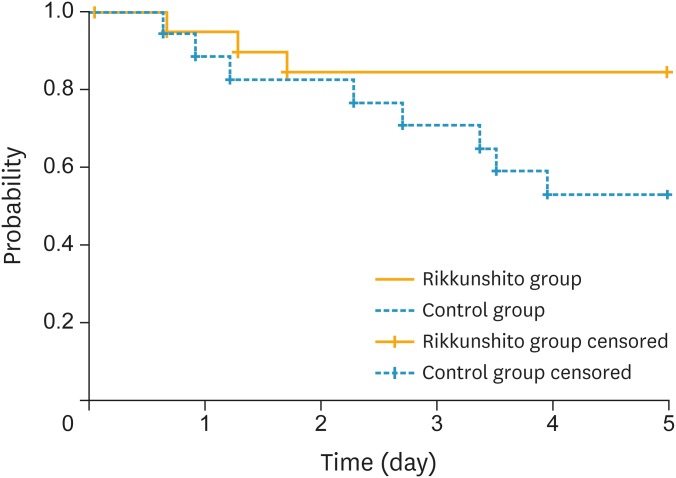
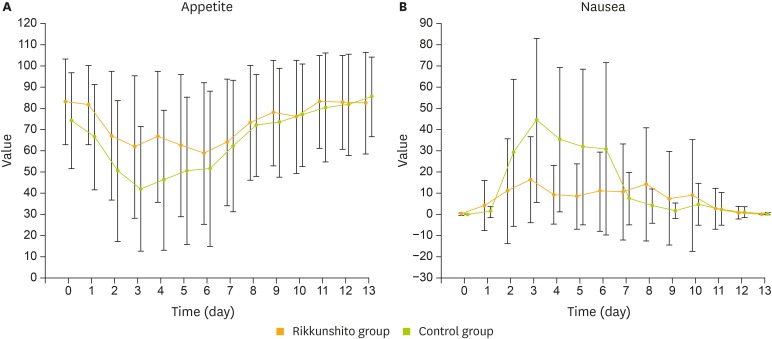
Results: The CC rate in the overall phase was significantly higher in the rikkunshito group than in the control group (57.9% vs. 35.3%, p=0.175), as were the secondary endpoints: the CC rate in the delayed phase (24-120 hours), and the complete response (CR) rates (no emesis and no rescue medication) in the overall and delayed phases (63.2% vs. 35.3%, p=0.095; 84.2% vs. 52.9%, p=0.042; 84.2% vs. 52.9%, p=0.042, respectively), and time to treatment failure (p=0.059). Appetite assessed by visual analogue scale (VAS) appeared to be superior in the rikkunshito group from day 2 through day 6.
Conclusion: Rikkunshito provided additive effect for the prevention of CINV and anorexia.
Keywords: Anorexia; Antiemetics; Nausea; Rikkunshito; Vomiting.
Copyright © 2017. Asian Society of Gynecologic Oncology, Korean Society of Gynecologic Oncology
Conflict of interest statement
No potential conflict of interest relevant to this article was reported.
Figures
Comment in
-
Traditional herbal medicine, Rikkunshito, for chemotherapy-induced nausea and vomiting.J Gynecol Oncol. 2017 Sep;28(5):e57. doi: 10.3802/jgo.2017.28.e57. Epub 2017 Jun 5. J Gynecol Oncol. 2017. PMID: 28657219 Free PMC article. No abstract available.
References
-
- Basch E, Prestrud AA, Hesketh PJ, Kris MG, Somerfield MR, Lyman GH. Antiemetic use in oncology: updated guideline recommendations from ASCO. Am Soc Clin Oncol Educ Book. 2012:532–540. - PubMed
-
- Roila F, Herrstedt J, Aapro M, Gralla RJ, Einhorn LH, Ballatori E, et al. Guideline update for MASCC and ESMO in the prevention of chemotherapy- and radiotherapy-induced nausea and vomiting: results of the Perugia consensus conference. Ann Oncol. 2010;21(Suppl 5):v232–43. - PubMed
-
- Schmoll HJ, Aapro MS, Poli-Bigelli S, Kim HK, Park K, Jordan K, et al. Comparison of an aprepitant regimen with a multiple-day ondansetron regimen, both with dexamethasone, for antiemetic efficacy in high-dose cisplatin treatment. Ann Oncol. 2006;17:1000–1006. - PubMed
-
- Poli-Bigelli S, Rodrigues-Pereira J, Carides AD, Julie Ma G, Eldridge K, Hipple A, et al. Addition of the neurokinin 1 receptor antagonist aprepitant to standard antiemetic therapy improves control of chemotherapy-induced nausea and vomiting. Results from a randomized, double-blind, placebo-controlled trial in Latin America. Cancer. 2003;97:3090–3098. - PubMed
-
- Hesketh PJ, Grunberg SM, Gralla RJ, Warr DG, Roila F, de Wit R, et al. The oral neurokinin-1 antagonist aprepitant for the prevention of chemotherapy-induced nausea and vomiting: a multinational, randomized, double-blind, placebo-controlled trial in patients receiving high-dose cisplatin--the Aprepitant Protocol 052 Study Group. J Clin Oncol. 2003;21:4112–4119. - PubMed
Publication types
MeSH terms
Substances
LinkOut - more resources
Full Text Sources
Other Literature Sources
Medical