Young Israeli women with epithelial ovarian cancer: prevalence of BRCA mutations and clinical correlates
- PMID: 28657222
- PMCID: PMC5540720
- DOI: 10.3802/jgo.2017.28.e61
Young Israeli women with epithelial ovarian cancer: prevalence of BRCA mutations and clinical correlates
Abstract
Objective: The current study investigates disease patterns and outcomes in young Israeli epithelial ovarian cancer (EOC) patients and their association with BRCA mutation status.
Methods: Consecutive EOC patients diagnosed at or below 50 years in a single institution between 1995-2011 were identified. All patients are referred for genetic counseling and testing for the predominant Jewish BRCA mutations: BRCA1-185delAG, BRCA1-5382insC, and BRCA2-6174delT. A comparison between BRCA mutation carriers and non-carriers was undertaken across demographic, pathologic, and clinical features; recurrence and survival were compared using the Kaplan-Meier method and associations with the variables of interest were analyzed using the Cox proportional hazards method.
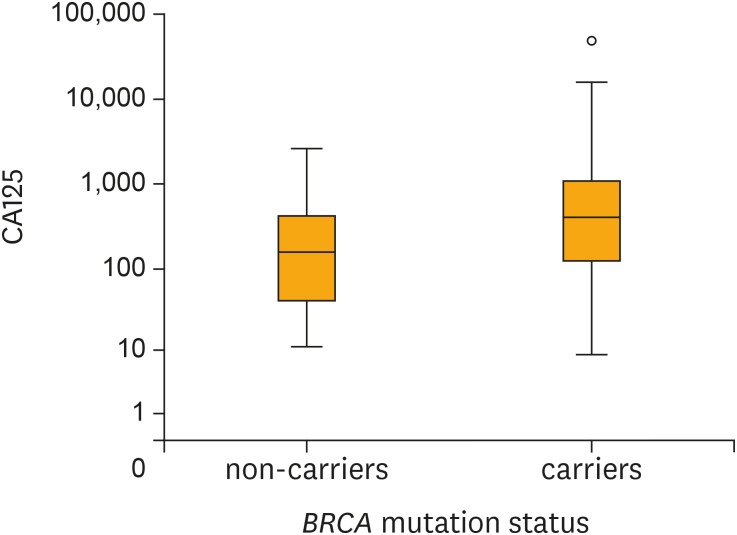
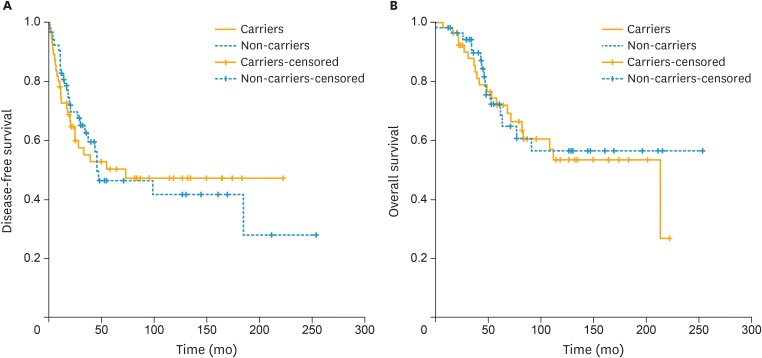
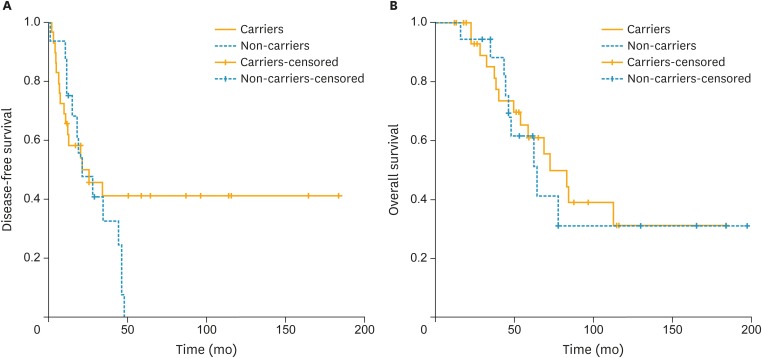
Results: One hundred eighty-six patients diagnosed with EOC at 50 years or younger were included, with a total follow-up of 1,088 person years. Mean age at diagnosis was 44±5 years. Of 113 patients with documented BRCA testing, 49.6% carried a germline BRCA mutation, compared with 29% in the general Israeli EOC population (p=0.001). BRCA mutation carriers had a higher rate of serous tumors (75% vs. 64%, p=0.040) and higher CA125 levels at diagnosis (median, 401 vs. 157, p=0.001) than non-carriers. No significant association between BRCA mutations and recurrence (hazard ratio [HR]=1.03; p=0.940) or survival (HR=1.40; p=0.390) was found.
Conclusion: BRCA mutations are encountered in almost 50% of young Israeli ovarian cancer patients; they are associated with serous tumors and high CA125 levels at diagnosis, but are not independently associated with recurrence or survival in this patient population.
Keywords: BRCA1; BRCA2; Glandular and Epithelial Neoplasms; Ovarian Neoplasms; Women; Young Adult.
Copyright © 2017. Asian Society of Gynecologic Oncology, Korean Society of Gynecologic Oncology
Conflict of interest statement
No potential conflict of interest relevant to this article was reported.
Figures
References
-
- Howlader N, Noone AM, Krapcho M, Garshell J, Miller D, Altekruse SF, et al. SEER cancer statistics review, 1975–2012. Bethesda, MD: National Cancer Institute; 2015.
-
- Daly MB, Pilarski R, Axilbund JE, Berry M, Buys SS, Crawford B, et al. Genetic/familial high-risk assessment: breast and ovarian, version 2.2015. J Natl Compr Canc Netw. 2016;14:153–162. - PubMed
-
- Modan B, Gak E, Sade-Bruchim RB, Hirsh-Yechezkel G, Theodor L, Lubin F, et al. High frequency of BRCA1 185delAG mutation in ovarian cancer in Israel. National Israel Study of Ovarian Cancer. JAMA. 1996;276:1823–1825. - PubMed
-
- Hirsh-Yechezkel G, Chetrit A, Lubin F, Friedman E, Peretz T, Gershoni R, et al. Population attributes affecting the prevalence of BRCA mutation carriers in epithelial ovarian cancer cases in Israel. Gynecol Oncol. 2003;89:494–498. - PubMed
MeSH terms
Substances
LinkOut - more resources
Full Text Sources
Other Literature Sources
Medical
Research Materials
Miscellaneous