


Causality on longitudinal data: Stable specification search in constrained structural equation modeling
- PMID: 28657454
- PMCID: PMC6249641
- DOI: 10.1177/0962280217713347
Causality on longitudinal data: Stable specification search in constrained structural equation modeling
Abstract
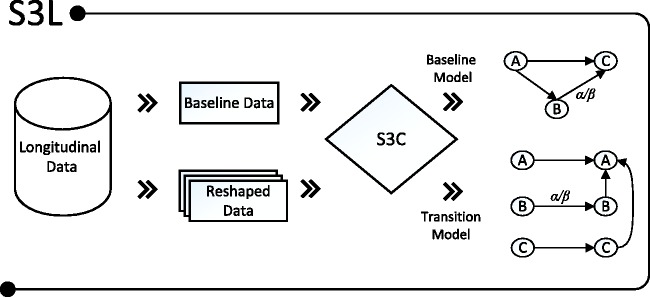
A typical problem in causal modeling is the instability of model structure learning, i.e., small changes in finite data can result in completely different optimal models. The present work introduces a novel causal modeling algorithm for longitudinal data, that is robust for finite samples based on recent advances in stability selection using subsampling and selection algorithms. Our approach uses exploratory search but allows incorporation of prior knowledge, e.g., the absence of a particular causal relationship between two specific variables. We represent causal relationships using structural equation models. Models are scored along two objectives: the model fit and the model complexity. Since both objectives are often conflicting, we apply a multi-objective evolutionary algorithm to search for Pareto optimal models. To handle the instability of small finite data samples, we repeatedly subsample the data and select those substructures (from the optimal models) that are both stable and parsimonious. These substructures can be visualized through a causal graph. Our more exploratory approach achieves at least comparable performance as, but often a significant improvement over state-of-the-art alternative approaches on a simulated data set with a known ground truth. We also present the results of our method on three real-world longitudinal data sets on chronic fatigue syndrome, Alzheimer disease, and chronic kidney disease. The findings obtained with our approach are generally in line with results from more hypothesis-driven analyses in earlier studies and suggest some novel relationships that deserve further research.
Keywords: Alzheimer’s disease; Longitudinal data; causal modeling; chronic fatigue syndrome; chronic kidney disease; multi-objective evolutionary algorithm; stability selection; structural equation model.
Figures
References
-
- Daniel RM, Kenward MG, Cousens SN, et al. Using causal diagrams to guide analysis in missing data problems. Stat Methods Med Res 2012; 21: 243–256. - PubMed
-
- Hoover KD. Causality in economics and econometrics. In: Steven N Durlauf and Lawrence E Blume (eds) The new Palgrave dictionary of economics. Basingstoke: Palgrave Mcmillan, 2008, p.2.
-
- Abu-Bader S, Abu-Qarn AS. Government expenditures, military spending and economic growth: causality evidence from Egypt, Israel, and Syria. J Policy Model 2003; 25: 567–583.
-
- Pearl J. Causal inference from indirect experiments. Artif Intell Med 1995; 7: 561–582. - PubMed
Publication types
MeSH terms
Grants and funding
LinkOut - more resources
Full Text Sources
Other Literature Sources
