. 2017 Aug 14;19(8):533-543.
doi: 10.1021/acscombsci.7b00080. Epub 2017 Jul 13.

Identification of Biologically Active Pyrimido[5,4-b]indoles That Prolong NF-κB Activation without Intrinsic Activity

Affiliations

Identification of Biologically Active Pyrimido[5,4-b]indoles That Prolong NF-κB Activation without Intrinsic Activity

Michael Chan et al. ACS Comb Sci. .

Abstract

Most vaccine adjuvants directly stimulate and activate antigen presenting cells but do not sustain immunostimulation of these cells. A high throughput screening (HTS) strategy was designed to identify compounds that would sustain NF-κB activation by a stimulus from the Toll-like receptor (TLR)4 ligand, lipopolysaccharide (LPS). Several pilot studies optimized the parameters and conditions for a cell based NF-κB reporter assay in human monocytic THP-1 cells. The final assay evaluated prolongation of LPS induced NF-κB activation at 12 h. The dynamic range of the assay was confirmed in a pilot screen of 14 631 compounds and subsequently in a main extensive screen with 166 304 compounds. Hit compounds were identified using an enrichment strategy based on unsupervised chemoinformatic clustering, and also by a naı̈ve "Top X" approach. A total of 2011 compounds were then rescreened for levels of coactivation with LPS at 5 h and 12 h, which provided kinetic profiles. Of the 407 confirmed hits, compounds that showed correlation of the kinetic profiles with the structural similarities led to identification of four chemotypes: pyrimido[5,4-b]indoles, 4H-chromene-3-carbonitriles, benzo[d][1,3]dioxol-2-ylureas, and tetrahydrothieno[2,3-c]pyridines, which were segregated by 5 h and 12 h kinetic characteristics. Unlike the TLR4 agonistic pyrimidoindoles identified in previous studies, the revealed pyrimidoindoles in the present work did not intrinsically stimulate TLR4 nor induce NF-κB but rather prolonged NF-κB signaling induced by LPS. A 42-member combinatorial library was synthesized which led to identification of potent N3-alkyl substituted pyrimidoindoles that were not only active in vitro but also enhanced antibody responses in vivo when used as a coadjuvant. The novel HTS strategy led to identification of compounds that are intrinsically quiescent but functionally prolong stimulation by a TLR4 ligand and thereby potentiate vaccine efficacy.

Keywords: LPS; NF-κB; TLR4; adjuvant; pyrimidoindole.


Conflict of interest statement

Notes

The authors declare no competing financial interest.

Figures
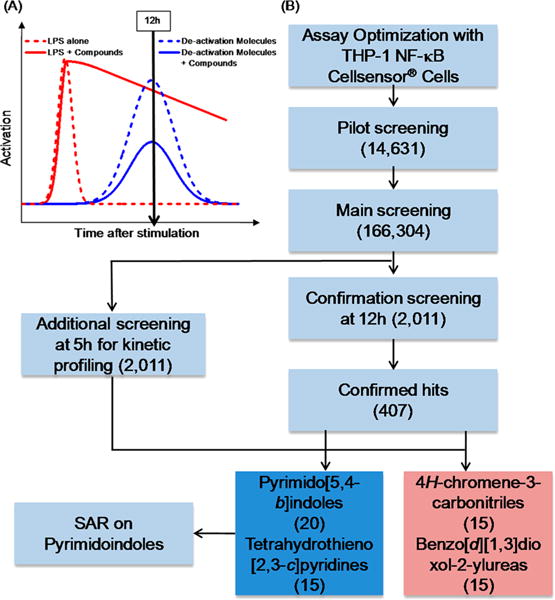
Figure 1
Figure 1
Theoretical kinetics of LPS activation and the HTS workflow strategy. (A) Theoretical kinetic profiles showing activation by LPS (dashed red line) and subsequent deactivation at 12 h due to an increase in deactivation molecules (dashed blue line). The addition of compounds that prolong the initial activation (solid red line) and also suppress the formation of deactivation molecules (solid blue line) were identified through HTS. (B) The cell based assay using THP-1 CellSensor NF-κB reporter cells was optimized for the identification of compounds that prolonged NF-κB activation when stimulated with LPS for 12 h. The assay was tested in a pilot screen of 14 631 compounds to validate the approach. In the main library screen, 166 304 compounds were screened in the presence of LPS for NF-κB activation at 12 h. Cluster based statistical analysis yielded 2011 compounds, which were retested in a confirmation screen at 12 h with LPS in duplicate. An additional screen was performed on these 2011 compounds for measuring NF-κB activity at 5 h to observe the activity kinetics. A total of 407 compounds that had confirmed activity at 12 h were structurally clustered using a Tanimoto index at 0.5. Four large families of chemotypes were identified as hits based on their kinetic profile of 5 h and 12 h that prolonged NF-κB activation with LPS. The pyrimidoindole class of compounds was selected for further SAR studies. The number in parentheses corresponds to the number of compounds.
Figure 2
Figure 2
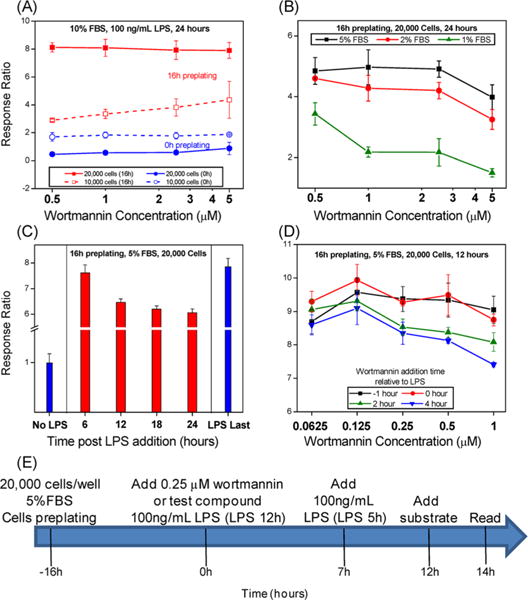
Optimization of assay conditions in THP-1 CellSensor assay. The assay conditions were optimized for the following parameters: (A) Cell numbers/well and cells preplating time, (B) FBS concentration, (C) incubation time, and (D) concentration of wortmannin and the time of its addition relative to LPS. (E) The schematic shows the optimum assay parameters and the assay protocol used for the HTS. Briefly, the cells were preplated at a density of 20 000 cells/well in 5% FBS 16 h prior to the addition of 100 ng/mL LPS alone or LPS with 0.25 μM wortmannin. An additional control (LPS 5 h) was added 5 h prior to the addition of FRET substrate at 12 h, and the plates were read at 14 h.
Figure 3
Figure 3
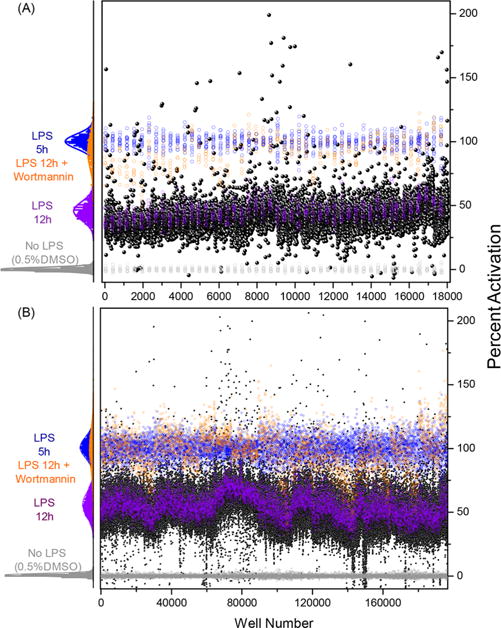
Pilot and HTS main screen. Percent activation values for the controls and test compounds from (A) the pilot screen and (B) the main screen. The histogram plot to the left for each screen shows the intra-assay statistics on the percent activation values for No LPS (0.5% DMSO, negative control), LPS 12 h (100 ng/mL LPS control added at time 0 h), LPS 12 h + wortmannin (positive control), and LPS 5 h (100 ng/mL LPS control added 5 h before the assay read out). The scatter plot to the right shows percent activation values for all the compounds and controls used in each screen. Each black circle represents an individual test compound, while controls are colored as in the histogram plot.
Figure 4
Figure 4
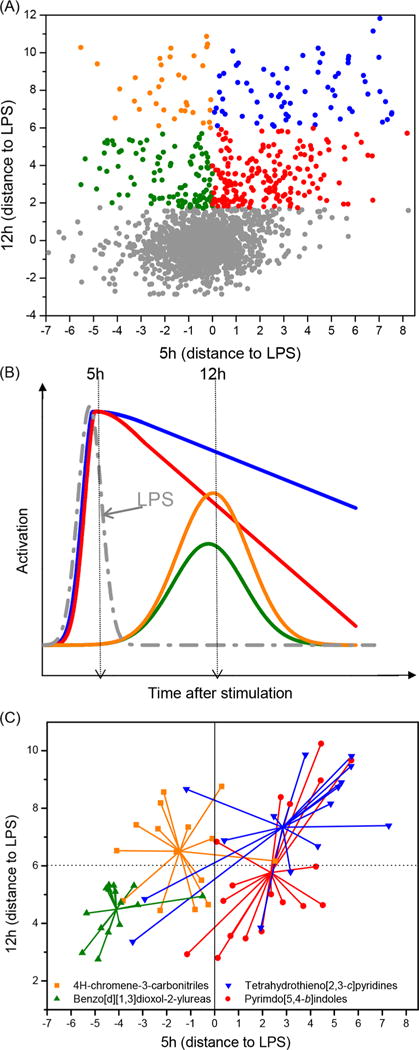
Confirmation and kinetic profile screens. (A) A scatter plot of distance to LPS values for 2011 compounds selected for confirmation and kinetic profile screens. The abscissa values correspond to the kinetic profile experiment while the ordinate values correspond to the confirmation screen experiment. (B) The compounds were divided into four categories based on their theoretical kinetic profiles for NF-κB activation with LPS. These compounds were either early inhibitors (5 h distance to LPS < 0) or early enhancers (5 h distance to LPS > 0). Within the early inhibitors, the compounds were grouped as either showing a moderate increase or high increase in NF-κB induction compared to LPS at 12 h (green and orange symbols and lines, respectively). Similarly, within the enhancer groups, compounds showed a moderate or high increase in NF-κB induction compared to LPS at 12 h (red and blue symbols and lines, respectively). (C) Cluster binning of confirmed hits indicates segregation of chemotypes into distinct kinetic profiles. Large clusters were colored based on chemotype, namely pyrimido[5,4-b]indoles (red circles), tetrahydrothieno[2,3-c]pyridines(blue triangles), benzo-[d][1,3]dioxol-2-ylureas (green triangles), and 4H-chromene-3-carbonitriles (orange squares). The center of the chemotype cluster was calculated as the geometric mean of the coordinates within a cluster. The colors are consistent with the kinetic profiles shown in B.
Figure 5
Figure 5
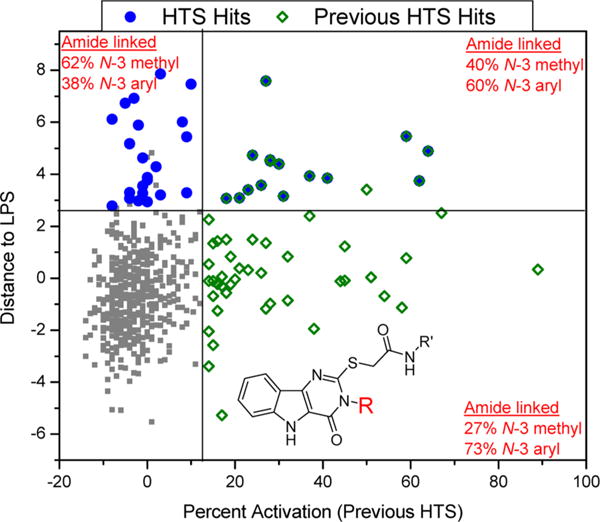
NF-κB activation data for pyrimidoindoles from two different HTS campaigns. A scatter plot of “distance to LPS” values from the current HTS on the Y axis and “percent activation” values from the previous HTS on the X axis for all the pyrimidoindoles shows clearly the distinct structural attribute for the C2–S-methylene acetamide linked molecules. The blue circles represent the hits identified in the current HTS campaign, while the green squares represent the hits identified in the previous HTS. The N3-aryl substituted pyrimidoindoles show intrinsic NF-κB activity while N3-methyl substituted pyrimidoindoles tend to prolong initial NF-κB activation by LPS without any intrinsic NF-κB activation.
Figure 6
Figure 6
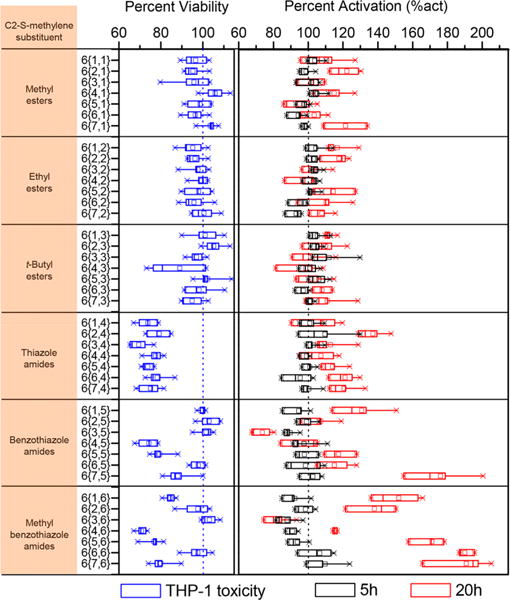
NF-κB induction assay and MTT toxicity in THP-1 cells. The viability (blue boxes) measured by MTT assay in THP-1 cells relative to DMSO (blue dotted line) and NF-κB percent activation for synthesized pyrimidoindole library compounds in the presence of LPS calculated relative to LPS alone (black dotted line) values at both 5 h (black boxes) and 20 h (red boxes). The values were statistically computed from two and four independent experiments for MTT cell viability and NF-κB activation assays, respectively in THP-1 cells. The C2–S-methylene substituent on the pyrimidoindole for the synthesized compounds is shown in the individual blocks on the left. Relative viability was calculated as a percentage of OD at 630 nm compared to DMSO. The OD at 630 nm for DMSO was 0.92 ± 0.1 (mean ± SD). Percent activation (%act) was calculated as a response ratio relative to LPS. The response ratio for LPS was 8.00 ± 1.2 and 2.58 ± 0.48 at 5 h and 20 h (mean ± SD), respectively.
Figure 7
Figure 7
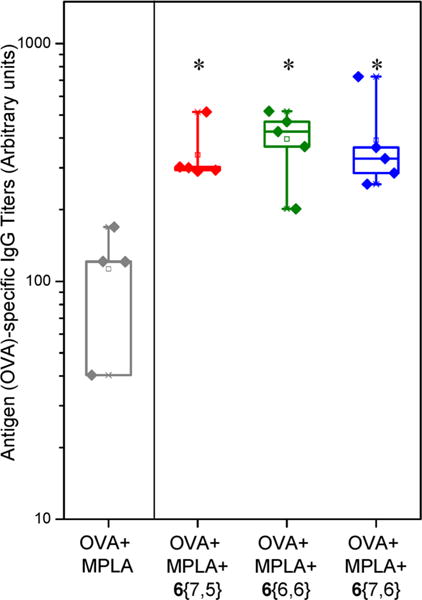
Coadjuvanticity of potent pyrimidoindole compounds with MPLA. Mice (n = 4–5 per group) were immunized via intramuscular route on day 0 and day 14 with antigen (ovalbumin, 20 μg/animal), MPLA (10 μg/animal), and compound 6{7,5} or 6{6,6} or 6{7,6} (100 nmol/animal). The immunized mice were bled on day 21, and OVA-specific IgG titers were measured using ELISA. Note that the potent compounds augmented the production of antigen-specific IgG by approximately 4 fold when coadjuvanted with MPLA compared to MPLA alone. *p < 0.05 compared to OVA + MPLA group using one-way ANOVA followed by Dunn’s post hoc testing.
Scheme 1
Scheme 1
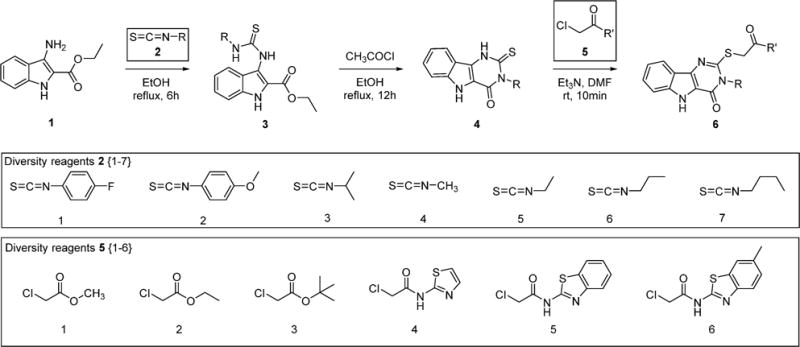
Syntheses of Differently N3- and C2-Substituted Pyrimidoindoles
Scheme 2
Scheme 2
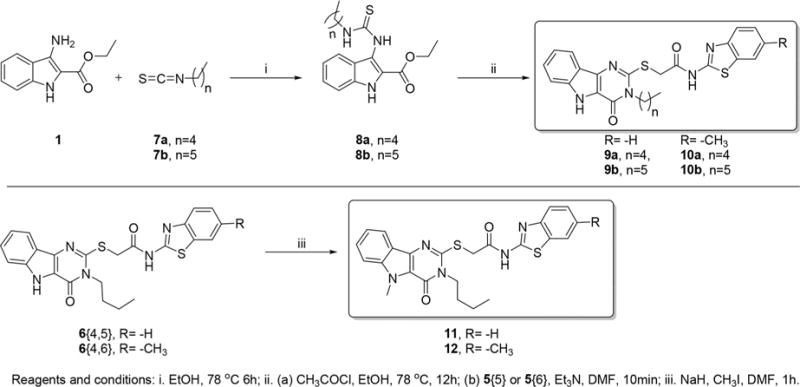
Syntheses of N3-Pentyl, -Hexyl, and N5-Methyl Substituted Derivatives of Select Pyrimidoindoles

References

    1. Van Buynder PG, Konrad S, Van Buynder JL, Brodkin E, Krajden M, Ramler G, Bigham M. The comparative effectiveness of adjuvanted and unadjuvanted trivalent inactivated influenza vaccine (TIV) in the elderly. Vaccine. 2013;31(51):6122–8. - PubMed
    1. Reed SG, Orr MT, Fox CB. Key roles of adjuvants in modern vaccines. Nat Med. 2013;19(12):1597–608. - PubMed
    1. O’Hagan DT, Rappuoli R, De Gregorio E, Tsai T, Del Giudice G. MF59 adjuvant: the best insurance against influenza strain diversity. Expert Rev Vaccines. 2011;10(4):447–62. - PubMed
    1. Doherty M, Schmidt-Ott R, Santos JI, Stanberry LR, Hofstetter AM, Rosenthal SL, Cunningham AL. Vaccination of special populations: Protecting the vulnerable. Vaccine. 2016;34(52):6681–6690. - PubMed
    1. Camilloni B, Basileo M, Valente S, Nunzi E, Iorio AM. Immunogenicity of intramuscular MF59-adjuvanted and intradermal administered influenza enhanced vaccines in subjects aged over 60: A literature review. Hum Vaccines Immunother. 2015;11(3):553–63. - PMC - PubMed

Publication types

MeSH terms