


History and Outcomes of 50 Years of Physician-Scientist Training in Medical Scientist Training Programs
- PMID: 28658019
- PMCID: PMC5617793
- DOI: 10.1097/ACM.0000000000001779
History and Outcomes of 50 Years of Physician-Scientist Training in Medical Scientist Training Programs
Abstract
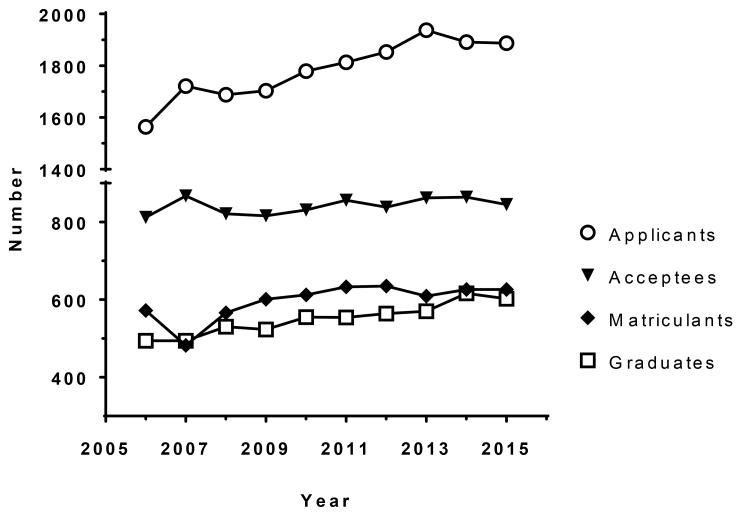
Physician-scientists are needed to continue the great pace of recent biomedical research and translate scientific findings to clinical applications. MD-PhD programs represent one approach to train physician-scientists. MD-PhD training started in the 1950s and expanded greatly with the Medical Scientist Training Program (MSTP), launched in 1964 by the National Institute of General Medical Sciences (NIGMS) at the National Institutes of Health. MD-PhD training has been influenced by substantial changes in medical education, science, and clinical fields since its inception. In 2014, NIGMS held a 50th Anniversary MSTP Symposium highlighting the program and assessing its outcomes. In 2016, there were over 90 active MD-PhD programs in the United States, of which 45 were MSTP supported, with a total of 988 trainee slots. Over 10,000 students have received MSTP support since 1964. The authors present data for the demographic characteristics and outcomes for 9,683 MSTP trainees from 1975-2014. The integration of MD and PhD training has allowed trainees to develop a rigorous foundation in research in concert with clinical training. MSTP graduates have had relative success in obtaining research grants and have become prominent leaders in many biomedical research fields. Many challenges remain, however, including the need to maintain rigorous scientific components in evolving medical curricula, to enhance research-oriented residency and fellowship opportunities in a widening scope of fields targeted by MSTP graduates, to achieve greater racial diversity and gender balance in the physician-scientist workforce, and to sustain subsequent research activities of physician-scientists.
Figures
Comment in
-
Remembering Thought Diversity: The Value of Social Science and Humanities Physician-Scholars in MD-PhD Programs.Acad Med. 2018 Feb;93(2):150. doi: 10.1097/ACM.0000000000002034. Acad Med. 2018. PMID: 29377854 No abstract available.
-
In Reply to Sun et al.Acad Med. 2018 Feb;93(2):150-151. doi: 10.1097/ACM.0000000000002036. Acad Med. 2018. PMID: 29377855 No abstract available.
References
-
- Flexner A. Medical Education in the United States: A Report to the Carnegie Foundation for the Advancement of Teaching. New York, NY: Carnegie Foundation for the Advancement of Teaching; 1910.
-
- Bush V. Science—The Endless Frontier: A Report to the President. Washington, DC: National Science Foundation; [Accessed March 25, 2017]. https://http://www.nsf.gov/od/lpa/nsf50/vbush1945.htm.
-
- Price V. Letter from Vincent Price, reprinted (original 1979) In: Burnley L, editor. Harvard Medical School MD-PhD Program. Boston, MA: Harvard Medical School; 2004.
-
- Williams G. Western Reserve's Experiment in Medical Education and Its Outcome. New York, NY: Oxford University Press; 1980.
-
- National Institutes of Health. [Accessed March 25, 2017];Medical Scientist Training Program (MSTP) Institutions. 2016 https://www.nigms.nih.gov/Training/InstPredoc/Pages/PredocInst-MSTP.aspx.
Publication types
MeSH terms
Grants and funding
LinkOut - more resources
Full Text Sources
Other Literature Sources
