


Socially Accountable Medical Education: An Innovative Approach at Florida International University Herbert Wertheim College of Medicine
- PMID: 28658020
- PMCID: PMC5753826
- DOI: 10.1097/ACM.0000000000001811
Socially Accountable Medical Education: An Innovative Approach at Florida International University Herbert Wertheim College of Medicine
Abstract
Problem: Despite medical advances, health disparities persist, resulting in medicine's renewed emphasis on the social determinants of health and calls for reform in medical education.
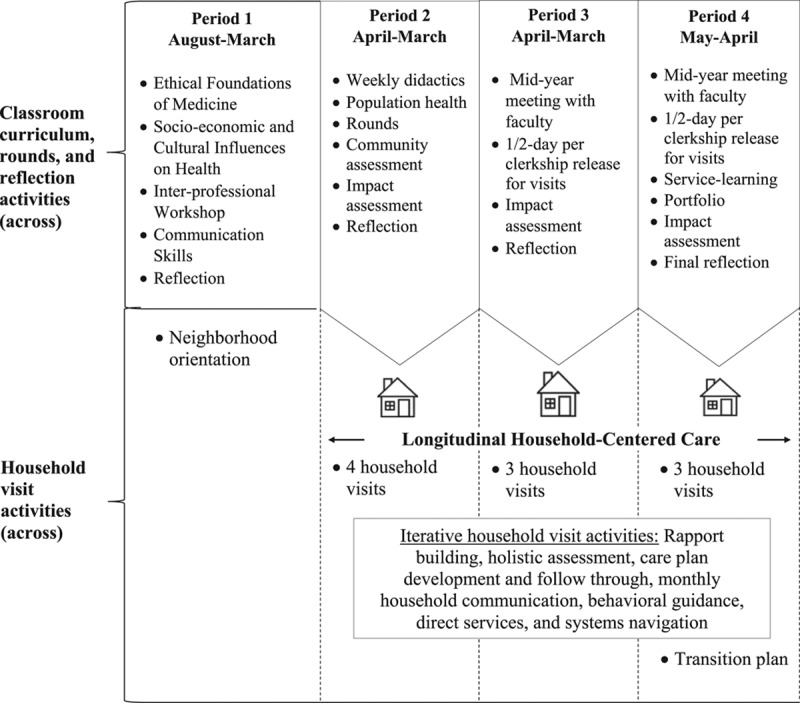
Approach: The Green Family Foundation Neighborhood Health Education Learning Program (NeighborhoodHELP) at Herbert Wertheim College of Medicine provides a platform for the school's community-focused mission. NeighborhoodHELP emphasizes social accountability and interprofessional education while providing evidence-based, patient- and household-centered care. NeighborhoodHELP is a required, longitudinal service-learning outreach program in which each medical student is assigned a household in a medically underserved community. Students, teamed with learners from other professional schools, provide social and clinical services to their household for three years. Here the authors describe the program's engagement approach, logistics, and educational goals and structure.
Outcomes: During the first six years of NeighborhoodHELP (September 2010-August 2016), 1,470 interprofessional students conducted 7,452 visits to 848 households with, collectively, 2,252 members. From August 2012, when mobile health centers were added to the program, through August 2016, students saw a total of 1,021 household members through 7,207 mobile health center visits. Throughout this time, households received a variety of free health and social services (e.g., legal aid, tutoring). Compared with peers from other schools, graduating medical students reported more experience with clinical interprofessional education and health disparities. Surveyed residency program directors rated graduates highly for their cultural sensitivity, teamwork, and accountability.
Next steps: Faculty and administrators are focusing on social accountability curriculum integration, systems for assessing and tracking relevant educational and household outcomes, and policy analysis.
Figures
Comment in
-
Social Empathy Lives Beyond the Classroom.Acad Med. 2018 Jun;93(6):817. doi: 10.1097/ACM.0000000000002198. Acad Med. 2018. PMID: 29846224 No abstract available.
-
In Reply to Kim.Acad Med. 2018 Jun;93(6):817-818. doi: 10.1097/ACM.0000000000002224. Acad Med. 2018. PMID: 29846226 No abstract available.
References
-
- Irby DM, Cooke M, O’Brien BC. Calls for reform of medical education by the Carnegie Foundation for the Advancement of Teaching: 1910 and 2010. Acad Med. 2010;85:220–227.. - PubMed
-
- Marmot M. Social determinants of health inequalities. Lancet. 2005;365:1099–1104.. - PubMed
-
- Fox CE, Morford TG, Fine A, Gibbons MC. The Johns Hopkins Urban Health Institute: A collaborative response to urban health issues. Acad Med. 2004;79:1169–1174.. - PubMed
-
- National Academies of Sciences, Engineering, and Medicine. A Framework for Educating Health Professionals to Address the Social Determinants of Health. 2016Washington, DC: National Academies Press. - PubMed
-
- Rourke J. AM last page. Social accountability of medical schools. Acad Med. 2013;88:430. - PubMed
Publication types
MeSH terms
LinkOut - more resources
Full Text Sources
Other Literature Sources
Medical
