


Prevalence of ESBL-producing Pseudomonas aeruginosa isolates in Warsaw, Poland, detected by various phenotypic and genotypic methods
- PMID: 28658322
- PMCID: PMC5489192
- DOI: 10.1371/journal.pone.0180121
Prevalence of ESBL-producing Pseudomonas aeruginosa isolates in Warsaw, Poland, detected by various phenotypic and genotypic methods
Abstract
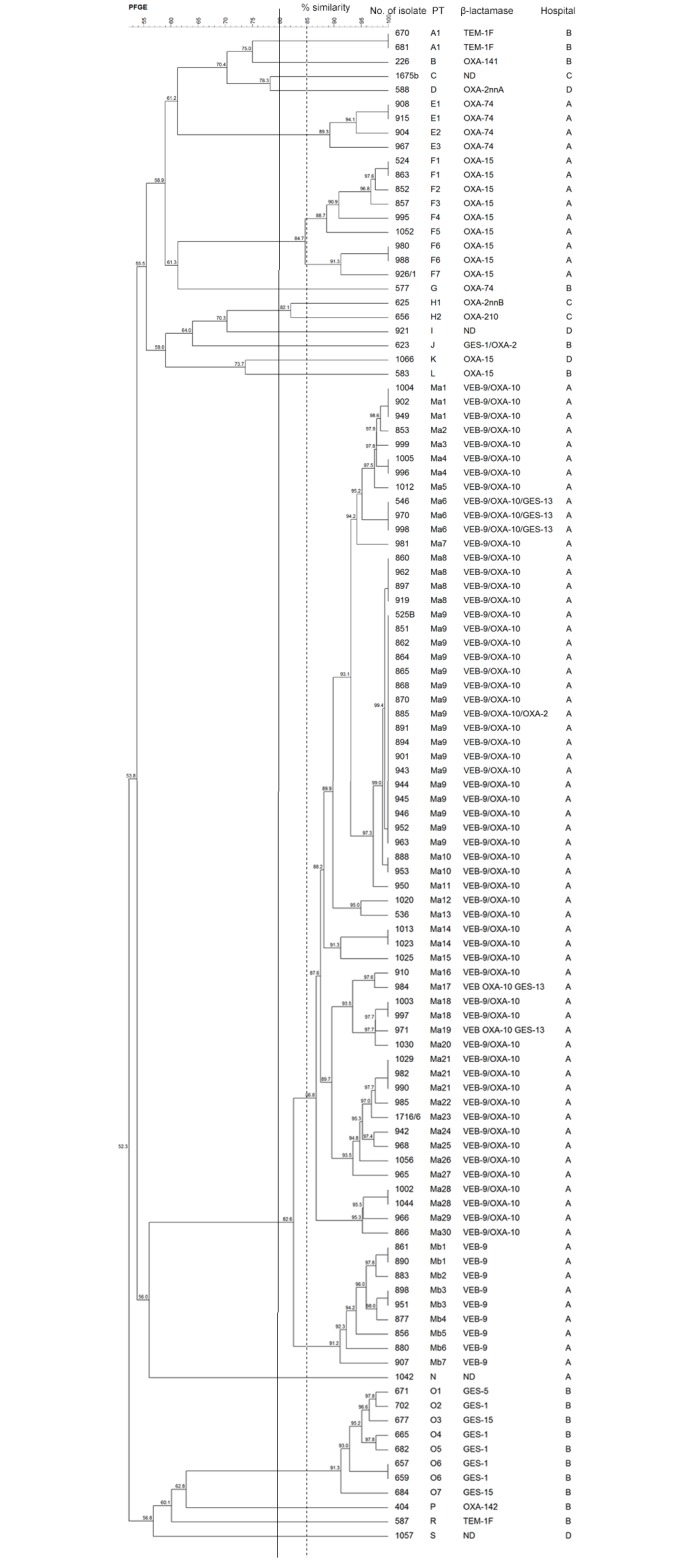
Knowledge of the prevalence of ESBL enzymes among P. aeruginosa strains compared to the Enterobacteraiceae family is limited. The phenotypic tests recommended by EUCAST for the detection of ESBL-producing Enterobacteriaceae are not always suited for P. aeruginosa strains. This is mainly due to the presence of other families of ESBLs in P. aeruginosa isolates more often than in Enterobacteriaceae, production of natural AmpC cephalosporinase and its overexpression, and co-production of metallo-β-lactamases. The aim of this study was to determine the occurrence of ESBLs in P. aeruginosa isolated from patients from hospitals in Warsaw, to evaluate the ESBL production of these isolates using currently available phenotypic tests, their modifications, multiplex PCR and molecular typing of ESBL-positive isolates by PFGE. Clinical isolates of P. aeruginosa were collected in 2000-2014 from four Warsaw hospitals. Based on the data obtained in this study, we suggest using three DDST methods with inhibitors, such as clavulanic acid, sulbactam and imipenem, to detect ESBL-producing P. aeruginosa strains. Depending on the appearance of the plates, we suggest a reduction in the distance between discs with antibiotics to 15 mm and the addition of boronic acid at 0.4 mg per disc. The analysed isolates carried genes encoding ESBL from the families VEB (69 isolates with VEB-9), GES (6 with GES-1, 1 GES-5, 5 GES-13 and 2 with GES-15), OXA-2 (12 with OXA-15, 1 OXA-141, 1 OXA-210, 1 OXA-543 and 1 with OXA-544) and OXA-10 (5 isolates with OXA-74 and one with OXA-142). The most important result of this study was the discovery of three new genes, blaGES-15, blaOXA-141 and blaOXA-142; their nucleotide sequences have been submitted to the NCBI GenBank. It is also very important to note that this is the first report on the epidemiological problem of VEB-9-producing bacterial strains, not only in Poland but also worldwide.
Conflict of interest statement
Figures
References
-
- Santajit S, Indrawattana N. Mechanisms of antimicrobial resistance in ESKAPE pathogens. Biomed Res Int. 2016;2016:2475067 doi: 10.1155/2016/2475067 - DOI - PMC - PubMed
-
- Potron A, Poirel L, Nordmann P. Emerging broad-spectrum resistance in Pseudomonas aeruginosa and Acinetobacter baumannii: mechanisms and epidemiology. Int J Antimicrob Agents. 2015;45: 568–585. doi: 10.1016/j.ijantimicag.2015.03.001 - DOI - PubMed
-
- Bae IK, Suh B, Jeong SH, Wang KK, Kim YR, Yong D, et al. Molecular epidemiology of Pseudomonas aeruginosa clinical isolates from Korea producing β-lactamases with extended-spectrum activity. Diagn Microbiol Infect Dis. 2014;79: 373–377. doi: 10.1016/j.diagmicrobio.2014.03.007 - DOI - PubMed
-
- Kos VN, McLaughlin RE, Gardner HA. Elucidation of mechanisms of ceftazidime resistance among clinical isolates of Pseudomonas aeruginosa by using genomic data. Antimicrob Agents Chemother. 2016;60: 3856–3861. doi: 10.1128/AAC.03113-15 - DOI - PMC - PubMed
-
- Poirel L, Naas T, Nordmann P. Diversity, epidemiology, and genetics of class D β-lactamases. Antimicrob Agents Chemother. 2010;54: 24–38. doi: 10.1128/AAC.01512-08 - DOI - PMC - PubMed
MeSH terms
Substances
LinkOut - more resources
Full Text Sources
Other Literature Sources
