Association of Electroconvulsive Therapy With Psychiatric Readmissions in US Hospitals
- PMID: 28658489
- PMCID: PMC5710550
- DOI: 10.1001/jamapsychiatry.2017.1378
Association of Electroconvulsive Therapy With Psychiatric Readmissions in US Hospitals
Abstract
Importance: Although electroconvulsive therapy (ECT) is considered the most efficacious treatment available for individuals with severe affective disorders, ECT's availability is limited and declining, suggesting that information about the population-level effects of ECT is needed.
Objective: To examine whether inpatient treatment with ECT is associated with a reduction in 30-day psychiatric readmission risk in a large, multistate sample of inpatients with severe affective disorders.
Design, setting, and participants: A quasi-experimental instrumental variables probit model of the association correlation of ECT administration with patient risk of 30-day readmission was estimated using observational, longitudinal data on hospital inpatient discharges from US general hospitals in 9 states. From a population-based sample of 490 252 psychiatric inpatients, a sample was drawn that consisted of 162 691 individuals with a principal diagnosis of major depressive disorder (MDD), bipolar disorder, or schizoaffective disorder. The key instrumental variable used in the analysis was ECT prevalence in the prior calendar year at the treating hospital. To examine whether ECT's association with readmissions was heterogeneous across population subgroups, analyses included interactions of ECT with age group, sex, race/ethnicity, and diagnosis group. The study was conducted from August 27, 2015, to March 7, 2017.
Main outcome and measures: Readmission within 30 days of being discharged.
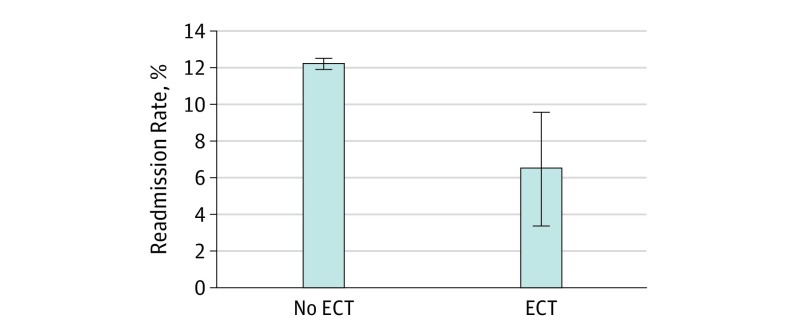
Results: Overall, 2486 of the 162 691 inpatients (1.5%) underwent ECT during their index admission. Compared with other inpatients, those who received ECT were older (mean [SD], 56.8 [16.5] vs 45.9 [16.5] years; P < .001) and more likely to be female (65.0% vs 54.2%; P < .001) and white non-Hispanic (85.3% vs 62.1%; P < .001), have MDD diagnoses (63.8% vs 32.0%; P < .001) rather than bipolar disorder (29.0% vs 40.0%; P < .001) or schizoaffective disorder (7.1% vs 28.0%; P < .001), have a comorbid medical condition (31.3% vs 26.6%; P < .001), have private (39.4% vs 21.7%; P < .001) or Medicare (49.2% vs 39.4%; P < .001) insurance coverage, and be located in urban small hospitals (31.2% vs 22.3%; P < .001) or nonurban hospitals (9.0% vs 7.6%; P = .02). Administration of ECT was associated with a reduced 30-day readmission risk among psychiatric inpatients with severe affective disorders from an estimated 12.3% among individuals not administered ECT to 6.6% among individuals administered ECT (risk ratio [RR], 0.54; 95% CI, 0.28-0.81). Significantly larger associations with ECT on readmission risk were found for men compared with women (RR, 0.44; 95% CI, 0.20-0.69 vs 0.58; 95% CI, 0.30-0.88) and for individuals with bipolar disorder (RR, 0.42; 95% CI, 0.17-0.69) and schizoaffective disorder (RR, 0.44; 95% CI, 0.11-0.79) compared with those who had MDD (RR, 0.53; 95% CI, 0.26-0.81).
Conclusions and relevance: Electroconvulsive therapy may be associated with reduced short-term psychiatric inpatient readmissions among psychiatric inpatients with severe affective disorders. This potential population health effect may be overlooked in US hospitals' current decision making regarding the availability of ECT.
Conflict of interest statement
Figures
Comment in
-
Modern Electroconvulsive Therapy: Vastly Improved yet Greatly Underused.JAMA Psychiatry. 2017 Aug 1;74(8):779-780. doi: 10.1001/jamapsychiatry.2017.1670. JAMA Psychiatry. 2017. PMID: 28658461 No abstract available.
-
Use of Instrumental Variables Methods in Examining Psychiatric Readmissions.JAMA Psychiatry. 2017 Aug 1;74(8):805-806. doi: 10.1001/jamapsychiatry.2017.1669. JAMA Psychiatry. 2017. PMID: 28658480 No abstract available.
References
-
- Hermann RC, Dorwart RA, Hoover CW, Brody J. Variation in ECT use in the United States. Am J Psychiatry. 1995;152(6):869-875. - PubMed
-
- American Psychiatric Association The Practice of Electroconvulsive Therapy: Recommendations for Treatment, Training, and Privileging: A Task Force Report of the American Psychiatric Association. Washington, DC: American Psychiatric Association; 2001.
-
- Greenhalgh J, Knight C, Hind D, Beverley C, Walters S. Clinical and cost-effectiveness of electroconvulsive therapy for depressive illness, schizophrenia, catatonia and mania: systematic reviews and economic modelling studies. Health Technol Assess. 2005;9(9):1-156, iii-iv. - PubMed
-
- UK ECT Review Group Efficacy and safety of electroconvulsive therapy in depressive disorders: a systematic review and meta-analysis. Lancet. 2003;361(9360):799-808. - PubMed
-
- Fink M, Taylor MA. Electroconvulsive therapy: evidence and challenges. JAMA. 2007;298(3):330-332. - PubMed
Publication types
MeSH terms
Grants and funding
LinkOut - more resources
Full Text Sources
Other Literature Sources
Medical