


Artificially sweetened beverages, sugar-sweetened beverages, plain water, and incident diabetes mellitus in postmenopausal women: the prospective Women's Health Initiative observational study
- PMID: 28659294
- PMCID: PMC5525115
- DOI: 10.3945/ajcn.116.145391
Artificially sweetened beverages, sugar-sweetened beverages, plain water, and incident diabetes mellitus in postmenopausal women: the prospective Women's Health Initiative observational study
Abstract
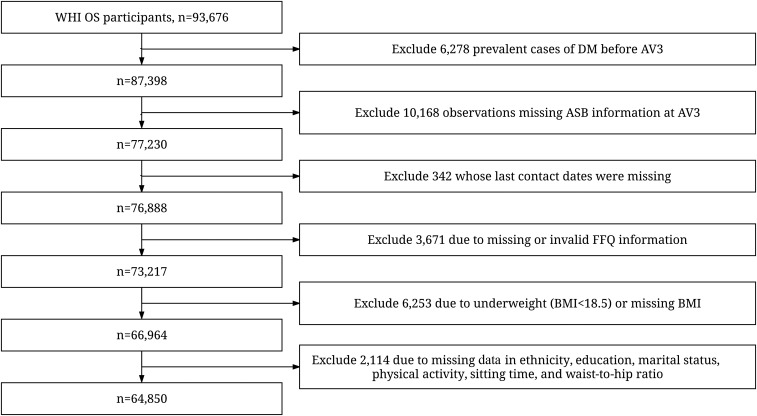
Background: Sugar-sweetened beverages (SSBs) have been associated with an increased risk of diabetes mellitus (DM), whereas the association with artificially sweetened beverages (ASBs) is unclear.Objective: We aimed to evaluate the associations of ASB and SSB consumption with the risk of developing DM and the potential benefit of replacing SSBs with ASBs or water.Design: The national Women's Health Initiative recruited a large prospective cohort of postmenopausal women between 1993 and 1998. ASB, SSB, and water consumption was measured by lifestyle questionnaires, and DM was self-reported.Results: Of 64,850 women, 4675 developed diabetes over an average of 8.4 y of follow-up. ASBs and SSBs were both associated with an increased risk of DM with an HR of 1.21 (95% CI: 1.08, 1.36) comparing ASB consumption of ≥2 serving/d to never or <3 serving/mo, and an HR of 1.43 (95% CI: 1.17, 1.75) comparing SSB consumption of ≥2 serving/d to <1 serving/wk (1 serving = one 12-ounce can or 355 mL). Subgroup analysis found an increased risk of DM associated with ASBs only in the obese group. Modeling the substitution of SSBs with an equal amount of ASBs did not significantly reduce the risk of developing DM. However, statistically substituting 1 serving of ASBs with water was associated with a significant risk reduction of 5% (HR: 0.95; 95% CI: 0.91, 0.99), whereas substituting 1 serving of SSBs with water was associated with a risk reduction of 10% (HR: 0.90; 95% CI: 0.85, 0.95).Conclusions: ASBs were associated with a 21% increased risk of developing DM, approximately half the magnitude of SSBs (associated with a 43% increased risk). Replacing ASBs and SSBs with water could potentially reduce the risk. However, caution should be taken in interpreting these results as causal because both residual confounding and reverse causation could explain these results.
Keywords: diabetes mellitus; diet soda; nonnutritive sweeteners; sweetened beverages; sweetening agents.
© 2017 American Society for Nutrition.
Figures
References
-
- CDC. National diabetes statistics report: estimates of diabetes and its burden in the United States, 2014. Atlanta (GA): US Department of Health and Human Services; 2014.
-
- Bantle JP, Wylie-Rosett J, Albright AL, Apovian CM, Clark NG, Franz MJ, Hoogwerf BJ, Lichtenstein AH, Mayer-Davis E, Mooradian AD, et al. . Nutrition recommendations and interventions for diabetes: a position statement of the American Diabetes Association. Diabetes Care 2008;31(Suppl 1):S61–78. - PubMed
-
- Bray GA, Nielsen SJ, Popkin BM. Consumption of high-fructose corn syrup in beverages may play a role in the epidemic of obesity. Am J Clin Nutr 2004;79:537–43. - PubMed
Publication types
MeSH terms
Substances
Grants and funding
LinkOut - more resources
Full Text Sources
Other Literature Sources
Medical
