


Associations of infant feeding with trajectories of body composition and growth
- PMID: 28659299
- PMCID: PMC5525119
- DOI: 10.3945/ajcn.116.151126
Associations of infant feeding with trajectories of body composition and growth
Abstract
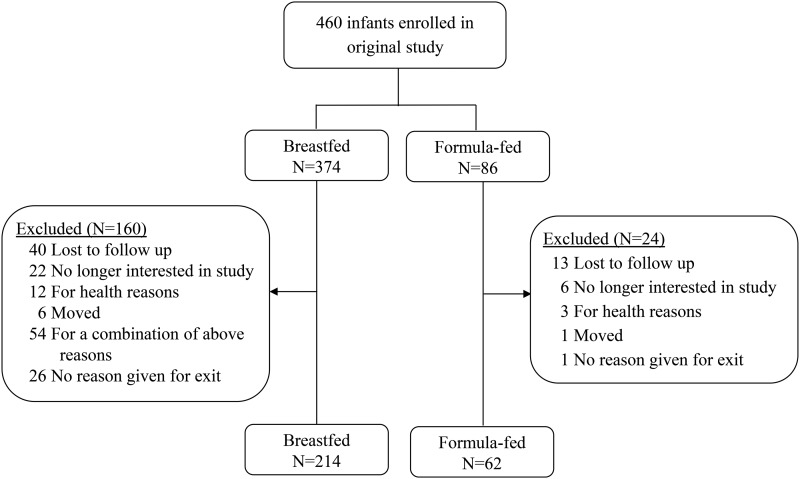
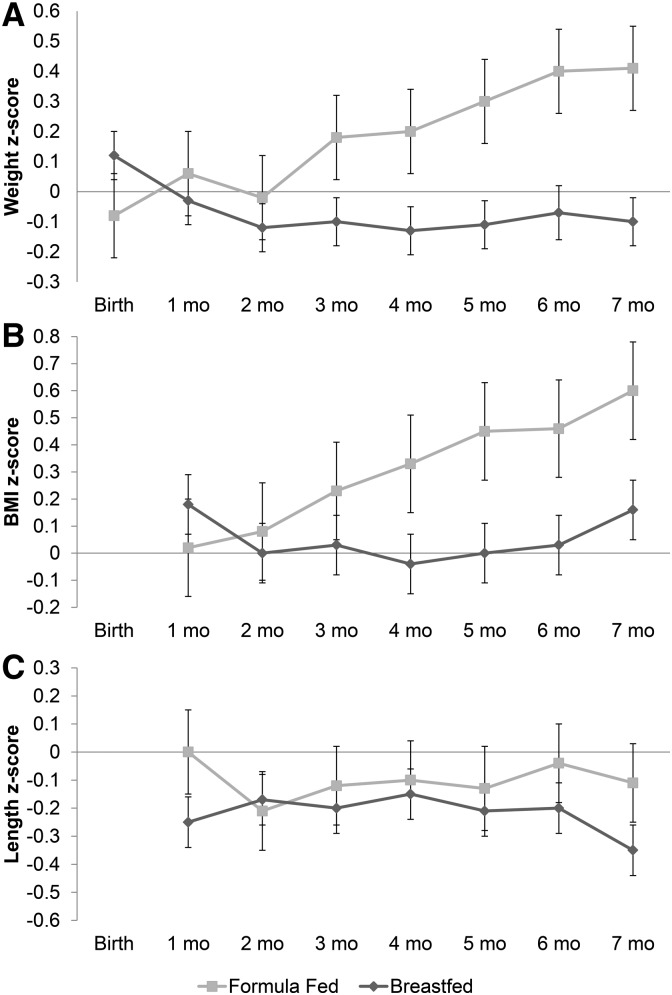
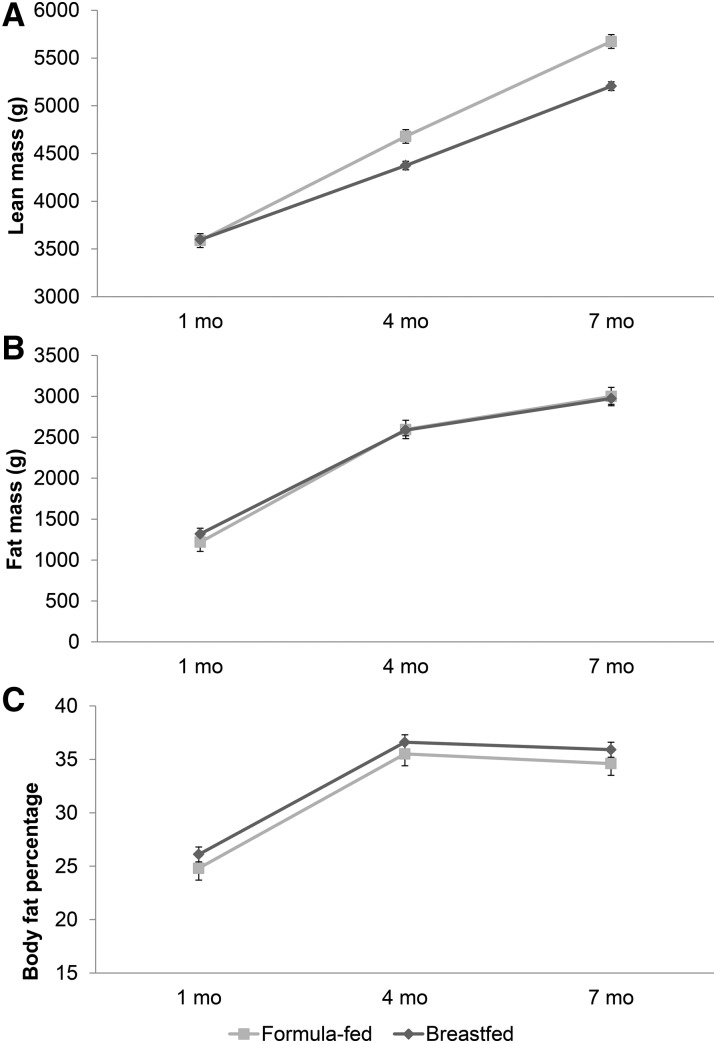
Background: The extent to which breastfeeding is protective against later-life obesity is controversial. Little is known about differences in infant body composition between breastfed and formula-fed infants, which may reflect future obesity risk.Objective: We aimed to assess associations of infant feeding with trajectories of growth and body composition from birth to 7 mo in healthy infants.Design: We studied 276 participants from a previous study of maternal vitamin D supplementation during lactation. Mothers used monthly feeding diaries to report the extent of breastfeeding. We measured infants' anthropometrics and used dual-energy X-ray absorptiometry to assess body composition at 1, 4, and 7 mo. We compared changes in infant size (z scores for weight, length, and body mass index [BMI (in kg/m2)]) and body composition (fat and lean mass, body fat percentage) between predominantly breastfed and formula-fed infants, adjusting in linear regression for sex, gestational age, race/ethnicity, maternal BMI, study site, and socioeconomic status.Results: In this study, 214 infants (78%) were predominantly breastfed (median duration: 7 mo) and 62 were exclusively formula fed. Formula-fed infants had lower birth-weight z scores than breastfed infants (-0.22 ± 0.86 and 0.16 ± 0.88, respectively; P < 0.01) but gained more in weight and BMI through 7 mo of age (weight z score difference: 0.37; 95% CI: 0.04, 0.71; BMI z score difference: 0.35; 95% CI: 0, 0.69), with no difference in linear growth (z score difference: 0.05; 95% CI: -0.24, 0.34). Formula-fed infants gained more lean mass (difference: 303 g; 95% CI: 137, 469 g) than breastfed infants, but not fat mass (difference: -42 g; 95% CI: -299, 215 g).Conclusions: Formula-fed infants gained weight more rapidly and out of proportion to linear growth than did predominantly breastfed infants. These differences were attributable to greater accretion of lean mass, rather than fat mass. Any later obesity risk associated with infant feeding does not appear to be explained by differential adiposity gains in infancy.
Keywords: adiposity; body composition; breastfeeding; breastmilk; formula; growth; infant; obesity.
© 2017 American Society for Nutrition.
Figures
References
-
- Dewey KG. Growth characteristics of breast-fed compared to formula-fed infants. Biol Neonate 1998;74:94–105. - PubMed
-
- Dewey KG, Heinig MJ, Nommsen LA, Peerson JM, Lönnerdal B. Breast-fed infants are leaner than formula-fed infants at 1 y of age: the DARLING study. Am J Clin Nutr 1993;57:140–5. - PubMed
-
- Butte NF, Wong WW, Hopkinson JM, Smith EO, Ellis KJ. Infant feeding mode affects early growth and body composition. Pediatrics 2000;106:1355–66. - PubMed
-
- Rebhan B, Kohlhuber M, Schwegler U, Fromme H, Abou-Dakn M, Koletzko BV. Breastfeeding duration and exclusivity associated with infants’ health and growth: data from a prospective cohort study in Bavaria, Germany. Acta Paediatr 2009;98:974–80. - PubMed
MeSH terms
LinkOut - more resources
Full Text Sources
Other Literature Sources
Medical
