


Comment
doi: 10.15252/embj.201797489.
Epub 2017 Jun 28.
ERCC1-XPF endonuclease-positioned to cut
Affiliations
- PMID: 28659377
- PMCID: PMC5509994
- DOI: 10.15252/embj.201797489
Item in Clipboard
Comment
ERCC1-XPF endonuclease-positioned to cut
EMBO J.
.
Abstract
To counteract damage to our genomes, numerous endo‐ and exonucleases incise the DNA backbone to remove damaged and aberrant DNA structures. It is imperative that such incisions be very tightly controlled, as unwanted DNA breaks are a key source of genome instability. Two new papers in The EMBO Journal shed light on how the activity of one such nuclease—ERCC1‐XPF, an enzyme involved in various DNA repair pathways—is regulated to perform incision in the vicinity of DNA interstrand crosslinks.
Figures
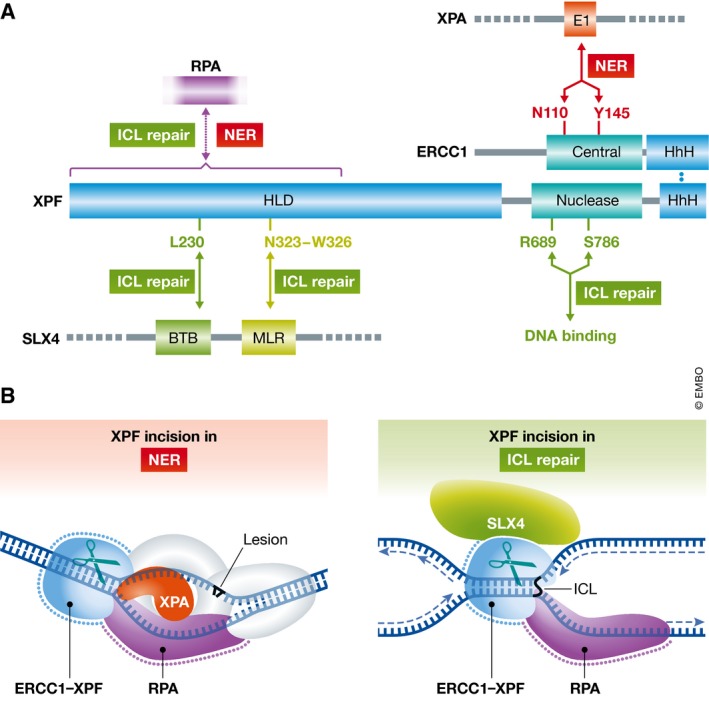
(A) ERCC 1‐XPF heterodimerizes via the C‐terminal HhH domains. The central domain of ERCC 1 mediates the interaction with XPA in NER and mutations in residues N110 and Y145 compromise the NER activity of ERCC 1‐XPF (shown in red). The nuclease domain in XPF contains the active site residues. Mutation of residues R689 and S786 does not affect the catalytic mechanism, but alters DNA binding in the nuclease domain and leads to an ICL repair‐specific defect (shown in green). The helicase‐like domain (HLD ) of XPF interacts with SLX 4 and likely RPA . Mutation of residue L230 abolishes ICL repair and SLX 4 binding; deletion of residues 323–326 abolishes ICL repair, but retains binding affinity for SLX 4 (shown in green). This region may mediate an interaction with SLX 4 that is needed for the proper positioning of XPF at sites of ICL repair. The interaction with RPA is required for NER and ICL repair, but the exact location of the RPA binding site in the HLD remains to be determined. (B) The XPA protein recruits ERCC 1‐XPF to NER complexes, SLX 4 to sites of ICL repair. RPA positions ERCC 1‐XPF for incision in NER and ICL repair by binding ssDNA with a defined polarity at the junction to position ERCC 1‐XPF for incision. The role of RPA is conserved between the two pathways.
Comment on
-
Recruitment and positioning determine the specific role of the XPF-ERCC1 endonuclease in interstrand crosslink repair.EMBO J. 2017 Jul 14;36(14):2034-2046. doi: 10.15252/embj.201695223. Epub 2017 Mar 14. EMBO J. 2017. PMID: 28292785 Free PMC article.
-
RPA activates the XPF-ERCC1 endonuclease to initiate processing of DNA interstrand crosslinks.EMBO J. 2017 Jul 14;36(14):2047-2060. doi: 10.15252/embj.201796664. Epub 2017 Jun 12. EMBO J. 2017. PMID: 28607004 Free PMC article.
References
-
- Bogliolo M, Schuster B, Stoepker C, Derkunt B, Su Y, Raams A, Trujillo JP, Minguillon J, Ramirez MJ, Pujol R, Casado JA, Banos R, Rio P, Knies K, Zuniga S, Benitez J, Bueren JA, Jaspers NG, Schärer OD, de Winter JP et al (2013) Mutations in ERCC4, encoding the DNA‐repair endonuclease XPF, cause Fanconi anemia. Am J Hum Genet 92: 800–806 - PMC - PubMed
-
- Dehe PM, Gaillard PH (2017) Control of structure‐specific endonucleases to maintain genome stability. Nat Rev Mol Cell Biol 18: 315–330 - PubMed
-
- Guervilly JH, Takedachi A, Naim V, Scaglione S, Chawhan C, Lovera Y, Despras E, Kuraoka I, Kannouche P, Rosselli F, Gaillard PH (2015) The SLX4 complex is a SUMO E3 ligase that impacts on replication stress outcome and genome stability. Mol Cell 57: 123–137 - PubMed
Publication types
MeSH terms
Substances
Grants and funding
LinkOut - more resources
Full Text Sources
Other Literature Sources
