


Odor identification as a biomarker of preclinical AD in older adults at risk
- PMID: 28659431
- PMCID: PMC5574678
- DOI: 10.1212/WNL.0000000000004159
Odor identification as a biomarker of preclinical AD in older adults at risk
Abstract
Objective: To assess odor identification (OI) as an indicator of presymptomatic Alzheimer disease (AD) pathogenesis in cognitively normal aging individuals at increased risk of AD dementia.
Methods: In 274 members of the PREVENT-AD cohort of healthy aging persons with a parental or multiple-sibling history of AD dementia, we assessed the cross-sectional association of OI with potential indicators of presymptomatic AD. Some 101 participants donated CSF, thus enabling assessment of AD pathology with the biomarkers total tau (t-tau), phospho-tau (P181-tau), and their ratios with β-amyloid (Aβ1-42). Adjusted analyses considered age, cognition, APOE ε4 status, education, and sex as covariates. We measured OI using the University of Pennsylvania Smell Identification Test and cognitive performance using the Repeatable Battery for Assessment of Neuropsychological Status. Standard kits provided assays of the AD biomarkers. Analyses used robust-fit linear regression models.
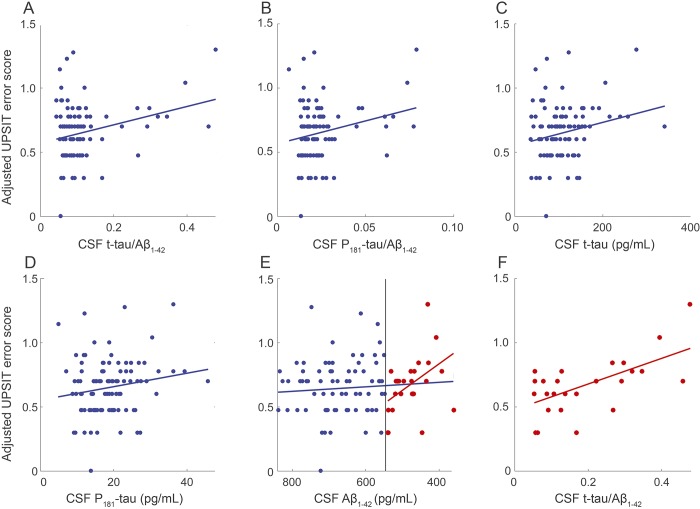
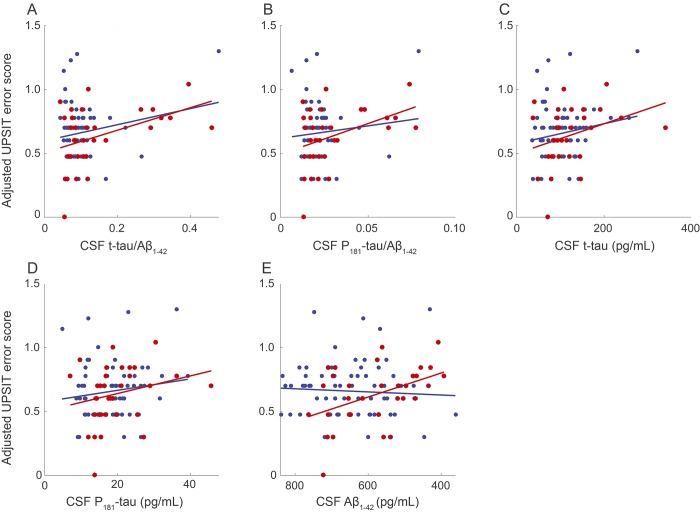
Results: Reduced OI was associated with lower cognitive score and older age, as well as increased ratios of CSF t-tau and P181-tau to Aβ1-42 (all p < 0.02). However, the observed associations of OI with age and cognition were unapparent in adjusted models that restricted observations to CSF donors and included AD biomarkers. OI showed little association with CSF Aβ1-42 alone except in APOE ε4 carriers having lowest-quartile Aβ1-42 levels.
Conclusions: These findings from healthy high-risk older individuals suggest that OI reflects degree of preclinical AD pathology, while its relationships with age and cognition result from the association of these latter variables with such pathology. Diminished OI may be a practical and affordable biomarker of AD pathology.
Copyright © 2017 The Author(s). Published by Wolters Kluwer Health, Inc. on behalf of the American Academy of Neurology.
Figures
Comment in
-
Reader response: Odor identification as a biomarker of preclinical AD in older adults at risk.Neurology. 2018 Feb 13;90(7):343. doi: 10.1212/WNL.0000000000004957. Neurology. 2018. PMID: 29440547 Free PMC article. No abstract available.
-
Author response: Odor identification as a biomarker of preclinical AD in older adults at risk.Neurology. 2018 Feb 13;90(7):343. doi: 10.1212/WNL.0000000000004959. Neurology. 2018. PMID: 29440548 No abstract available.
References
-
- Breitner JCS, Poirier J, Etienne PE, Leoutsakos JM; PREVENT-AD Research Group. Rationale and structure for a new center for Studies on Prevention of Alzheimer's Disease (StoP-AD). J Prev Alzheimers Dis 2016;3:236–242. - PubMed
-
- Daulatzai MA. Olfactory dysfunction: its early temporal relationship and neural correlates in the pathogenesis of Alzheimer's disease. J Neural Transm (Vienna) 2015;122:1475–1497. - PubMed
-
- Tabert MH, Liu X, Doty RL, et al. A 10-item smell identification scale related to risk for Alzheimer's disease. Ann Neurol 2005;58:155–160. - PubMed
-
- Djordjevic J, Jones-Gotman M, De Sousa K, Chertkow H. Olfaction in patients with mild cognitive impairment and Alzheimer's disease. Neurobiol Aging 2008;29:693–706. - PubMed
MeSH terms
Substances
LinkOut - more resources
Full Text Sources
Other Literature Sources
Medical
Miscellaneous
