Review
. 2017 Jun 13:9:189.
doi: 10.3389/fnagi.2017.00189. eCollection 2017.

Oscillatory Activities in Neurological Disorders of Elderly: Biomarkers to Target for Neuromodulation

Affiliations
Review

Oscillatory Activities in Neurological Disorders of Elderly: Biomarkers to Target for Neuromodulation

Assenza Giovanni et al. Front Aging Neurosci. .

Erratum in

Abstract

Non-invasive brain stimulation (NIBS) has been under investigation as adjunct treatment of various neurological disorders with variable success. One challenge is the limited knowledge on what would be effective neuronal targets for an intervention, combined with limited knowledge on the neuronal mechanisms of NIBS. Motivated on the one hand by recent evidence that oscillatory activities in neural systems play a role in orchestrating brain functions and dysfunctions, in particular those of neurological disorders specific of elderly patients, and on the other hand that NIBS techniques may be used to interact with these brain oscillations in a controlled way, we here explore the potential of modulating brain oscillations as an effective strategy for clinical NIBS interventions. We first review the evidence for abnormal oscillatory profiles to be associated with a range of neurological disorders of elderly (e.g., Parkinson's disease (PD), Alzheimer's disease (AD), stroke, epilepsy), and for these signals of abnormal network activity to normalize with treatment, and/or to be predictive of disease progression or recovery. We then ask the question to what extent existing NIBS protocols have been tailored to interact with these oscillations and possibly associated dysfunctions. Our review shows that, despite evidence for both reliable neurophysiological markers of specific oscillatory dis-functionalities in neurological disorders and NIBS protocols potentially able to interact with them, there are few applications of NIBS aiming to explore clinical outcomes of this interaction. Our review article aims to point out oscillatory markers of neurological, which are also suitable targets for modification by NIBS, in order to facilitate in future studies the matching of technical application to clinical targets.

Keywords: EEG; TMS/tDCS; neuromodulation; non-invasive brain stimulation; oscillations.


Figures
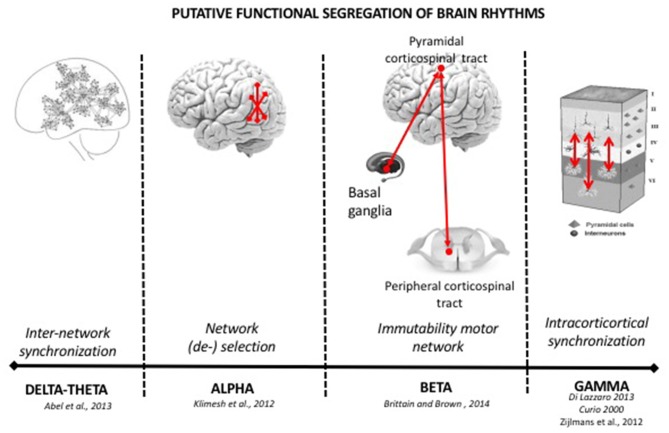
Figure 1
Figure 1
Functional role of brain rhythms in healthy subjects. In healthy participants, brain oscillations are subsumed in specific canonical frequency band, with presumably different functions. Slower rhythms (delta-theta) are associated with higher power spectra generated by the synchronization of a big number of neurons or of networks of neurons. They prevail during sleep, when memory consolidation phenomena occur. The alpha rhythm is the dominant oscillation in the awake state has been associated with inhibitory functions to gate information flow. Beta activity is a rhythm of the motor system (pyramidal and extra-pyramidal) and inhibits the changing of motor activity. Gamma and higher oscillations are resident in intracortical activity synchronizing small group of neurons. See the text of manuscript for more details.
Figure 2
Figure 2
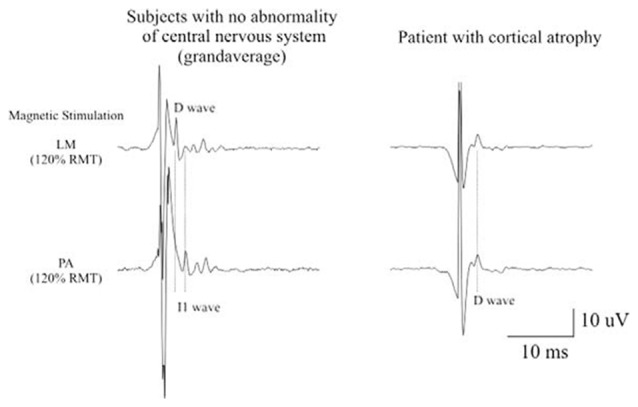
Epidural activity recorded in a patient with cerebral cortex atrophy. Descending volleys evoked by latoro-medial magnetic stimulation and posterior-anteriormagnetic stimulation at 120% resting motor threshold (RMT) in five patients with no abnormality of the central nervous system and at the maximum stimulator output in one chronic alcoholic patient. The grand averages of epidural volleys recorded in patients with no abnormality of central nervous system are shown on the left and the averages of epidural volleys (of 10 sweeps) recorded in the patient with cerebral cortex atrophy are shown on the right. The latencies of the D and I1 waves evoked by LM and PA magnetic stimulation are indicated by vertical dotted lines. In control subjects, LM stimulation evokes a large D wave followed by 5 I waves; PA stimulation evokes only I waves. In the patient with cerebral cortex atrophy the output evoked by LM and PA magnetic stimulation is similar. Both techniques evoke a large D wave and no clear I waves but only two very small and delayed peaks (Di Lazzaro et al., 2004b).
Figure 3
Figure 3
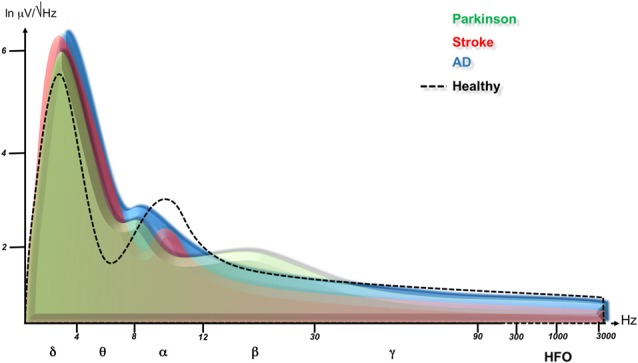
Cortical oscillation changes in neurological disorders. This figure is a summary of published data and shows power spectra after Fast Fourier Transformation are superimposed for healthy subjects (dashed line), Parkinson disease (green, Jenkinson and Brown, ; Melgari et al., 2014), stroke (affected hemisphere (AH), red, Tecchio et al., ; Graziadio et al., ; Assenza et al., 2013b) and Alzheimer disease (blue, Babiloni et al., 2013a,b). Note that neurological disorders cause an increase of slow rhythms, possibly as an attempt to overcome the dysfunction through cortical network synchronization. Degenerative diseases downshift the alpha frequency peak corresponding to a worsening of cognitive performance. Parkinson disease shows a specific beta rhythm increase consistent with an anti-kinetic condition, while the stroke hemisphere produces a reduction of rapid oscillations (alpha, beta, gamma) paralleling with motor performance. Please see the text of the manuscript for more references.

References

    1. Abel T., Havekes R., Saletin J. M., Walker M. P. (2013). Sleep, plasticity and memory from molecules to whole-brain networks. Curr. Biol. 23, R774–R788. 10.1016/j.cub.2013.07.025 - DOI - PMC - PubMed
    1. Adler G., Brassen S., Jajcevic A. (2003). EEG coherence in Alzheimer’s dementia. J. Neural Transm. 110, 1051–1058. 10.1007/s00702-003-0024-8 - DOI - PubMed
    1. Altenmüller E., Marco-Pallares J., Münte T. F., Schneider S. (2009). Neural reorganization underlies improvement in stroke-induced motor dysfunction by music-supported therapy. Ann. N Y Acad. Sci. 1169, 395–405. 10.1111/j.1749-6632.2009.04580.x - DOI - PubMed
    1. Androulidakis A. G., Mazzone P., Litvak V., Penny W., Dileone M., Doyle Gaynor L. M. F., et al. (2008). Oscillatory activity in the pedunculopontine area of patients with Parkinson’s disease. Exp. Neurol. 211, 59–66. 10.1016/j.expneurol.2008.01.002 - DOI - PubMed
    1. Antal A., Ambrus G. G., Chaieb L. (2014). Toward unraveling reading-related modulations of tdcs-induced neuroplasticity in the human visual cortex. Front. Psychol. 5:642. 10.3389/fpsyg.2014.00642 - DOI - PMC - PubMed

LinkOut - more resources